 |
|
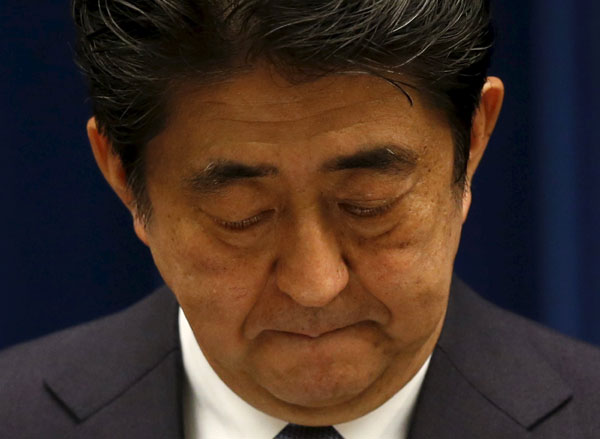
Japan's Prime Minister Shinzo Abe attends a news conference for delivering a statement marking the 70th anniversary of World War II's end, at his official residence in Tokyo, August 14, 2015. [Photo/Agencies] |
A very cleverly worded speech. Impressive play of the words. That's about everything we could say about Japanese Prime Minister Shinzo Abe's latest statement on his country's unseemly record in World War II.
Abe didn't seem to deviate much from the well-received benchmark statement in 1995 by then Japanese prime minister Tomiichi Murayama. And the key points of that historic speech, including "aggression", "colonial rule", "remorse" and "apology", did find their way into his speech, though with abundant ambiguity.
For many in his audience, his expression of "heartfelt gratitude" to those who have been tolerant of his country and helped it return to the international community might be an unexpected bonus -not unlike his pledge to "squarely face the history of the past". That could be why some believe Abe has delivered more than what had been anticipated, given the discrepancies among its versions in different languages.
That East Asia just got around a potentially explosive occasion that could have escalated tensions is itself something to celebrate. For Japan's vigilant neighbors, however, whether or not Abe included the salient points of the Murayama Statement in his speech is not just a touchstone to gauge his attitude toward history, but the bottom line as well. Once that line is crossed, Japan's deteriorating ties with neighboring China and the Republic of Korea will slide past a point of no return, at least during Abe's term in office.
Abe knows what will come next. So, even after provoking neighboring countries no end, he waved olive branches at them requesting meetings at the highest level. He is yet to get one, precisely because of his betrayal of the Murayama Statement's spirit.
By incorporating the key expressions of that milestone statement, Abe may effectively silence some of his critics, whose latest demand was that his statement include the core Murayama expressions.
But make no mistake, he didn't present an apology of his own. He merely stated the obvious truth that earlier Japanese cabinets had expressed "heartfelt apology" for the atrocities committed by imperial Japan.
It would be naive to think the tensions paralyzing East Asia will thus be gone. That Abe didn't cross the Rubicon, at best, means he was aware of the dire consequences of doing so and avoided it. And, that tremendous public pressure from home and abroad forced him to squeeze those words into his speech doesn't mean he actually meant it.
Rhetoric counts when dealing with Japanese politicians, for whom whether or not the Abe statement includes those key words makes a difference. Japanese politicians' infamous tradition of "slip of the tongue", however, makes it even more important to see how they act.
Abe's track record belies his claims of commitment to peace and good neighborly relations. That Abe and his advisers had reportedly struggled over whether or not to include Murayama's expressions, that the ruling parties had not agreed on the exact use of the expressions in the final transcript until the very last moment, that Abe managed to avoid directly referring to Japan's war as one of aggression and some of the perished Japanese as war criminals, and that his words became evasive when it came to Japan's colonial rule and the "comfort women" issue all betrayed a sense of reluctance.
Needless to say, reading between the lines of the Murayama Statement and Abe's speech even a casual reader can feel the difference in tones. In contrast to Murayama's sincerity, Abe seemed eager to shut out the past, though its sophisticated wording did hit the sentimental sweet spot at some points. But that will not be possible until Abe acts sincerely to achieve real reconciliation.
Therefore, even after weathering an otherwise imminent crisis, East Asia will continue to struggle in the long shadow of history.
Copyright 1995 - . All rights reserved. The content (including but not limited to text, photo, multimedia information, etc) published in this site belongs to China Daily Information Co (CDIC). Without written authorization from CDIC, such content shall not be republished or used in any form. Note: Browsers with 1024*768 or higher resolution are suggested for this site.
License for publishing multimedia online 0108263 Registration Number: 130349