China and the OECD can build on two decades of mutually beneficial collaboration
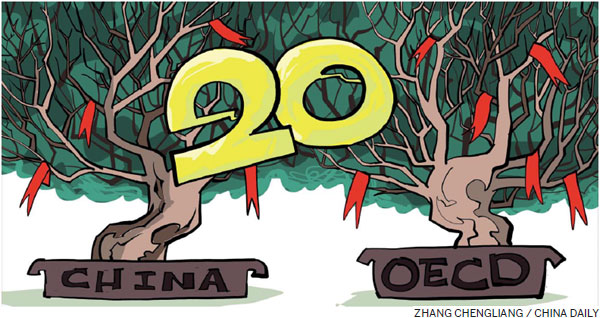
This year we proudly celebrate the 20th anniversary of China-OECD relations. Over these past 20 years, we have not only forged a mutually beneficial partnership that is improving people's lives in China and around the world, we are also creating the building blocks for more resilient, inclusive and green economies for future generations. Today, China is a key OECD partner country and we look forward to deepening our engagement even further in the years to come.
Our relationship began in 1995 when we co-organized a policy dialogue on trade and investment; it was further strengthened in 2007 when the Organization for Economic Cooperation and Development Council decided to enhance engagement with China as well as with Brazil, India, Indonesia and South Africa, and in 2012 when China became a key partner of the organization. Cooperation continues to grow stronger with the OECD's support for China's G20 presidency in 2016, and has also broadened to meet the ever-growing global requirements for better policy analysis, design and implementation. The policy dialogue with the OECD addresses issues that affect people throughout their lives.
The OECD and China have achieved a number of milestones over the past two decades, providing evidence-based analysis through regular economic surveys, sectoral policy reviews and thematic studies in a broad range of areas including agriculture, corporate governance, public administration, taxes, environment, urban development, science and technology, and education.
This is a mutually beneficial relationship. China is benefiting from the organization's ability to bring together expertise and experience from a wide range of countries and policy communities, and the OECD benefits from China's accumulated experiences. For instance, China's participation in the OECD's Program for International Student Assessment, which ranked Shanghai at the top of the list on financial literacy. It put Shanghai's share of top performers in financial literacy at 42.6 percent of students compared with 8 percent on average in OECD countries. As a result, the United Kingdom has set up a math teacher exchange so that their teachers can learn the most effective teaching methods from their counterparts in Shanghai.

China is also actively engaged in the work of OECD technical committees and has adhered to numerous OECD instruments such as the Declaration on International Science and Technological Cooperation for Sustainable Development. China's economy is currently undergoing a significant transformation and the OECD stands ready to support it. The country is now moving toward a slower, but more sustainable growth rate - the new normal.
If the next 20 years are to be as bright as the last, China will have to overcome a number of important challenges. In particular, the government will need to manage China's transition from rural to urban, public to private, prime-of-life age to aging, investment to consumption, and manufacturing to services. This will call for a raft of structural reforms across a range of policy domains.
The 13th Five-Year Plan (2016-20) represents an important opportunity for China to make this happen. The OECD is proud to have been asked to make a substantial contribution to the government's preparation for the secretary-general of the OECD. In this year in which we celebrate 20 years of successful cooperation with China, we have produced three reports for the National Development and Reform Commission as input for the 13th Five-Year Plan: "China in a changing Global Environment", "All on Board: Making Inclusive Growth Happen in China", and "A National Urban Policy Review of China". We have also delivered our 2015 Economic Survey of China.
Looking ahead, we should continue to consolidate and deepen this mutually beneficial partnership to perfect policymaking and implementation, and to find coordinated solutions to global challenges. Together, we can do a lot more to accompany China in its endeavor to build a "moderately prosperous society" by 2020, specifically by strengthening market mechanisms and upholding the rule of law.

China could make even greater use of the OECD's pioneering indicators, such as the measure of trade in value-added, which is changing the way we look at trade and investment and how we design policies to engage in global value chains. And China could intensify its participation in OECD bodies and adhere to more OECD instruments, which would yield mutual benefits. For example, as an associate member of the OECD Freedom of Investment Project, China could play a more active role in fostering an open and rules-based international investment climate.
Naturally, we must continue to address global challenges hand-in-hand. Our partnership in the framework of the G20 has been paramount in stabilizing the global economy and avoiding an outright collapse of the international financial system. For instance, China's role, alongside other G20 and OECD countries, remains critical in the global fight against tax evasion and avoidance. The same can be said about its support for the development of a coherent set of international tax rules to end base erosion and profit shifting.
Chinese philosopher Laozi said, "A journey of a thousand miles begins with a single step". China and the OECD have taken not one but many steps in the past two decades toward a comprehensive and mutually beneficial partnership. Our journey will continue for years to come. We can work together to learn from each other, to think creatively and to make the world a better place for present and future generations. Together, we can design, develop and deliver better policies for better lives.
The author is Secretary-General of the Organization for Economic Co-operation and Development. The views do not necessarily reflect those of China Daily.

Copyright 1995 - . All rights reserved. The content (including but not limited to text, photo, multimedia information, etc) published in this site belongs to China Daily Information Co (CDIC). Without written authorization from CDIC, such content shall not be republished or used in any form. Note: Browsers with 1024*768 or higher resolution are suggested for this site.
License for publishing multimedia online 0108263 Registration Number: 130349