Education exchanges are lifting standards in classrooms across Britain and China
The BBC documentary, Are Our Kids Tough Enough? Chinese School, which sparked so much debate in the summer, portrayed what many argued were stereotypical views of education in Britain and China.
Chinese students, who have dominated the global education rankings in recent years, were painted as respectful and stoic, while the teachers were strict disciplinarians. British schools by contrast were bigger on creativity and encouraged students to innovate.
|
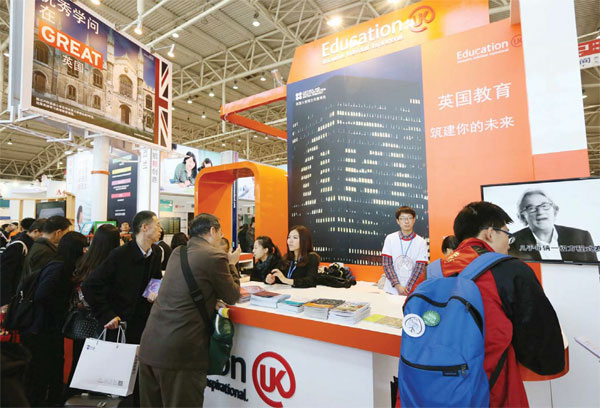
The British pavilion at the China International Education Exhibition Tour 2015 in Beijing. An estimated 150,000 Chinese study in Britain. Photos Provided to China Daily |
|
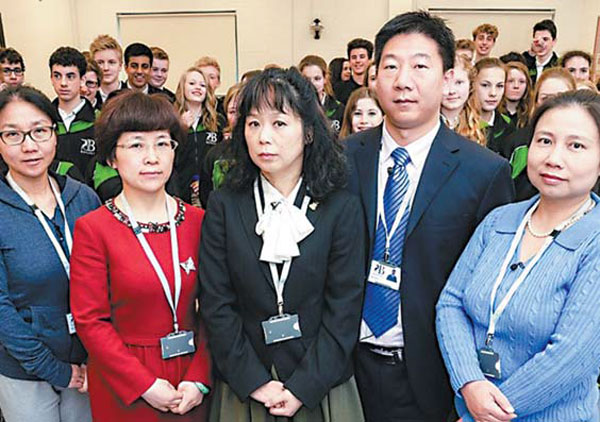
The five Chinese teachers featured in the BBC documentary Are Our Kids Tough Enough? Chinese School. The documentary triggered a heated debate on British and Chinese education methods. |
While clear differences do exist, critics say the three-part programme was a rather two-dimensional affair compared with the vivid realities of China and Britain's collaboration in education.
"Education co-operation and exchanges have been one of the highlights of our bilateral relations," says Shen Yang, minister counsellor for education at the Chinese embassy in London, adding that the collaboration ranged from schools to higher education to vocational training.
Higher education has been the most prominent. The number of Chinese students at British universities has continued to rise, making the country their most popular destination in the European Union.
More than 435,000 non-British students were enrolled at colleges and universities last year, of which 20 percent were Chinese, far more than any other foreign nationality, according to the Higher Education Statistics Agency.
Shen says the total number is closer to 150,000 because the agency only covered registered students and excluded those on foundation courses or language programs.
The influx has been good for the economy too. A recent report by London First, an organization representing London businesses, estimated that international students in the capital used 540 million pounds ($824 million; 724 million euros) in public services, such as the NHS, but injected more than 2.8 billion pounds into the British economy via tuition fees, personal spending and visits by friends and family.
As opportunities in the education market have grown, British universities have been expanding their presence on campuses in China since the mid-2000s.
The University of Surrey, for example, has forged 17 partnerships with universities in China, aimed at helping students further their education, offering dual degrees or setting up research links.
Raising the college's profile in China "puts us in a strong position in terms of student recruitment and helps us to embrace the current development in China", says Pro Vice-Chancellor Vincent Emery. He says the plan was to team up with more top-quality universities.
In addition, more than 7,000 British students were in education programs in China as of June, according to the British embassy.
To encourage more young people to gain China experience, the British Council launched its Generation UK campaign, which aims to increase the number of British students and interns in China to 80,000 by 2020.
"I've always aspired to work internationally and with China's growing influence there's tremendous value in learning Chinese," Louise Garrett-Evans, a Generation UK scholar who studied Chinese at Shanghai's Fudan University, was quoted as saying in a British Council report. "It's my hope to work for an international organization that will value what I have learned during my time here. The opportunity to continue to speak Chinese in my career is essential to me."
On a government level, education collaboration reached new heights in September when the countries signed 23 agreements on academic research and exchanges during the third China-UK Education Summit in London.
"Our relationship with China is entering a new phase of scientific and educational collaboration on an unprecedented scale," said Universities Minister Jo Johnson during the summit. "Our agreement will bring researchers together to address global challenges and build partnerships across school, vocational and higher education to provide students in both countries with the right skills to become the leaders of the future."
On a practical level, an exchange scheme for Shanghai maths teachers enabled 59 Chinese educators to share their experience and knowledge with British primary schools between November and March.
Britain has been keen to learn from Shanghai's methods, as its students regularly rank highly for maths, reading and science in international education assessments. In 2012, British students were ranked 26th in the world for maths.
"Education collaboration between Britain and China is vital if we're to learn from each other's successes and to help us use international evidence of best practice to drive up academic standards in our schools," says Schools Minister Nick Gibb.
He says schools that took part in the exchange said the Shanghai teachers' methods had already started to pay dividends and that a third group was slated to arrive in Britain in November.
"The Shanghai approach - with children taught as a whole class, building depth of understanding of the structure of maths, supported by the use of high-quality textbooks - is proving a hit in those schools where it has been tried," says Gibb. "And the standard of maths in these schools is rising rapidly.
"Careful teaching of the traditional calculation methods and plenty of practice in class and as part of pupils' homework are key to this success."
Charlie Stripp, director of the National Centre for Excellence in the Teaching of Mathematics, says even more encouraging were the early signs that the exposure to Shanghai methods was helping primary school children develop a deeper understanding of the structure of maths, "which is something that will be invaluable as they journey through school and life".
Contact the writers at wangmingjie@mail.chinadailyuk.com and zhangchunyan@chinadaily.com.cn
(China Daily European Weekly 10/16/2015 page15)

Copyright 1995 - . All rights reserved. The content (including but not limited to text, photo, multimedia information, etc) published in this site belongs to China Daily Information Co (CDIC). Without written authorization from CDIC, such content shall not be republished or used in any form. Note: Browsers with 1024*768 or higher resolution are suggested for this site.
License for publishing multimedia online 0108263 Registration Number: 130349