 |
|
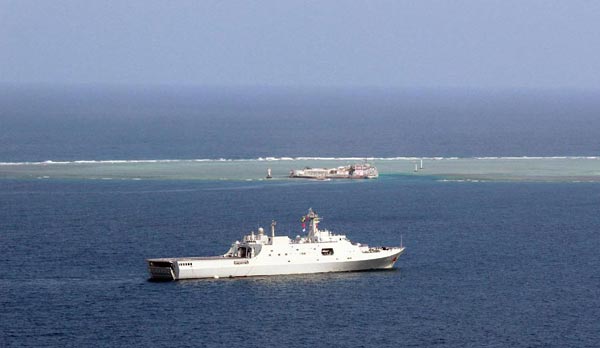
China firmly upholds her sovereignty and maritime rights and interests in the South China Sea. [Photo/Xinhua] |
Japanese Prime Minister Shinzo Abe recently said he would raise the issue of China's construction work in the South China Sea at the G7 summit in Bavaria, Germany, on June-7-8. Before that, US Secretary of Defense Ashton Carter had said China's reclamation work in the South China Sea was "out of step" and required "an immediate end", and threatened to send more US ships and aircraft to patrol the areas nearby, to which, Beijing responded saying Washington should adopt a responsible attitude and play a constructive role in the region.
China has been emphasizing that its construction work will help make navigation safer in the South China Sea. But instead of paying heed to China's assertions, the US is tacitly supporting Vietnam and the Philippines in the South China Sea disputes because its intention is to contain China. No wonder, it has turned a blind eye to similar construction activities of Vietnam and the Philippines in the South China Sea for the past several years.
With Washington misjudging Beijing's strategic intentions and calling it "aggressive", Hanoi and Manila have taken an even tougher stance against Beijing. Because of a similar misjudgment, Washington stubbornly opposed the Asian Infrastructure Investment Bank for which it is likely to incur huge losses. And now it faces a similar situation in the South China Sea issue.
True, China has been following a more proactive maritime policy in recent years. But that doesn't mean its defense policy has become aggressive. It has not raised any new maritime claims, for its policy is focused on responding to neighboring countries' provocations, which include the "nationalization" of the disputed Diaoyu Islands by Japan and the attack on Chinese fishermen by the Philippines. Besides, China's moves have been bilateral rather than unilateral in nature, as it seeks coordination with ASEAN member states.
China's moves are aimed at thwarting the Philippines and Vietnam from further violating its territorial integrity and maritime rights. The small size of a country does not prevent it from using aggressive means against bigger countries - think about Japan's attack on Pearl Harbor that ultimately dragged the US into World War II.
The US has been accusing China of violating international laws. But the fact is, China has signed and ratified the United Nations Convention on the Law of the Sea, something the US has refused to do for fear of losing its maritime primacy across the globe. More important, since the UNCLOS is not designed to solve historical or current sovereignty disputes, China has the right to refuse international arbitration in the South China Sea issue, which the Philippines has unilaterally sought.
As a matter of fact, if disputing states fail to reach an agreement or develop mutual trust, neither international law nor arbitration in the international court can settle the dispute. On the contrary, such an attempt could worsen the problem. For this reason China has always emphasized the importance of using bilateral means to settle a dispute between two states. For the same reason the US selectively ratifies international laws according to its own interests.
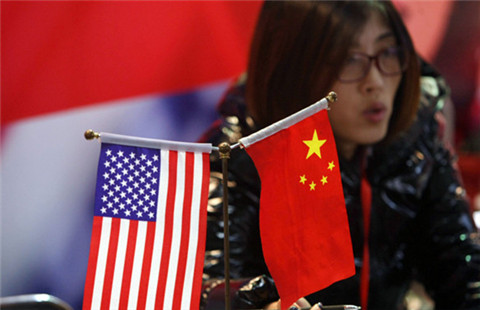
But when it comes to issues related to China, the US is misled by anti-China "experts". By misjudging China's strategic intentions, the US has already created enough obstacles for the healthy development of bilateral relations. And by thinking China is out to grab territories, which is impossible in today's world of highly interdependent countries, the US is building more hurdles in bilateral relations.
But one thing is for certain, China is determined to safeguard its territorial integrity and sovereignty. And for that, it has the right to draw the red line.
The US should learn lessons from the failure of its covert involvement in the Syria and Ukraine crises. It must realize that there is always a price to be paid for intervening in other countries' affairs, and South China Sea is not a good playfield for practicing power politics.
The author is a member of think tank Chahar Institute.
Related Stories
Copyright 1995 - . All rights reserved. The content (including but not limited to text, photo, multimedia information, etc) published in this site belongs to China Daily Information Co (CDIC). Without written authorization from CDIC, such content shall not be republished or used in any form. Note: Browsers with 1024*768 or higher resolution are suggested for this site.
License for publishing multimedia online 0108263 Registration Number: 130349