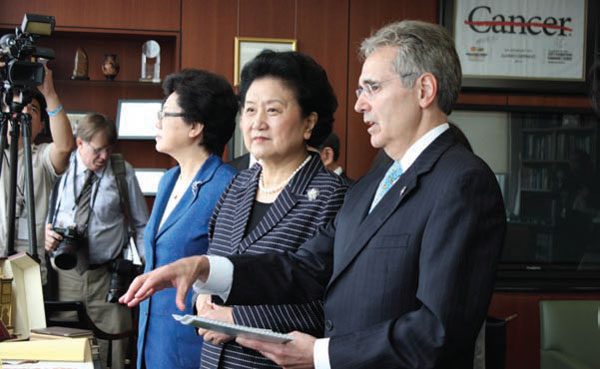
China will continue to work closely with the United States and deepen cooperation in medical research and practices to curb cancer and other diseases, Chinese Vice-Premier Liu Yandong said at a meeting with some 20 faculty members and staff at the University of Texas MD Anderson Cancer Center on Sunday in Houston.
After listening to an introduction by Ronald A. DePinho, president of the world-renowned cancer research and treatment institution, Liu reiterated the Chinese government's resolve to reform its medical and healthcare system.
She also shared her concerns about the rising number of cancer patients in China, and the prevention, early detection and treatment for the patients.
|
Chinese Vice-Premier Liu Yandong visits the office of Ronald A. DePinho, president of University of Texas MD Anderson Cancer Center on Sunday. She vows to deepen existing cooperation in medical research and practice between Anderson and China in order to curb the prevalent cancer and other diseases in China. Chang Jun / China Daily |
There are about 3.4 million Chinese diagnosed with cancer each year, of which about 2.1 million will not survive.
The five-year survival rate of cancer patients in China is only about 30 percent, much lower than that at the Anderson Center, Liu said at the meeting.
"We have to work with the United States and Anderson Center to learn from the advanced science and technology, particularly in our nation's fight against cancer, concerning early diagnosis and detection, precision treatment and early prevention," said Liu, who at an April national conference said that medical reform in China was at a difficult and crucial stage.
"Both China and the US have agreed this year to add medical cooperation into our ongoing dialogue on high-level consultation on People-to-People Exchange," Liu said.
DePinho said a good opportunity exists for the US and China to battle cancer together. His organization is currently working with partners around globe. China is the most active partner country, with six sister institutions and numerous seed grants started.
"In a proud moment for us, one of our sister institutions, Sun Yat-sen University Cancer Center (Guangzhou), nominated MD Anderson to receive the International Science and Technological Cooperation Award in January at a ceremony held at the Great Hall of the People," said DePinho. "This recognition and our extensive work together are important symbols of our collaborative efforts to accomplish our mission of Making Cancer History."
The ceremony in January, attended by President Xi Jinping, Premier Li Keqiang and the vice-premier recognized MD Anderson's international ties to sister institutions in China with which it collaborates on training, education and patient care. The award was granted through the Chinese State Council to foreign scientists, science and technology engineers and managers, and organizations that have made important contributions to China's bilateral or multilateral scientific and technological cooperation.
Medical exchanges between Anderson and China date back to 2003, when China sent its junior faculty and researchers to Houston for training and industry expertise. In the past decade or so, Anderson and China have launched numerous collaborations on many fronts, said Dihua Yu, professor of molecular and cellular oncology at Anderson.
"It's very rewarding experience (of working with Chinese counterparts); we've made major progress, which led to joint grants, joint publication and joint co-training of a younger generation of scientists and doctors," said Yu, adding that the efforts have benefited patients in both countries, "thus we will continue".
According to MD Anderson, its Sister Institution Network Fund (SINF) which was launched in 2010, includes six institutions in the cities of Beijing, Shanghai, Hong Kong, Guangzhou and Tianjin.
An example of a joint project is the Center for Translational and Public Health Genomics, created by Xifeng Wu, chair of the Department of Epidemiology at the Houston center.
"We have been conducting clinical research on radiation therapy as well as other epidemical diseases," Wu said. "We obtained (much) useful data, and in the end, we share the results of research to benefit patients in both countries."
Wu's center also provides training to students, junior faculty, clinicians and professors from Beijing, Xi'an, Shanghai, Nanjing and elsewhere.
"They (trainees) are top-notch research professionals, and many of them, upon finishing training with us, went back to China and set up similar research programs there. This enables us to continue to cooperate on various projects," Wu said.
Wu said that through cooperative projects she saw how much the Chinese government has invested in medical science research and training.
Contact the writers at junechang@chinadailyusa.com and mayzhou@chinadailyusa.com.
(China Daily USA 06/22/2015 page8)
Copyright 1995 - . All rights reserved. The content (including but not limited to text, photo, multimedia information, etc) published in this site belongs to China Daily Information Co (CDIC). Without written authorization from CDIC, such content shall not be republished or used in any form. Note: Browsers with 1024*768 or higher resolution are suggested for this site.
License for publishing multimedia online 0108263 Registration Number: 130349