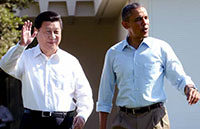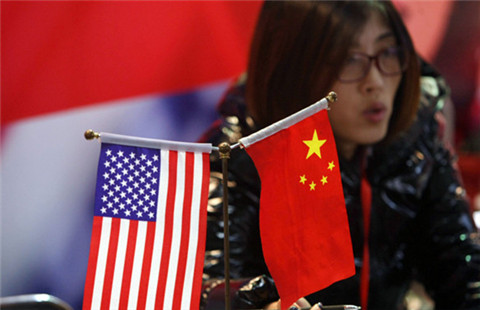
President Xi Jinping and President Barack Obama have plenty to talk about this week. The relationship between China and the US is far-reaching, and the agenda spans a broad range of economic and diplomatic topics.
As the two leaders look for ways to make the world a better place, we hope they also discuss the pace of innovation in mobile-phone technology. Why? Because the world's economic prosperity actually depends on faster innovation in mobile - and because the US and China are where most big breakthroughs in mobile are happening.
It's a topic that needs signals from the highest levels, because there are too many barriers holding up mobile innovation. Faster, better innovation is essential to unleash literally trillions of dollars of new spending and growth. But barriers are preventing today's 4G networks from reaching as far as they should, and impeding development of 5G - the next big technology leap.
We all highly value our smartphones. But there's a huge gap between what is and what could be. The Boston Consulting Group (BCG) estimates that in 2020, more than 5 billion people globally still won't have access to smartphones connected to high-speed 4G mobile, even though 4G equipment has been available since 2009 and is ubiquitous in developed economies. This despite the fact that Chinese and US companies continue to invest in 4G, and Chinese companies in particular play major roles in financing and building new mobile networks throughout the emerging world.
The global opportunity cost is colossal. Expanding advanced mobile service to 4 billion more users would add over $1 trillion to global GDP, according to BCG's research. Each new subscriber realizes an economic benefit equivalent to nearly $1,000 per year.
The impact of advanced mobile access is greatest in developing economies. Every 10 percent increase in 4G penetration increases growth in per-capita GDP by 0.8 to 1.4 percent compared to 0.4 to 0.6 percent for the same increase in developed countries, reports the World Bank.
Equally, there are worries about how quickly societies will be able to realize the potential of next-generation mobile. 5G will be as different from today's mobile capabilities as the newest smartphones are from the first cellular phone "bricks". 4G technology is 12,000 times faster than 2G and 99 percent cheaper to run; 5G will be another huge advance, using a tenth of the energy needed today, with enough capacity for everyone on earth to have 1,000 connected devices each.
In terms of economic prosperity, 5G promises to transform healthcare systems, connect driverless cars and revolutionize public services worldwide. We're referring not only to mobile phones but to a growing array of wearable devices, to connected cars, and to entire ecosystems of new connected devices. But there are many technology challenges to be solved and technical standards to be agreed on before those visions can be realized - issues that require massive investments. Those investments are by no means guaranteed. They need to be encouraged.
The rapid development of 5G technology is crucially important to both Chinese and US mobile-phone companies. It could trigger literally trillions of dollars of new infrastructure spending as mobile operators upgrade to the new networks and as consumers spend trillions on new devices.
That's what happened with the last big performance jump. The rise of 3G and 4G networks spurred nearly $2 trillion in private sector investment in infrastructure and R&D spending between 2009 and 2014 - spending that wouldn't have happened if the new technology hadn't been so much better than the old. The same phenomenon is poised to repeat with 5G - if the innovation investments happen first.
We hope that the two leaders talk about this because their nations lead in mobile technology and stand to gain the most. In the US, Apple is practically synonymous with innovation. Other American companies are pre-eminent: Qualcomm, for example, was the first to launch the CDMA smartphone in 1998. Its Snapdragon processors power many of the world's smartphones. And Chinese companies such as Huawei, ZTE and Xiaomi have, seemingly overnight, become major global players. They are making huge investments in mobile. Huawei and ZTE in particular are filing patent after patent.
But here's the problem. No company - not Chinese, not US, not any - will comfortably invest if there are real uncertainties about the rewards for those investments, whether they are to extend 4G's reach or spur 5G's development.
When policies, regulations and business practices work against innovation, the creators of new technology don't invest as they should, and consequent spending and growth don't happen as they should.
David Michael is a senior adviser at The Boston Consulting Group and a professor at the School of Global Policy and Strategy, University of California-San Diego.
(China Daily USA 09/24/2015 page6)
Copyright 1995 - . All rights reserved. The content (including but not limited to text, photo, multimedia information, etc) published in this site belongs to China Daily Information Co (CDIC). Without written authorization from CDIC, such content shall not be republished or used in any form. Note: Browsers with 1024*768 or higher resolution are suggested for this site.
License for publishing multimedia online 0108263 Registration Number: 130349