Beyond the headlines and the photo ops, a small Midwestern town is a symbol of Xi's vision
President Xi Jinping's state visit to the United States was high powered, high profile and high intensity - Internet and big business events in Seattle; the summit in Washington; and then activities honoring the 70th anniversary of the United Nations in New York. But something that happened just earlier, far from the big cities and bright lights, could represent a fresh way of thinking for strengthening China-US relations. Significantly, it could indicate how Xi, China's strongest leader in decades, approaches international relations.
In Muscatine, Iowa, a ceremony was held to dedicate the "China-US Friendship House". The house has come to symbolize the desire of common people for closer ties between China and the US, because in 1985, Xi - as a young local official - stayed in this house as part of a delegation visiting Iowa to learn the latest agricultural techniques. The hospitality and friendship of Americans from the "heartland" made such an impression on Xi, even though his visit was brief and years ago, that he continues to value the experience to this day.
For several weeks, in preparation for President Xi's trip, I have been discussing China-US relations with leading China experts in Washington and leading US experts in Beijing (for CCTV and international media). So when I was invited to speak at the Muscatine ceremony, I wasn't sure I could make it. Until I actually arrived in Muscatine (traveling more hours than I care to remember), I could not grasp its significance.
I now bear witness how Chinese entrepreneurs and Muscatine residents overcame initial uncertainties, even misunderstandings, to form a strong bond of friendship, respect, business and win-win cooperation. Beyond cultural exchanges and investment projects, there is a sense that continuous exchanges between Muscatine and China have expanded horizons and enriched lives on both sides. Most important, perhaps, is the genuine warmth radiating between American and Chinese people.
If one makes a list of the most memorable events in China-US relations - "memorable" in a positive, productive, constructive, edifying sense - then Xi's visit to Muscatine in 2012 - when he was China's vice-president - should be on that list.

Why? Why does a simple visit to a small town in the American Midwest farmlands have such significance?
There are two reasons. The first is that Xi's visit to Muscatine personifies one of the core facets of his foreign policy - people-to-people communications and exchanges, a kind of "public diplomacy".
Whether Xi speaks about China-US relations, working with the world's most powerful country, or about nations participating in his (Silk) "Belt and Road" Initiative, which are mostly developing countries in need of infrastructure development, people-to-people exchanges always play a central role in Xi's overarching objectives.
The second reason that Xi's trip to Muscatine in 2012 has such significance is that it resonated extraordinarily well with the American public. To most Americans, Xi in Muscatine was the most memorable part of his entire trip. Even for me, though I attended Xi's lunch in Los Angeles with leaders in entertainment, business and government, it was Muscatine that stood out.
Why? How could Muscatine compete with Los Angeles and Washington? Why do we now speak about the "Muscatine Spirit"? I suggest four reasons.
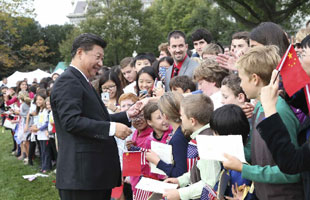
First, Xi meeting with ordinary Americans, especially those not from sophisticated cities, shows a sense of common humanity, even humility, we like that in our leaders.
Second, Xi is respecting his own historical roots - his early career when he was a young county official seeking to learn modern technologies.
Third, it honors a time during the early stages of China's reform and opening-up, when China reached out to the US for advice and guidance, and the US was pleased to cooperate.
Fourth, Xi's Muscatine visits, in 1985 and in 2012, though under very different circumstances, exemplified people-to-people communications, the kind of public diplomacy that now plays a central role in Xi's foreign policy philosophy.
There is something simple, pure and honest about people-to-people exchanges that I saw so wonderfully exemplified in Muscatine.
Now, what is it about people-to-people exchanges that enable them to become effective public diplomacy? Here are four characteristics.
First, people-to-people exchanges are done for their own sake; they are not a "stepping stone" to something else and there are no ulterior motives.
Second, they spring naturally from many small sources; they do not emanate artificially from a single large source.
Third, they have diverse linkages or connections, such as common professions, like fields of science and areas of culture, or common interests, such as sports and charities.
Fourth, they have diverse timeframes, such as a single one-off event like tourists traveling abroad, or continuing relationships like healthcare professionals working together for the common good.
Issues of contention between China and the US are no secret, but the world's two largest economies must work together for mutual benefit. Highest importance, certainly, is economic stability and growth. Prosperity will be enjoyed by both China and the US - or enjoyed by neither. With our economies so tightly intertwined, it is simply impossible for one country to succeed and the other not.
Additional issues in common include stopping regional wars, terrorism, organized crime, pandemics, and climate change, while promoting alternative energy and green technologies.
And the best way to convert mutual opportunities and common needs into active cooperation and strong relations is through people-to-people diplomacy. The Muscatine Spirit leads the way.
The author is a public intellectual, political/economics commentator, and international corporate strategist. He is host and co-producer of Closer To China on CCTV News. The views do not necessarily reflect those of China Daily.
Copyright 1995 - . All rights reserved. The content (including but not limited to text, photo, multimedia information, etc) published in this site belongs to China Daily Information Co (CDIC). Without written authorization from CDIC, such content shall not be republished or used in any form. Note: Browsers with 1024*768 or higher resolution are suggested for this site.
License for publishing multimedia online 0108263 Registration Number: 130349