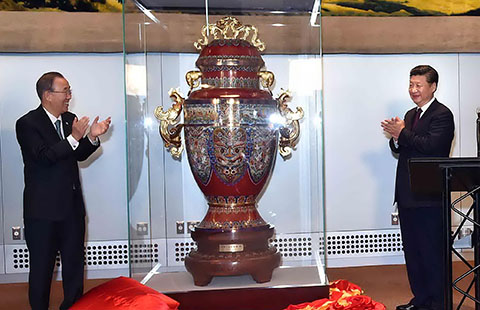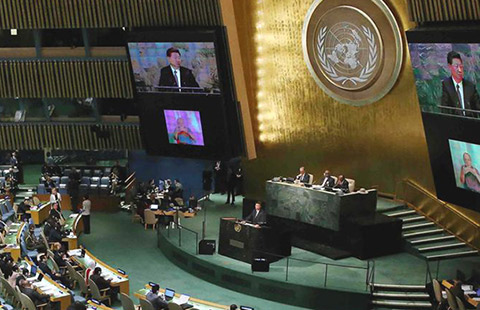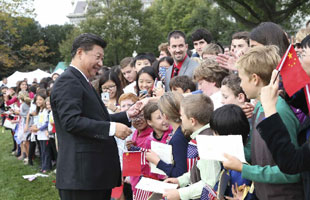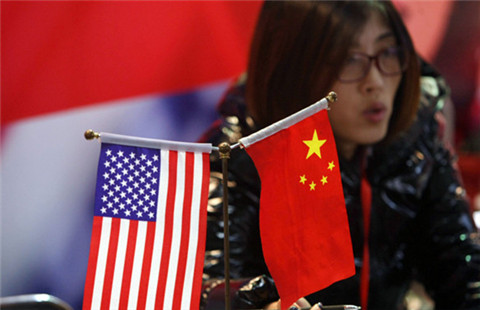
As China's President Xi Jinping arrives in Washington for the state visit, US-China relations may appear as rough waters churning on the surface. The international media may shine a spotlight on harsh rhetoric that crashes like waves against the relationship.
Using public diplomacy as a foreign policy tool to navigate such rough political waters may seem challenging.
However, the winds of globalization are blowing in favor of China's strength. In a world that is becoming increasingly interconnected on so many levels - travel, trade, technology, environment and even disease - those who master relational and networking public diplomacy approaches will be the more skilled navigators.
In this, China's cultural heritage that highlights proper relations gives it an edge as a masterful relationship-builder.
As Ambassador Cui Tiankai recently wrote in The National Interest, China is working closely with the United States on several fronts. This includes climate-change initiatives, the Iran nuclear agreement and fighting Ebola together.
One can also see the intertwining nature of China-US relations. Annual two-way trade is approaching $600 billion. Travelers between the two countries reached 4.1 million in 2014.
There are some 270,000 Chinese students studying in US universities, and China has surpassed Germany, Australia and Mexico for study by American students. Additionally, some 30,000 students are studying Chinese in the United States, thanks in large part to the Confucius Institutes.
Moving forward, strategic relationship-building may help to deepen the quality of relations. For the Confucius Institutes, this may mean stabilizing their growth while enhancing students' educational experience or research collaboration.
Similarly, an opportunity for extending relations from trade benefits to social engagement may exist. In 2014, China was among the top three export markets for 39 states across America. In human terms, these exports help create jobs and build families. Exploring opportunities for building sister-city agreements can help turn numbers into faces and places.
Public diplomacy as a field today still tends to focus on bilateral relations. However, looking at relations globally helps put China's relations with the United States in perspective. China is not alone in trying to navigate relations with this major power in an age of globalization.
Media reports and other writings reveal some of America's closest friends are experiencing strains. Robert Kagan's influential book, Of Paradise and Power: America and Europe in the New World Order, suggests a growing separation of perspectives.
Relations with Canada, America's neighbor to the north and top trading partner, were described in a Financial Times report as 'tepid" to as cold as an "Ottawa winter in the deep freeze."
Relations with America's neighbor to the south and second-largest trading partner, Mexico, may be even more worrisome given the highly inflammatory language of some of the US presidential candidates. Keeping perspective may be particularly important as the US moves into its election cycle and focus turns inward and more aggressively patriotic.
China appears keenly aware of the broader relational horizon of its region. The Silk Road, ASEAN-China Maritime Cooperation and Asian Infrastructure Investment Bank constitute a potentially vibrant relational structure. At a time when Europe and the US are experiencing an immigration crisis, China's initiative represents a relational awareness that in an interconnected world one's prosperity and stability rest not on securing them solely for one's self, but ensuring that one's neighbors enjoy them as well.
While China enjoys an edge in relational public diplomacy, there is room to expand its public diplomacy repertoire. Messages and media are the dominant currency of communication for Western and US publics. The constant barrage of sophisticated campaigns has raised public expectation of strategic messaging and impactful delivery. Many students study public speaking as a requirement. Some join debate clubs to sharpen their rhetorical skills; other take assertiveness-training courses.
Here it is important to highlight an often overlooked difference between aggressive and assertive communication. Aggressive speech may be an uncontrolled emotional outburst or a deliberately designed attack to weaken the opponent.
Name-calling and scapegoating to shift blame are familiar tactics well displayed in the US presidential contest. In contrast, assertive speech seeks to effectively express intent, preference or action with the goal of promoting understanding and preserving the relationship. Assertive rhetoric in the public sphere, like negotiations, is a honed diplomatic skill. Here China's forte of relational sensitivity can help it become a model of assertive communication.
The importance of effective strategic communication cannot be underestimated in the global public sphere with different cultural understandings of how and what nations communicate.
Developing discourse power may go against the Chinese adage of "quick to action, but slow in speech". However, from the US public perspective, having a strong voice and asserting one's interpretation of an action is critical for giving meaning to action. Given the cross-cultural potential for misunderstandings of Chinese action or policies, it is perhaps even more important for Chinese public diplomacy.
Strategic communication is not a cure-all or replacement for relational approaches, but it is an asset that, well developed and timed, can help smooth rough waters and make navigating in China-US relations perhaps a little easier.
The author is a professor in the School of Communication at American University in Washington.
Copyright 1995 - . All rights reserved. The content (including but not limited to text, photo, multimedia information, etc) published in this site belongs to China Daily Information Co (CDIC). Without written authorization from CDIC, such content shall not be republished or used in any form. Note: Browsers with 1024*768 or higher resolution are suggested for this site.
License for publishing multimedia online 0108263 Registration Number: 130349