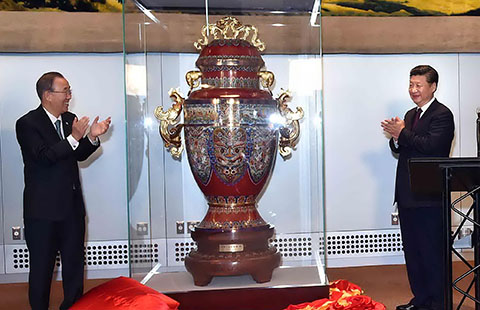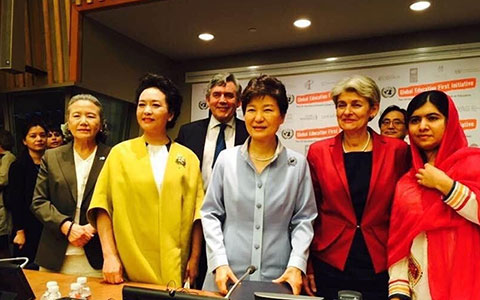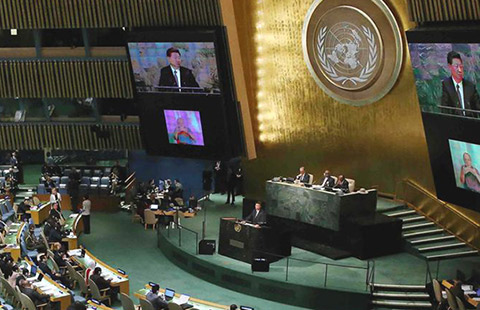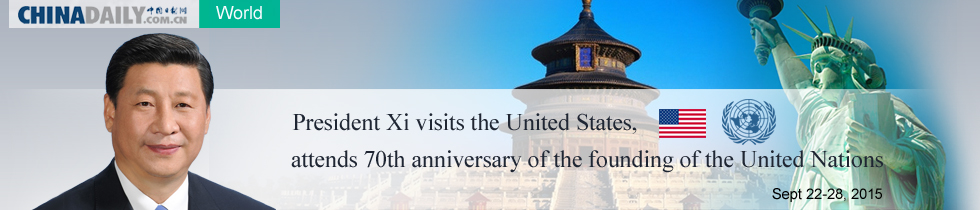
For a few days in late September, relations between the United States and China have been playing out on center stage as President Xi Jinping visits Seattle, New York, and Washington, DC. Like most dramas, this one is expected to go mostly according to script. Yet treating this as simply a revival of an old classic would be a mistake.
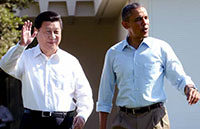
First, the scenery has changed since Xi Jinping visited Sunnylands and Muscatine. Economic storm clouds from a slowing economy, a volatile stock market, and currency intervention have altered the mood, and the American business community, once perceived as reliable ballast in the relationship, has soured.
Second, the overall narrative of the drama has shifted. No more is the storyline simply how a declining power accommodates and makes way for a rising one, a narrative that emerged from the wreckage of the 2008 financial crisis. As China’s growth has faltered, so too has its image of infallibility. And as markets have scrambled to find a safe haven, the United States has retained it reputation as a port in a storm.
This considerably changes the dynamics of President Xi's visit.
Many voices in the United States are now clamoring for the US government to take a firmer stand on issues such as South China Sea land reclamation, detention of lawyers, stringent proposed civil society regulations, and the cyber intrusions that have affected many of the very government specialists who will be working on the arrangements for this visit.
This is exacerbated by the sound and fury of presidential hopefuls as they engage in a rhetorical race to the bottom, attempting to capitalize on the fears and struggles of American workers.
But both American and Chinese leaders would be wise to look beyond the near-term narratives of relative bilateral power and domestic political sparring and focus instead on the long-term relationship in the context of global stability and prosperity.
In a speech to the National Committee on US-China Relations in 2008, Wang Qishan remarked that relations between the United States and China seem to operate according to wave theory. Applying that theory, there is little doubt that we are now in a trough. President Xi's visit presents an opportunity to start the climb back up to a peak, but only if both sides treat this visit as something more than pomp and circumstance and more than a standard bilateral deliverable-driven meeting like the S&ED or JCCT.
Both sides should take a broad view of the long-term relationship and demonstrate how collaboration and strategic diplomacy can lead to positive outcomes. Aside from addressing global issues such as climate change and the Iran nuclear deal, one area ripe for serious consideration is China’s One Belt, One Road framework and its overlap with American interests in the region.
Global issues aside, this visit cannot afford to avoid dealing with near-term bilateral disagreements, but should approach them with respect. The United States should not use China's current turmoil as a chance to score political points. Regardless of how the general public feels about some of the irritants in the relationship, a state visit is neither the time nor the forum to embarrass anyone.
On China's side, it is important not to let temporary domestic struggles translate into international aggressiveness. Chinese leadership might be tempted to project overconfidence, even arrogance, in an effort to quell potential domestic criticisms, but this would be shortsighted and counterproductive over the long term.
Both sides need to lead by positive example rather than through fear and opportunism. Fear encourages a retrenchment to parochial core interests, while leading by example often highlights shared interests.
Global economic stability may very well depend on cooperation and coordination between the United States and China, and cooperation is best built upon a foundation of mutual respect. This visit is a chance to build that mutual respect by treating each other as equals and establishing some solid rules of the road for the next couple years.
To do so, however, there are important issues that need to be addressed. Certain irritants in the relationship are only going to get worse if they are not dealt with head-on. Mutual respect often necessitates frank exchanges on sensitive issues, rather than simply setting aside differences.
From the US perspective, Chinese intentions in the South China Sea need to be clarified. Proposed regulations of foreign NGOs, including universities, should also be addressed. NGOs and universities have formed the connective tissue that has bound the two countries the closest since 1979, so great care should be given in sheltering them from interference.
From the Chinese perspective, President Xi should use actions to counter the negative narrative that has taken hold in the United States, equating economic struggles with political weakness. Simply announcing a new model of major country relations does not make it so. For all the talk about a new model, there has been little progress on strategic trust; if anything, it has decreased. If the new model is ever going to be operationalized, it needs to start with frank and open communication, and even commitments, on this trip — even if they result in some public criticism back home.
Only by dealing frankly and respectfully with the irritants can the two sides emerge to cooperatively blaze a path to global prosperity and stability.
Nathaniel Ahrens is director of China affairs, Univeristy of Maryland
Copyright 1995 - . All rights reserved. The content (including but not limited to text, photo, multimedia information, etc) published in this site belongs to China Daily Information Co (CDIC). Without written authorization from CDIC, such content shall not be republished or used in any form. Note: Browsers with 1024*768 or higher resolution are suggested for this site.
License for publishing multimedia online 0108263 Registration Number: 130349