I have tried to arrange the Chinese-language books that rest on the vertical bookshelf in my living room in the order in which they were studied. My fourth-year book, however, has thwarted my quest for organization, as it must rest under the weight of all of the books, including my first-year book, in order to close properly.
The fourth-year book, Reading Chinese Newspapers, currently resembles a pop-up book thanks to the seventh chapter titled, "China-US Relations". The teastained pages and worn edges that make the book so diffi cult to close are a reminder of the countless days I spent as an undergraduate student memorizing the details of each US-China presidential exchange since President Nixon's visit to China in 1972, the US' first visit to China since the founding of the PRC in 1949.
Now, more than ever before, it is agreed that Nixon was correct, perhaps prophetic, to regard his weeklong visit to China as "the week that changed the world".
The visit marked the very start of normalization of relations between the US and China. The goal of normalization was carried into both the Ford and Carter administrations and led President Carter to announce in 1978 that the US would offi cially recognize the communist government in Beijing and sever its formal relationship with Taiwan.
The goal of normalization initiated during Nixon's visit prompted an economic relationship between the US and China that would ultimately become one of the world's largest trade partnerships.
However, there is a crucial part of Nixon's visit that is too often overlooked. During meetings between Nixon, Henry Kissinger and Chinese Premier Zhou Enlai, emphasis also was placed on the importance of cultural exchange between China and the US.
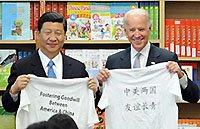
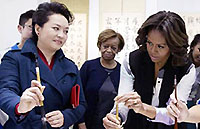
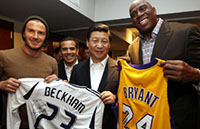
Over the past few decades, the US and China have engaged in art, scientific, sport and, notably, education exchanges. According to a briefi ng paper published by the Institute of International Education, between 1998 and 2008 the number of Americans studying abroad in China increased by 500 percent.
The number of Chinese students coming to learn in the US and the number of Chinese scholars coming to teach in the US also demonstrates an upward trajectory. It is my belief that it is essential for these exchanges to continue, as they arguably will help facilitate the political and economic relationship between the US and China.
Through cultural exchanges, many, including myself, have been fortunate enough to explore the philosophies that have shaped Eastern and Western approaches to politics, economics and social structure. A tour guide at a museum in Beijing highlighted what is considered to be a fundamental diff erence in the two approaches. The tour guide asked our group to consider the diff erences between famous artworks in Western culture and those in Eastern culture. Quite consistently, the magnum opus of Western artwork is considered to be Leonardo da Vinci's Mona Lisa.
(This was confi rmed during my trip to the Louvre last year; the Mona Lisa was the only painting requiring a roped line queue and security.) The painting's singular subject is in contrast to the most famous Chinese paintings, such as Riverside Scene at Qingming Festival, which depicts a group of subjects.
Additionally, these two paintings place importance on the scenery surrounding the subjects. The tour guide's point was that Western art traditionally placed emphasis on an individual, whereas in the East, attention was not meant to be drawn to a singular subject — collectivism was the goal.
I could not help but to draw a parallel between the art discussion with the tour guide and a recent business quagmire brought to my attention by a friend, a China native working for a China-based company hoping to purchase land in the US.
Before the land is purchased, the company seeks to do several tests to ensure that the land is suitable for its needs. However, the US fi rm from which the company would like to purchase the land insists on being paid before any of the tests are performed.
"The US fi rm does not understand," she said, "that in China, the approach to business is that we are one group, we are all in this together. No one gets paid until it can be assured that the purchase will be a success for everyone involved.
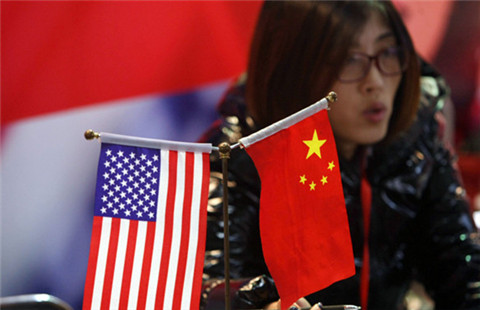
As with any relationship, healthy communication and understanding are necessary to overcome any wujie. The US' political and economic relationship with China is in perpetuity. In 2014, Fortune reported the US to be the top destination for emigrating wealthy Chinese and the most popular investment choice for wealthy Chinese: US real estate.
Additionally, we are all familiar with the fact that China has been accumulating US Treasury securities for decades. Cross-cultural understanding is crucial in facilitating the multiple facets of the US-China relationship, and thus cultural exchanges between the two nations must continue to be promoted.
Clarissa Shah is a Chinese linguist and the supply chain staff counsel at Emerson Electric Co.
Copyright 1995 - . All rights reserved. The content (including but not limited to text, photo, multimedia information, etc) published in this site belongs to China Daily Information Co (CDIC). Without written authorization from CDIC, such content shall not be republished or used in any form. Note: Browsers with 1024*768 or higher resolution are suggested for this site.
License for publishing multimedia online 0108263 Registration Number: 130349