 |
This problem is intensified by local wars, climate change and weather extremities like "El Nino," which make food prices soar. A main contributor to the problem is inadequate production. The global food crisis of 2007-2008 made the world aware that more and better quality food should be produced.
Agriculture is crucial to African development as it currently generates 40% of African GNP, 40% of its exports, and 70-80% of its employment.
However, the sector has faced significant declines in the post-colonial era. Government neglect has turned Africa from a major net exporter of agricultural goods in the early 1960s to a net importer in the 2000s.
There has also been widespread soil degradation and decline in natural vegetation. Some food shortages in Africa are of catastrophic proportions. The effect is detrimental to many, especially women and children.
The fact that Sub-Saharan Africa needs its own green revolution has been recognized by African heads of state. Certain policies would be necessary in order to protect people from displacement and prevent a colonial-like "land grab."
There are technical solutions for more sustainable agriculture and higher yields, and the need for economic measures, political will, and key international partnerships.
China's involvement with Africa can help reverse the decline. The Chinese experience of reform and national transformation in the last four decades is solid evidence that poverty can be reduced.
During that time, China has eradicated more poverty than any other country in history – from 60 % in 1978 to about 7% in 2014, and serves as an outstanding model for the world.
Chinese leaders also have the foresight in regards to future potential food shortages in Asia, so they can raise agricultural productivity in Africa, where much agricultural potential has yet to be tapped into, and would benefit the world.
Historically, China's agricultural involvement in Africa was mainly expressed in technical assistance and capacity building. But recently, for sustainability and trade expansion, China has promoted public-private partnerships and providing incentives for agribusiness investments in Africa.
By 2009, China had performed over 200 agricultural projects, established 23 fisheries, founded 11 agricultural research centers, and stationed 1,100 Chinese agricultural experts throughout the continent.
Besides larger state-owned farming groups, smaller Chinese private farms and business people can find new opportunities in Africa. Thousands of Africans travel to China for agricultural exchanges and learning.
China may see Africa as a potential place to grow food for Chinese domestic consumption, but the current Chinese agricultural engagement there has focused on meeting local and regional demand.
Its primary interest has been developing partnerships and global food security. Recent policy changes in Africa have accommodated the process.
One good example of how China's agricultural assistance is improving local livelihood is Mozambique - a country in which half the population lives below the poverty line, and about 27% of the people are unemployed.
Even though the southern African country has large alluvial plains of arable land, it faces serious food deficits and lack sufficient grain due to primitive farming techniques.
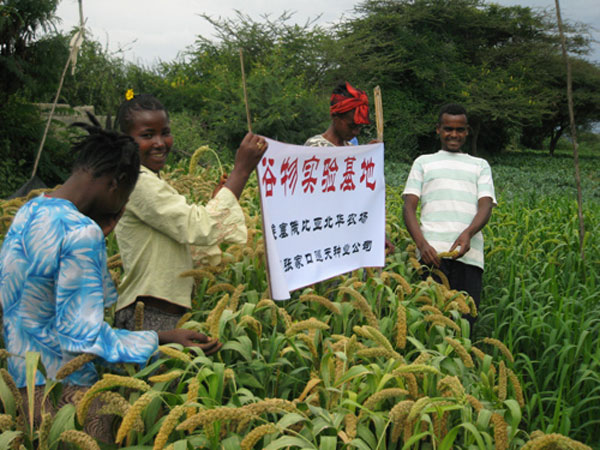
In the last decade, the Chinese have supplied high-yielding seeds and equipment, facilities for irrigation, water harvesting, and preservation. Mozambican researchers and government officials say Chinese involvement is crucial to solving the country's food and unemployment crisis.
Rudy Manuel from Xai-Xai district in the Gaza province said in 2011 that his father's farm yielded 1.5 tons of grain per hectare.
With newly-introduced Chinese technologies and hybrid seeds the yield has more than tripled as a result of the work of Hubei's WanBao Grains and Oils Co., and its USD 200 million investment in the region.
Another success story is the cotton farming project located in Beira, which assists farmers with cotton cultivation and processing.
Carried out by the China-Africa Cotton Development Co., Ltd., it provides 1000 jobs and partners with 50,000 Mozambican households involved in cotton plantation. The project has helped increase local income and improved living conditions.
According to Donald Cassell, China has done more to alleviate poverty and reduce hunger in Africa than anything the western colonialism or the more traditional partners have ever done before.
African leaders can use China's assistance to develop their agricultural sector and invest in local cadre to manage the process. It is a great opportunity for them to seize and manage well.
By Miroslav Atanasov, Ph.D., Renmin University of China
The opinions expressed here do not necessarily reflect the opinions of Panview or CCTV.com.
Copyright 1995 - . All rights reserved. The content (including but not limited to text, photo, multimedia information, etc) published in this site belongs to China Daily Information Co (CDIC). Without written authorization from CDIC, such content shall not be republished or used in any form. Note: Browsers with 1024*768 or higher resolution are suggested for this site.
License for publishing multimedia online 0108263 Registration Number: 130349