 |
|
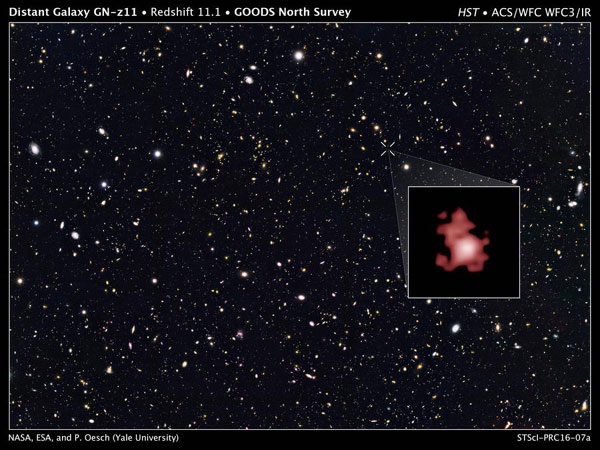
Hubble Space Telescope image shows the Galaxy GN-z11, shown in the inset, as it was 13.4 billion years in the past, just 400 million years after the big bang, when the universe was only three percent of its current age, in this image released by NASA on March 3, 2016. The galaxy is ablaze with bright, young, blue stars, but looks red in this image because its light has been stretched to longer spectral wavelengths by the expansion of the universe. Astronomers said on March 3, 2016 they had discovered a galaxy that formed just 400 million years after the Big Bang explosion, the most distant galaxy found to date. [Photo/Agencies] |
WASHINGTON - An international team of astronomers said Thursday that using the Hubble Space Telescope they have spotted the farthest galaxy ever seen in the universe.
This surprisingly bright infant galaxy, named GN-z11, was seen as it was 13.4 billion years in the past, just 400 million years after the Big Bang, the team reported in the Astrophysical Journal.
"We've taken a major step back in time, beyond what we'd ever expected to be able to do with Hubble. We see GN-z11 at a time when the universe was only three percent of its current age," principal investigator Pascal Oesch of Yale University said in a statement.
The team also included scientists from Yale University, the Space Telescope Science Institute, and the University of California.
The astronomers also revealed that GN-z11 is 25 times smaller than the Milky Way and has just one percent of our galaxy's mass in stars.
However, the newborn GN-z11 is growing fast, forming stars at a rate about 20 times greater than our galaxy does today.
Previously, the team had estimated GN-z11's distance by determining its color through imaging with Hubble and NASA's Spitzer Space Telescope.
Now, for the first time for a galaxy at such an extreme distance, the team used Hubble's Wide Field Camera 3 to precisely measure the distance to GN-z11 spectroscopically by splitting the light into its component colors.
The measurement was based on the "redshift" of a galaxy, which means if a distant galaxy is moving away from us its light appears redder. The greater the redshift, the farther the galaxy.
Before astronomers determined the distance for GN-z11, the most distant galaxy measured spectroscopically had a redshift of 8.68, which translates to a distance of 13.2 billion light-years away.
Now, the team confirmed GN-z11 to be at a redshift of 11.1, nearly 200 million years closer to the time of the Big Bang.
"This new record will likely stand until the launch of the James Webb Space Telescope," investigator Pieter van Dokkum of Yale University added, referring to Hubble's successor, which is scheduled to launch in 2018.
Copyright 1995 - . All rights reserved. The content (including but not limited to text, photo, multimedia information, etc) published in this site belongs to China Daily Information Co (CDIC). Without written authorization from CDIC, such content shall not be republished or used in any form. Note: Browsers with 1024*768 or higher resolution are suggested for this site.
License for publishing multimedia online 0108263 Registration Number: 130349