 |
|
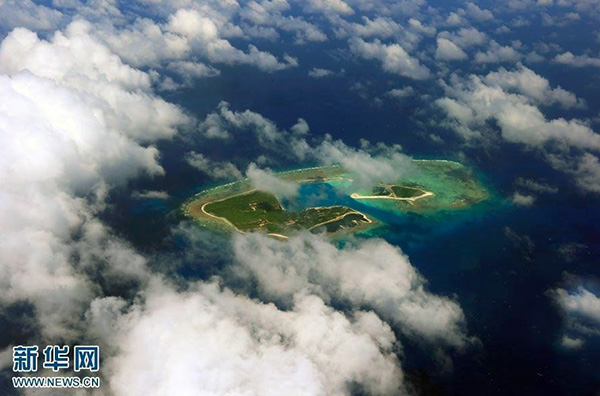
File photo of South China Sea. [Photo/Xinhua] |
A seminar on the South China Sea Arbitration and International Rule of Law was held on Sunday in the Hague, the location of the Permanent Court of Arbitration's arbitral tribunal. At the seminar hosted by both Chinese and Dutch academic institutions, experts from various countries warned that the unilateral filing of the South China Sea arbitration case by the Aquino administration of the Philippines and the arbitral tribunal's overreach and abuse of power is a desecration of the spirit of the rule of law and pose a threat to current international order.
With this move, the Philippines is just adorning itself with borrowed plumes. First of all, estoppel is a basic principle of international law. As is known to all, China and ASEAN countries, including the Philippines, signed the Declaration on the Conduct of Parties in the South China Sea (DOC) in 2002, in which all sides agreed to settle disputes over the South China Sea through friendly negotiation and consultation by parties directly concerned.
In 2011, the Philippines and China issued a joint statement, reiterating their respect and observation of the DOC. However, just two years later, the Aquino administration unilaterally submitted the South China Sea case for arbitration in spite of its previous commitments.
Secondly, the Philippines ignores basic historical facts by presumptuously claiming that the Chinese people never lived or conducted activities in the South China Sea region, thus bearing no sovereignty over the islands in the region.
Yet no one can deny the historical fact that those islands have been part of China's territory since ancient times. Successive Chinese governments have continued to govern the islands through multiple approaches including setting administrative divisions, military patrols and conducting salvages at sea.
Respecting historical fact is an important principle of international law. Through its lack of respect for the facts, the South China Sea case violates this principle.
Moreover, the Philippines' interpretation of the legal status of the islands and reefs in the South China Sea is not in line with the United Nations Convention on the Law of Sea (UNCLOS) and other international laws.
The Southeast Asian nation claims that the Huangyan Island and the Nansha islands cannot be considered islands as such no one can establish exclusive economic zones or claim the continental shelves there. Such an argument flies in the face of objective reality.
The Philippines deliberately misrepresented factual information about the islands and reefs in the South China Sea during the trial and carelessly negated the integrity of the Nansha islands as well as the island status of Taiping Island and other large islands in area. However, its claims are not only inconsistent with reality, but also incompatible with UNCLOS and other international laws.
The legal representatives of the Philippines also withheld necessary information concerning other islands in the South China Sea (not included in its arbitration request) on purpose, and refused to present them to the court. It is safe to say that the Philippines' argument concerning the South China Sea islands and reefs lacks basic credibility.
Taking this into consideration, the arbitral tribunal has clearly violated UNCLOS, abused the UNCLOS settlement procedure and exceeded its jurisdiction by accepting the unilateral request of the Philippines and even trying to deliver a verdict on the South China Sea issue. Its self-proclaimed "jurisprudence" and "normative power" demonstrate great irony.
The core of the South China Sea issue between China and the Philippines are territorial and maritime delimitation disputes. Territorial issues do not fall within the scope of UNCLOS authority. Additionally, as early as 2006, China has excluded compulsory settlement procedures from maritime delimitation disputes in accordance with Article 298 of UNCLOS.
As a temporary institution founded on UNCLOS, the tribunal has zero jurisdiction over this case. Arbitration and other international judicial methods to resolve disputes means resorting to third-party settlement. However, this option has already been excluded by internationally binding bilateral agreements between China and the Philippines.

Copyright 1995 - . All rights reserved. The content (including but not limited to text, photo, multimedia information, etc) published in this site belongs to China Daily Information Co (CDIC). Without written authorization from CDIC, such content shall not be republished or used in any form. Note: Browsers with 1024*768 or higher resolution are suggested for this site.
License for publishing multimedia online 0108263 Registration Number: 130349