Imports of beef and other items from the South American country overtake those from Australia
Limited domestic output and rising per-capita incomes are pushing beef-hungry China to import the high-protein, low-fat meat in increasing quantities from Brazil.
About a year after recovering from a scare related to mad cow disease, Brazil has supplanted Australia as the biggest seller of beef to China.


A production deficit is widening in China, and imports are heading for a record.
Brazil's ample supplies and low prices helped companies including JBS SA, Minerva SA and Marfrig Global Foods SA to boost exports to China by 65 percent in the first half of the year.
While the Chinese eat far more pork than any other meat, per-capita consumption is falling. At the same time, demand for beef is increasing.
Only the US imports more beef than China. Rapid economic growth over the past decade in China has created the world's second-largest economy and an expanding middle class that can afford more protein in their diets.
At the same time, Brazil has plenty of surplus beef, as domestic demand stagnates, and the country's exports are appealing to buyers after its currency plunged last year.
China ended a three-year-old embargo on Brazilian beef imports in May last year, imposed because of the mad cow disease epidemic that hit Brazil in 2012.
"China will have a major impact on the beef trade," said Miguel Gularte, head of JBS's Mercosul beef unit. "It's a fantastic market for Brazil" because the Asian country has "hundreds of millions of people moving to consume red meat," he said.
Per-capita consumption of beef in China will reach a record 3.864 kg this year, compared with 3.029 kg a decade ago, according to estimates by the Organization for Economic Co-Operation and Development.
But production has not kept pace, so China's imports this year will jump 22 percent to 1.23 million tons, including purchases by Hong Kong, according to the US Department of Agriculture.
That is an almost fourfold increase from 2012, and imports now account for 36 percent of demand, up from 25 percent last year.
Wang Kai, a professor at Nanjing Agricultural University in Jiangsu province, said demand for lamb in China's western region, particularly in the Ningxia Hui and Xinjiang Uygur autonomous regions, and Qinghai and Gansu provinces, has quickly grown over the past five years, mainly because it is getting more expensive to raise cattle in western China, where the economy and livestock industry are less developed than in the eastern provinces.
Because of rising feed prices, limited grazing land and the breeding cycle, China's cattle-raising sector lags behind consumer demand, resulting in higher lamb prices over the past five years, according to a report released last December by the Chinese Academy of Agricultural Sciences.
"As China has found it impossible to grow all of the food it needs and has consequently formed closer ties with the world food market, demand for beef, mutton, fruit, wine and dairy products will certainly provide many opportunities for major agricultural produce exporters such as Chile, Brazil, Argentina and the United States."
Bilateral trade between China and Brazil stood at $71.59 billion in 2015, making China Brazil's largest export destination and source of imports, data released by the General Administration of Customs show.
Not only agricultural products, China has purchased large sums of raw materials from Brazil over the years, where it has also invested heavily in infrastructure, including hydropower facilities, construction machinery and automobile production. Chinese companies had invested $18.94 billion in Brazil by the end of 2014.
Australia had been China's top foreign beef supplier, but its output declined. That created an opportunity for Brazil, where a 33 percent plunge in its currency last year because of a recession and political scandal made its exports more appealing to buyers.
Shipments to the Chinese mainland and Hong Kong in the first six months of this year were a combined 265,800 tons, up from 161,000 tons a year earlier, industry data show. Total exports to all countries rose 12 percent to 736,000 tons.
"There's a lot of tailwinds for the Brazilian industry at this moment," Justin Sherrard, an animal-protein global strategist at Rabobank, said in a telephone interview from Utrecht, Netherlands.
Brazil almost missed out. A single positive test for mad cow disease in 2012 led to import bans by China and other countries, including South Korea and Japan. The case was considered a "negligible risk," based on criteria established by the World Organization for Animal Health, because the animal never made it into the food chain. That meant a quicker path to lifting the ban, which China did in May 2015.
While some forms of Brazilian meat are still restricted, like organs or boned meat, China now permits most common meat cuts including steaks and ground beef, though most of the purchases are the low-end cuts used in processed meat products. With most of the so-called premium markets including Japan and South Korea still closed to Brazilian beef, most of the country's shipments of prime cuts like steaks end up in Europe.
"China is emerging as the first alternative to Europe for Brazil's premium beef," Antonio Camardelli, head of Brazil's beef industry group, Abiec, said in a telephone interview from Sao Paulo. "There's still a lot of room to increase exports of gourmet beef to China."
There are signs that demand will slow from China buyers who are "pressuring prices down," Mercosul's Gularte said. Still, Brazilian shipments to China this year will be twice what they were in 2015, he said.
Asia represented 26 percent of exports for Minerva in the year ended in March, making it the main destination for Sao Paulo-based company's exports. That's up from 18 percent a year before.
"There are consumers that are willing to pay a premium for having a differential," Fernando Galletti Queiroz, chief executive officer of Minerva SA, said in an interview in Sao Paulo. "The price gap to Europe is shrinking."
Not only purchasing agricultural products from Brazil, China has also invested more in both Brazil and Latin America's manufacturing, financial and infrastructure sectors to boost growth as it adjusts its trade structure and diversifies investment categories under current global business setting.
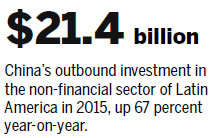
China's outbound investment in the non-financial sector of Latin America reached $21.4 billion in 2015, surging 67 percent year-on-year. Its investment mainly flowed into countries including Brazil, Venezuela, Argentina and Ecuador, data from the Ministry of Commerce show.
Contact the writer at zhongnan@chinadaily.com.cn
|
A restaurant attendant prepares beef for customers in Guangzhou, Guangdong province. Provided to China Daily |
(China Daily 08/08/2016 page13)

Copyright 1995 - . All rights reserved. The content (including but not limited to text, photo, multimedia information, etc) published in this site belongs to China Daily Information Co (CDIC). Without written authorization from CDIC, such content shall not be republished or used in any form. Note: Browsers with 1024*768 or higher resolution are suggested for this site.
License for publishing multimedia online 0108263 Registration Number: 130349