IMF urges China to invest in soft infrastructure


China has made remarkable progress in building infrastructure in the past decades from roads to bridges to high-speed railways, but experts believe that enhancing soft infrastructure will be critical to the country's sustainable growth in the future.
In its latest book, Modernizing China: Investing in Soft Infrastructure, the International Monetary Fund (IMF) believes that as China rebalances its economy toward more sustainable and efficient growth, it is necessary to invest more in "soft infrastructure", such as strengthening fiscal and monetary frameworks, continuing the reform of state-owned enterprises (SOEs), developing a policy to address financial risk and improving the dissemination of macroeconomic statistics.
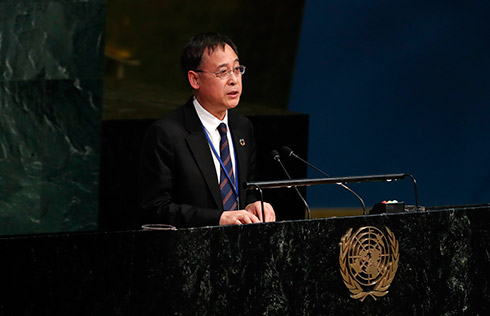
"In China, building resilience means reform and rebalancing of the economy," IMF Deputy Managing Director Mitsuhiro Furusawa said in a talk on Tuesday at the Center for Strategic and International Studies. He was referring to China's bid to shift away from investment- and export-led growth to a more domestic consumption-driven and sustainable economy.
Furusawa noted that China's rebalancing could have an impact across the globe.
According to IMF estimates, a one percentage point decline in China's GDP growth could reduce global growth by 0.2 percent and almost twice that rate in many Asian economies.
Markus Rodlauer, deputy director of IMF's Asia and Pacific Department, emphasized that the rebalancing means to change the role of the state, especially in the area of economic governance.
"This means transforming government away from direct ownership of assets, allocation of resources and physical investment in planned infrastructure towards a much more indirect role as an enabler," he said.
Zhang Tao, IMF's deputy managing director and a former vice-governor of China's central bank, made a similar comment in Beijing last month. "One shift (to a new generation of reform) is for government to move from directing, owning and investing in physical infrastructure, to one as a facilitator and regulator of private initiative, enterprise and innovation," he said.
The new IMF book described the SOE reform as an Achilles heel.
The 150,000 SOEs in China account for half of the credit. Their productivity is less than half of private companies. And they are responsible for a large part of the overcapacity, corporate debt and "zombie" firms, businesses that are extremely inefficient, according to Alfred Schipke, IMF's senior resident representative for China.
"You have to make sure that you're creating a level-playing field of SOEs, the private sector. That means enforcing hard budget constraints," he said.
Recognizing that China is now moving toward using the market and moving ahead with liberalization, Schipke said the key is to have strong frameworks. "Because in the absence of that, just liberalization might create more problems down the road," he said. "That is why we believe investment in soft infrastructure will be the most critical part going forward."
It is not the first time an international financial organization offered policy advice to the Chinese government.
Back in 2012, the World Bank, in collaboration with the Development Research Center of China's State Council, published China 2030: Building a Modern, Harmonious, and Creative Society, mapping out a path for China to avoid the "middle-income trap" and attain "rich country" status by 2030.
Rodlauer described the Chinese government as "very open to external advice" and then makes its own decisions.
Furusawa said that as China continues to develop, the IMF would continue to provide policy advice, training and technical assistance.
chenweihua@chinadailyusa.com
(China Daily USA?02/15/2017 page2)