Mother's Day a good time to reflect on tradition, future


Mother's Day, the widely celebrated American holiday, in recent years has become so popular in China that it's almost a household term. An increasing number of Chinese families now observe the Western holiday, and, of course, in a Chinese way.

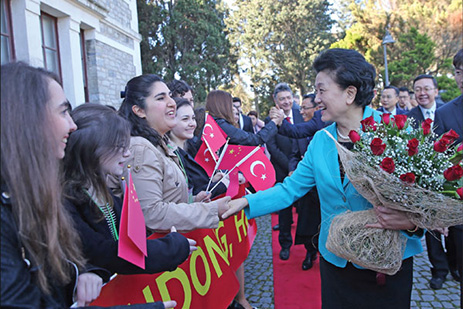
The theme of a Mother's Day celebration among the Chinese doesn't differ much from that in the West: we honor the beauty, sacrifice, courage and unconditional love of motherhood. Children express gratitude to mothers for their companionship, protection and guidance, especially when they are vulnerable and weak. On a Mother's Day gathering of more than 100 guests in San Francisco on May 13, Qiao Li, wife of China's Consul General in San Francisco Luo Linquan, greeted her guests from all walks of life by calling them "outstanding representatives of mothers and women in America."
Chinese-American women have been playing key roles in immigrant families in supporting their spouses and children, all the while assimilating to a foreign environment themselves, said Qiao. "No matter how many hardships you have encountered, you conquer them with grace, perseverance and resilience, as the wife, and as the mother," she said.
There are several reasons why this holiday has caught on in China.
On the one hand, the essence of Mother's Day coincides with traditional values of Chinese culture, especially the deep-rooted virtue of filial piety. About 2,500 years ago, Confucius, China's most well-known philosopher and educator, proposed that filial piety was the one virtue to be held above all others. He emphasized the responsibility of offspring to care for, respect and obey their parents.
Confucius said there were three degrees of filial piety: "The highest is being an honor to our parents, the second is not disgracing them and the most basic is being able to simply support them."
From a more current point of view, observance of a holiday like Mother's Day is in sync with China's national effort to tackle the problems associated with an aging population. According to statistics from the Ministry of Civil Affairs in China, at the end of 2015, more than 222 million people in China — about 16 percent of the population — were age 60 or older, this as the average life expectancy has risen to 76 years.
The China National Working Commission on Aging predicts that by 2033, the country will be home to 400 million people age 60 or older, and the number will grow at a rate of 10 million a year. In other words, senior citizens are likely to account for more than one-third of the population by 2050. In 2013, China passed a law to protect the rights and interests of parents aged 60 and above, and to promote the virtue of filial piety. The law said that younger family members should listen to and satisfy the psychological needs of their parents.
For those who don't live with their parents, they should visit, and check on the well-being of their elderly on a regular basis — if not, they risk of facing fines or detention.
Indoctrination in filial piety among Chinese children starts at an early age. China's National Association for Ethical Studies announced in 2016 that they would train a million children between the ages of 4 and 6 in the basics of filial piety and apply their learning to get along with parents. "The programs were originally well-intentioned, but I doubt how much influence they will have on children," said He Konghua, chairwomen of Greater China Women's Association in San Francisco. "I'm still often saddened to see how fiercely mothers confront their children as so-called ‘tiger moms' and how spoiled children take for granted everything their mothers have done for them." Contact the writer at junechang@chinadailyusa.com.