London's Chinatown set to change as Cantonese move over for mainlanders


 |
|
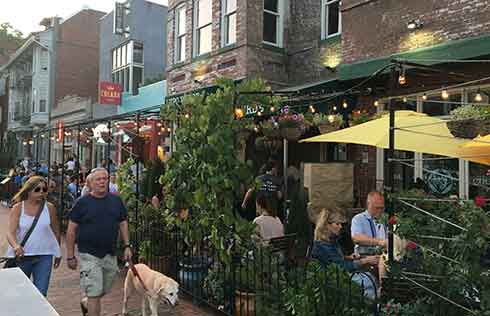
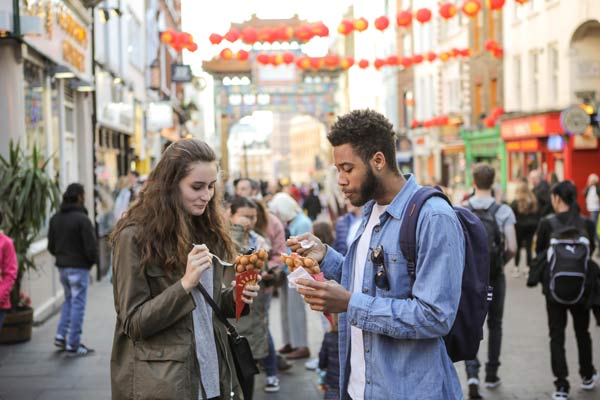
A couple enjoys bubblewrap waffles in London's iconic Chinatown, an area that is expected to undergo transformation. [Photo/China Daily] |
For more than 50 years, London's Chinatown has been the heartland of the United Kingdom's Cantonese community. It was where they shopped, ate, and socialized.
But it is now being transformed to accommodate and reflect other Chinese communities and to keep up with the changing profile of the Chinese in the United Kingdom.
The adjustment means there will be fewer supermarkets and family-run restaurants in the years ahead and more large-scale branded restaurants.
Most of the property in Chinatown, which is in the southern part of the Soho area of Central London, is owned by Shaftesbury, a public limited company. Tom Welton, the property director of Shaftesbury, said neighborhoods change over time.
"Chinatown, in its own way, is evolving to cater for different tastes," he said. "We're seeing now lots of students from the Chinese mainland hanging out in Chinatown. They might come from different parts of China and have different tastes, but the businesses are responding to that."
London's first Chinatown was in the east of the city, close to its docks. It migrated to its current location in the 1970s, when rents were cheap and Soho was a byword for crime and prostitution.
It is a bustling network of traditional dim sum restaurants, old fashioned barber shops, grocery stores, and gambling places but now also features shops selling Taiwan bubble tea, matcha ice cream, and Instagram-friendly bubblewrap waffles.
Shaftesbury wants new tenants to offer more to Chinese students and visitors, people who are more likely to come from the Chinese mainland than Hong Kong.
Welton said the increasing number of Chinese tourists to the capital is a major catalyst for change in Chinatown. Around 160,000 Chinese tourists visited London last year, each spending an average of 1,370 pounds ($1,808), which is more than half of an average Londoner's monthly net salary of 2,227 pounds, according to the Office for National Statistics.
The number of Chinese tourists is expected to reach 330,000 a year by 2025, which will make them the largest group of tourists visiting London.
Welton said Cantonese people and products will still play an important role in Chinatown, but there will be less of them.
"Places evolve, and things change," he said. "They don't just get fixed in time and you have to respond to that."
Soho has become more popular and expensive since the 1970s and small businesses now find it hard to afford the rent. Jon Man, a member of the West End Chinatown Tenants' Association, said increasing rents forced his Chinese restaurant out of the area. He is skeptical about whether newcomers will be able to succeed there because of the high overheads. "They do not have a clue what the market is like," he said. "They think it's a gold mine, but that's not what it is."
Welton said the company does not want to simply lease property to the highest bidder. "Chinatown has a very special location and very unique characteristics. We want to keep the best of those things there, and it would be madness to try and move out all these restaurants and rebrand it and that's not our intention," he said.
Peter Lam, the president of London Chinatown Chinese Association, said he fears Chinatown could become like any other part of London.
"We do not mind the landlord introduces the new stuff as long as they want to keep the authenticity of Chinatown," he said.
Lam, who owns restaurants in Chinatown, noted the neighborhood was built on the hard work of migrants.
"There is a lot of hard work from our grandparents and parents' generation to build Chinatown as it is today, the glory of which we can see from many old restaurants," he said.
But he wonders if future generations will be willing to work as hard to keep their foothold in Central London.
"If you go down the kitchen to take a look, the daily running is a tough sell compared to working as a solicitor or an accountant. That could be a threat to the future of Chinatown," he added.
Zhang Yangfei contributed to the story