The human element: progress focuses on rich history, culture


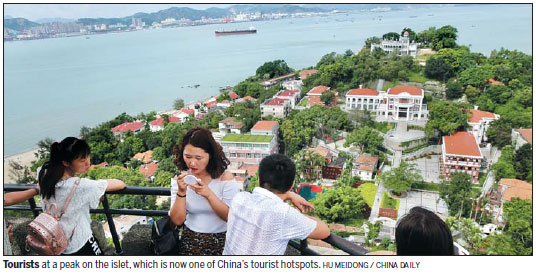
Gulangyu has a lot going for it: Beautiful scenery, delicious food, historic architecture and a quiet atmosphere.
But after the island, known in the local dialect as Kulangsu, was recognized by UNESCO on its list of World Cultural Heritage sites, the officials charged with overseeing its development decided to focus on another aspect of island life: the human beings who settled there, and the unique culture they created.
The 1.88-square-kilometer islet was residence for around 14,750 people in 2015, including 11,265 permanent residents and 3,485 transient residents, who moved there not long ago.
"Since the beginning step of Gulangyu's application for World Cultural Heritage sites until it was successfully included into the list, the issue of its preservation is always under challenge," said Wei Qing, director of a consulting team that worked on Gulangyu's application for UNESCO World Cultural Heritage status.
"The concept of human settlement of Gulangyu should be implemented throughout the preserving process," Wei said at a media forum held on July 28.
Through the effort made by local Chinese people, overseas Chinese and foreigners from varied countries, Gulangyu was built into an international settlement in the past centuries.
The diverse cultures and modern lifestyle rooted in the settlement embodies the modern concept of human settlement during the mid-19th to 20th century, according to Wei.
Before the 1980s, Gulangyu was a comprehensive system of human settlement, containing factories in which to work as well as home in which to live.
Starting in the 1980s, the local government proposed to make tourism the primary financial base for Gulangyu and made plans to move out the factories, some of the hospitals and schools that had been on the islet.
Thereafter, the tourism industry of islet gradually become the pillar industry, while factories shrank.
In 2008, the work on Gulangyu's application for UNESCO World Cultural Heritage status was put on the schedule. Since then, the local government has recovered some of the historic relics and streets, human facilities and plants.
The ancient buildings of Gulangyu are incredibly hard to mend, said Dong Qinong, president of the Volunteer Association in Gulangyu.
All the construction materials including bricks must be shipped from Xiamen to the islet. After downloaded onto the islet, the materials have to be carried by human-powered carts, as driving is not allowed there.
The difficulty in transportation boosted the price of recovery projects and made them exceptionally time consuming. In 2008, local government proposed a policy to facilitate the operation of household hotels.
The social participants including more than 300 household hotels on Gulangyu invested more than 500 million yuan ($74.33 million) on the recovery of the old buildings, according to Dong.
"Although Gulangyu has become a UNESCO World Cultural Heritage site, it doesn't mean we should put it on the shelf and bury it under dust.
"We should make full use of civil power to protect the historical buildings on the island and rejuvenate the islet in the process of proper use," Dong said.
However, the overly heated tourism really affects the daily life of the residents. The high price of products drive residents to buy things off-island. To deal with the problem, Dong suggests government offer subsidies to island residents, supplementing the income they gain from tourism.
Another key concept rooted in this historical international settlement is the inclusiveness.
The government provided financial support to folk bands, letting them buy the instruments they wanted. It also sponsored the cultural activities on the islet, according to Cai Songrong, deputy director of Kulangsu Cultural Heritage Monitoring Center.
However, the core value of Gulangyu is rooted in its role as a historic international settlement. The preservation of human settlements needs the participation of generations, Wei said.
"We should make more communication with the local residents, encouraging them to work together in the preservation work and build up identity recognition as Gulangyu residents," Wei said.