China, Australia embrace cooperation, free trade in face of rising protectionism


 |
|
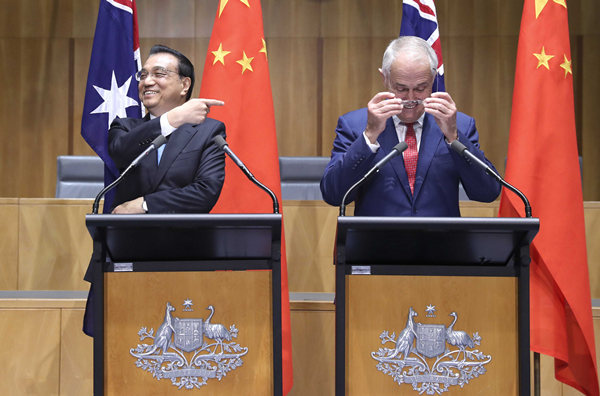
Premier Li Keqiang shares a light moment with Australian Prime Minister Malcolm Turnbull during a news conference at Parliament House in Canberra, Australia, on Friday. [Photo/Xinhua] |
BEIJING - China and Australia on Friday inked a series of bilateral agreements and moved to expand free trade between the two major Asia-Pacific economies in a vote of confidence for regional cooperation in the face of rising protectionism.
Visiting Chinese Premier Li Keqiang and his Australian counterpart, Malcolm Turnbull in Canberra witnessed the signing of a number of cooperation documents in such fields as the economy and trade, innovation, agriculture, food, intellectual property, security of law enforcement, tourism and education.
The two countries also started negotiations to further expand the China-Australia Free Trade Agreement (ChAFTA) to other fields, especially services and investment, Li told the Australia-China Economic and Trade Cooperation Forum in Sydney.
In the new global reality that seems to be tilting towards protectionism and anti-globalization, China and Australia offer a perfect example of how free trade does not lead to tit-for-tat combat, but generates gains for both.
Australia, a country abundant in natural resources, needs globalization for international trade, while the world's biggest trader China needs an open market.
As Australia's biggest trading partner for the past 8 years, China has been a loyal buyer of everything from iron ore to milk powder and a passionate salesman of everything the country makes. Australia has become China's eighth largest trading partner.
China-Australia bilateral trade reached 104 billion U.S. Dollars in 2016, expanding at least 1,500-fold since the two forged diplomatic relations in 1972.
"Those solid facts tell the world they need each other," said Liu Qing, head of the Asia-Pacific department at the China Institute of International Studies (CIIS).
No doubt protectionism is going to win applause somewhere somehow, said Liu, but it would not change the prospects between China and Australia.
The two have highly complementary economies and development strategies, said Liu, referring to China's Belt and Road Initiative and Australia's development plan in its north.
In an article on The Australian newspaper on Thursday, Li said, "Advance is a key word in both the Chinese and Australian national anthems."
He believed that the two countries will counter global instability through steady development and co-operation.
China and Australia have a long history of cooperation.
The two countries sign the ChAFTA in 2015, which immediately brought down tariffs for Australian beef, wine, fruits and other products to have easier access to the Chinese market.
In the wine industry, before ChAFTA, China was Australia's second-largest market, worth about 320 million U.S. dollars in 2015-2016. Australian wine was subject to a 14-percent tariff before it hit Chinese shelves.
Now about a year later, with the tariff reduced to 5.6 percent, China has become Australia's largest market for wine, now worth almost 375 million U.S. dollars annually.
According to the ChAFTA, a third round of tariff cuts took place in January. When the agreement is fully implemented, 96 percent of Australian goods will be duty free, so are 100 percent of Chinese exports to Australia.
China and Australia do not always see eye to eye -- anti-dumping probes come and go -- and the ChAFTA process was full of twists and turns.
But the fact that they have overcome various hurdles and reached the present stage demonstrates that they have both the will and the wisdom to chart a win-win course.
"This is a bilateral relationship that has been overwhelmingly good for both countries," said James Laurenceson, deputy director of the Australia-China Relations Institute at the University of Technology Sydney.
"You don't trade because one person wins and one person loses. That's the beauty of economics; whether it's trade or investment, it's a positive sum game," said Laurenceson.