German Industry 4.0 could work as driver for China


 |
|
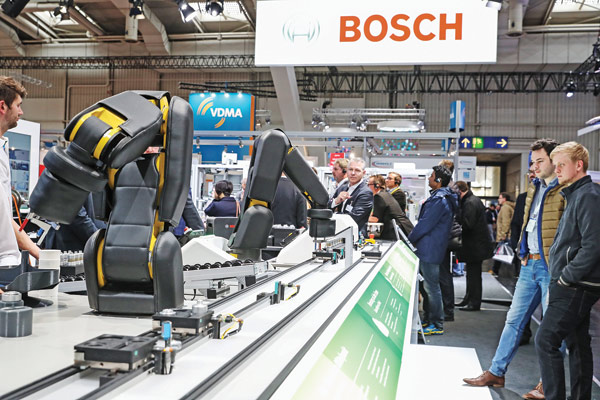
An intelligent factory is displayed at the Bosch pavilion in Hannover in April. [Photo/Xinhua] |
Strategy likely to advance the nation's 'Made in China 2025' development goal
Germany's new industrial strategy will push Chinese companies to accelerate their development and aid their ability to compete with rivals, according to Chinese and German business leaders.
The leaders were speaking on the eve of President Xi Jinping's visit to Germany for the G20 Summit in Hamburg this week.
In 2012, the German government set up Industry 4.0 working groups to push its companies to utilize new technology and thinking to maintain its pre-eminence in manufacturing.
The phrase 4.0 refers to a phase of manufacturing in which automation and interconnection play a far greater role in making the manufacturing process more efficient. The first generation of industrialization (1.0) refers to the first use of mechanization and water power, the second generation (2.0) refers to the use of electricity and assembly lines and the third generation (3.0) refers to the use of automation and early computers.
Feng Yaoxiang, a spokesman for the China Council for the Promotion of International Trade in Beijing, said many of China's manufacturers are transiting from phase 2.0 to 3.0, so the German example could drive the transformation and upgrading of China's manufacturing industry.
Many of the G20 members are pursuing similar strategies. The United States has proposed a manufacturing industry renaissance program. Japan, France and the United Kingdom also have their own strategies or programs to revitalize manufacturing to stimulate exports. For its part, China has been implementing the "Made in China 2025" plan to modernize the country's manufacturing through technological upgrades, knowledge-based industries and environmentally friendly development.
Peter Tyroller, member of the board of management of Robert Bosch GmbH responsible for Asia Pacific, said to support the "Made in China 2025" plan and "Internet plus" initiative in China, Bosch has been seeking local partnerships.
Smart Mobility
"China's growing demand for high-value-added products and services, especially for its automobiles, home-related service businesses and manufacturing projects, offers many growth points," said Tyroller.
Bosch and China's Baidu search engine signed a strategic cooperation agreement on smart mobility in China. Bosch will be involved in Baidu's "Apollo" project, which aims to provide open, comprehensive, and reliable software for the development of automated vehicles.
Under the deal, Bosch will contribute its sensors and the "Bosch Road Signature" for vehicle localization. Moreover, both companies will provide their technical expertise to support the drafting of legislation relating to automated driving in China.
Fang Jian, managing partner for China of global law firm Linklaters LLP, said: "Investment in technology-based services and trade in high-end products — such as cloud platform systems, smart manufacturing projects and sensors and industrial automation goods — is set to account for an even greater proportion of bilateral business ties."
Chinese companies pumped more than 11 billion euros ($12.6 billion) into Germany last year, investing in 281 projects that created more than 3,900 jobs.
Chinese investment in Germany has focused on manufacturing and greenfield sectors in the past few years but it has started to focus more on high-tech companies for acquisition, such as robotics manufacturer Kuka AG, which was bought by Chinese consumer products company Midea Group in 2016.
Joe Kaeser, chief executive officer of Siemens AG, said China is making progress on the path to becoming an advanced and competitive economy, but it will take time for the required changes to have an impact. Patience and consistency will be required, as well as continuous reforms along the way, he said.
Xue Rongjiu, deputy director of the Beijing-based China Society for World Trade Organization Studies, said: "As the United States has been pressing both China and Germany to appreciate their currency exchange rates to maintain competitiveness in manufacturing, both countries have been keen to upgrade the content of their partnership, especially in services and high-end product trade."
Germany is China's biggest trading partner in Europe. Trade between the two countries totaled $64.1 billion between January and May this year, up 13.4 percent from the year before, data from the General Administration of Customs show.
Contact the writer at zhongnan@chinadaily.com.cn
- China, Germany at forefront of the 'interconnected world'
- China, Germany to lead on climate protection at G20
- China-Germany ties serve as model for Sino-European partnership
- Xi says China, Germany in new era of high-level, comprehensive strategic cooperation
- China-Germany ties a model for cooperation