Comments
  Print
Print  Mail
Mail  Large Medium Small
Abe's evil designs cannot check China's peaceful rise or deter the world from advancing toward peace and prosperity
History is a mirror, and people can distinguish contemporary politicians' sense of right and wrong and their actions through their understanding of history. And going by history, there seems little doubt that Japanese Prime Minister Shinzo Abe and his supporters worship Japan's imperial past, a past of naked fascism and brutal aggression.
From posing for photographs in a plane emblazoned with "731", the number that represents the notorious Japanese chemical and biological warfare Unit 731, and shouting "Long live the emperor", a chant commonly used by Japanese soldiers during World War II, to visiting Yasukuni Shrine that honors 14 Class-A war criminals, Abe has exhibited his appreciation for Japan's militarist past and hard-line stance on territorial disputes with neighboring countries.
Why has Abe disregarded international and domestic opposition and insisted on paying respects to Class-A war criminals?
First, Abe's actions are the result of his interaction with his supporters and their wrong viewpoint on history, which show that Japanese politics has taken a rightist turn. After being elected Japan's prime minister for the second time, Abe has garnered the support of all right-wing elements in Japan by honoring war criminals and trying to revive militarism. The denial of historical facts, especially on Yasukuni Shrine and "comfort women", and revision of textbooks in an attempt to glorify Japan's militarist past and overturn the judgment of the Tokyo Trials have provided Abe the appropriate political environment to realize his political ambitions.
Second, under the cloak of "patriotism", Abe is using extreme nationalism to stabilize his administration. And among all forms of nationalism, "territorial nationalism" has the most powerful influence and greatest emotional appeal, especially in a country like Japan which has relatively scarce natural resources. Japan's territorial disputes with its neighbors have not only marred its relations with China, the Republic of Korea and Russia, but also fueled nationalist sentiments among many Japanese people, who regard China as an enemy, and detest the ROK and Russia. The result: a theory of Yamato superiority in the name of patriotism is coming into being.
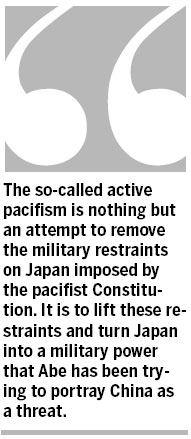
Third, Abe wants to use "active pacifism" to change the path of peaceful development that Japan took after World War II. The so-called active pacifism is nothing but an attempt to remove the military restraints on Japan imposed by the pacifist Constitution. It is to lift these restraints and turn Japan into a military power that Abe has been trying to portray China as a threat.
Because of these developments, China, the ROK and other countries that once suffered the brutalities of Japanese invasion have to establish regular communication and jointly safeguard the judgment of the international community and maintain peace and stability in the region.
But East Asian countries' efforts to promote peace and stability are not expected to be reciprocated by Abe-led Japan, because in Abe's view, history has nothing to do with right and wrong or good and evil and even aggression is yet to be definitively defined by the academia or the international community.
By deliberately confusing right and wrong, Abe and his supporters aim to make a mess of history to glorify Japan's militarist past and then modify the pacifist Constitution. Their ultimate aim is to transform Japan into a military superpower. What Abe has been trying to do is not only harmful to East Asian countries, but in the final analysis it will endanger the entire international community.
Let's return to the cardinal issue of historical right and wrong, because only by squarely facing history can a country chart the right future for itself. Is there right and wrong in human history? Is there a unified standard of "aggression and resistance" in civilized society? The answer is "yes" for all countries and individuals, except for Abe and his supporters. Without right and wrong, values such as fairness, justice, human rights, freedom and democracy will lose their meanings.
If Abe and his government refuse to change their ways, they will indeed cause great harm to East Asia and the world beyond. But in the long run, Abe's evil designs will not interrupt the process of China's peaceful development nor can they stop the world's advance toward peace and prosperity.
A thousand sails skim past the shipwreck, a forest thrives beside the withered tree. History has proven many times that those who want to repeat historical tragedies eventually find their ruin in history.
The author is a researcher at the Institute of Japanese Studies, affiliated to the Chinese Academy of Social Sciences.
(China Daily 02/10/2014 page8)

 Chinese lose sleep as they aim to achieve goals
 Balancing an egg on end during vernal equinox
 Children receive treatment after eating rat poison
 Men can be good pole dancers
 Farmer builds own drones to spray crops
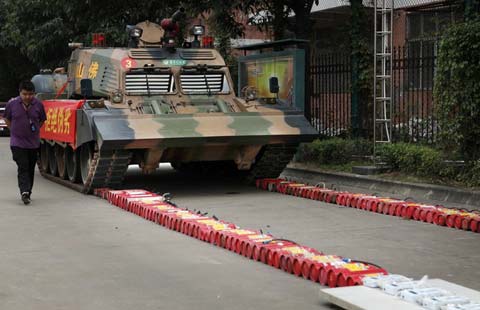 Tank flattens phony fire fighting gear
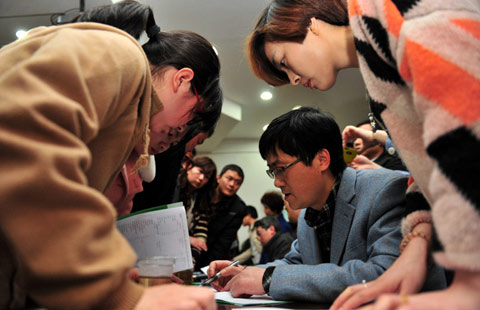 No common health ills for kids given drugs
 Sand storm hits Xinjiang
Copyright 1995 - . All rights reserved. The content (including but not limited to text, photo, multimedia information, etc) published in this site belongs to China Daily Information Co (CDIC). Without written authorization from CDIC, such content shall not be republished or used in any form. Note: Browsers with 1024*768 or higher resolution are suggested for this site.
License for publishing multimedia online 0108263 Registration Number: 20100000002731