Comments
  Print
Print  Mail
Mail  Large Medium Small
 |
|
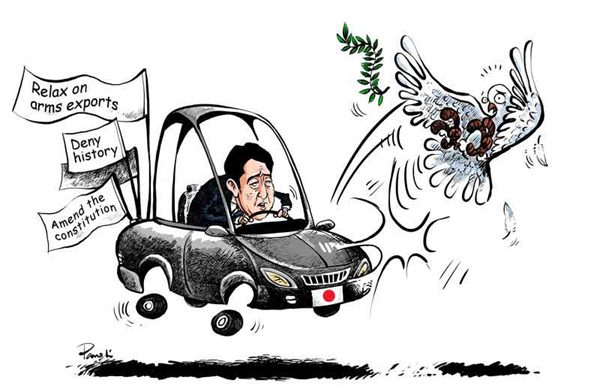
Abe's Pandora's box |
China as victim of Japanese aggression has every reason to show concern that Japan is renewing arms exports
The Japanese cabinet on April 1 approved eased principles and guidelines on the transfer of defense equipment to replace the country's original Three Principles on Arms Exports. The Japanese government's "success" in renewing arms exports after decades of an absolute ban on the trade of defense equipment and technologies marks a major change in the country's defense and security policy and suggests that the Shinzo Abe cabinet has made an important step toward turning the country into a military power.
In order to realize the goal of making Japan a "normal military power" and restoring its "missing" national security defense mechanism and function, Japanese conservatives over the years have seen the country's self-imposed ban on security policy formed after World War II as a stumbling block or an "inhibiting magic phrase" and are eager to lift the restraints.
Among these restrictions, in addition to the "pacifist Constitution", prohibition on the exercise of the "right to collective self-defense", civilian control of the forces and the "purely defensive" defense policy, and the Three Principles on Arms Exports adopted in 1967 have been seen as an important symbol of the country's pacifist stance.
Japan's efforts to ease and lift its arms export ban is not a recent development. Since the original three principles turned into a virtual ban in 1976, Japan has clinched 21 business deals involving the production of fighter planes, missile defense cooperation programs and vessel exports through temporary measures. Japanese political groups eager to lift the ban argue that it will be of great importance to the country's national defense industry, the strength of the US-Japan alliance and relations with friendly countries, and for it to counterbalance China, if the country engage in arms exports and carry out joint development of defense equipment and technology with other countries like a normal state.
In order to reduce questioning and criticism of the new arms export policy both at home and abroad, the Abe cabinet has been handling the matter with painstaking care and has adopted an ostrich-like approach. The new three principles first prohibit Japan from exporting arms to countries involved in conflict and to those that violate UN resolutions and state that with strict screening and data disclosure, arms exports will be allowed only if they serve the purpose of contributing to international cooperation and Japan's security interests.
However, these statements can hardly dispel people's questions and concerns. The countries that are prohibited from importing arms from Japan are small in number. That is to say in the name of contributing to international cooperation and its security interests, Japan can theoretically sell weapons to the vast majority of countries in the world.
Earlier, Abe began pushing for what he calls "active pacifism" in a bid to further get involved in international security affairs and enhance Japan's international status and influence, renewing arms exports can serve as stepping stone in pushing forward this strategy. Japan has also sought to modify the outline of its Official Development Assistance and hook the ODA directly to defense equipment exports. All these actions have added great uncertainty to the international security situation, and the world should be on the alert.
China, as a close neighbor of Japan and a victim of Japan's past aggression, has every reason to be concerned about Japan renewing its arms exports, especially as they might abet regional disputes. The new principles will enable Japan to sell defense equipment with the purpose of improving the defense capabilities of Southeast Asian countries, which is indicated in the Japanese National Security Strategy.
Seeing that some Southeast Asian counties have maritime territorial disputes with China, Japan intends to make the most of these contradictions and narrow the gap between these countries and their powerful neighbor in military strength through arms exports in a bid to counterbalance China. Japan's move is undoubtedly further strangling China-Japan relations.
Moreover, the new principles and guidelines on arms exports will have a great influence on the formation of international joint development and the production of defense equipment. Japan is already in the lead in researching and developing many conventional weapons, and if it can work together with the United States and European countries that own advanced science and technology and powerful military industries, it will put more pressure on neighboring countries' security assurance and defense equipment level. Meanwhile, Japan is still using every means to hinder European and other countries' arms exports to China and their and defense cooperation with it.
At present, Japan's relations with its close neighbors, including China, Russia, the Republic of Korea and the Democratic People's Republic of Korea, all have rifts to a greater or lesser extent. In this situation, Japan's move to ease arms exports will inevitably disrupt the regional military balance and security order, directly forcing neighboring countries to increase their defense investment, resulting in an arms race and security dilemma in the region.
At the end of 2011, the Yoshihiko Noda cabinet approved a plan to ease the Three Principles on Arms Exports that excluded Japan's allies and friendly countries from the ban contained in the three principles. Since then, Japan has gradually begun to engage in joint development of defense equipment with Vietnam, the Philippines, Britain, France, Australia, India, Turkey and other countries. People have reason to wonder about the future of Japan's arms exports. Japan has been speeding up the "normalization of national defense" in pursuit of military power. With the eased principles and guidelines for weapons exports, it will go further off track on the road of exports and the joint development of arms.
Shinzo Abe is using arms exports as important means to revive Japan as a powerful country. By lifting the ban on arms exports, promoting a qualitative change in Japan's security policy and basic national policy and pushing Japan forward as a "normal military power", the conservative political groups led by Abe are trying to reverse the trend of the times. However, they will finally be hoisted by their own petard. We hope that what Abe has done and would do will not strike up a prelude to the collapse of Japan's "peace building" established for decades after WWII.
The author is a researcher and director of the Political Research Center of the Institute of Japanese Studies, the Chinese Academy of Social Sciences.
 Cleaver-wielding man subdued after tense standoff
 China's top research vessel on maiden expedition
 Racing against time for rescue in Yunnan mine flood
 Travel congestion for last day of Qingming Festival
 Photo special: Weird buildings in China
 Nobody hurt in Lijiang fire
 Spring blossoms
 Confucian coming of age ceremony in Xi'an

Copyright 1995 - . All rights reserved. The content (including but not limited to text, photo, multimedia information, etc) published in this site belongs to China Daily Information Co (CDIC). Without written authorization from CDIC, such content shall not be republished or used in any form. Note: Browsers with 1024*768 or higher resolution are suggested for this site.
License for publishing multimedia online 0108263 Registration Number: 20100000002731