Japanese Prime Minister Shinzo Abe's Yasukuni shrine visit on Dec 26, 2013 has made China-Japan relations drop to the freezing point. Shinzo Abe, speaking at the Davos forum in Switzerland on Jan 22, 2014, compared today's China-Japanese relations to those between Britain and Germany before WWI. Chinese Foreign Minister Wang Yi responded that 2014 is not like 1914, or 1894 and Japan should learn from today's Germany, not Germany of the past. However, to realize "the Japanese dream of becoming a greater power", Tokyo further implements right-wing policies at "full speed" to achieve what Japan has defined as "overall normalization".
According to analysts, the two countries cannot afford a total breakdown in relations, and China must be prepared for further aggressive moves from Japan in the next few years.
|
Dropping 'no-war' pledge,Jan 19- Japan revises teaching manuals which describe the disputed territories as " Japan's integral parts,"Jan28- |
Japan under Abe is undergoing a profound transition to the right. Abe's personal attempts to rewrite history and rebuild Japanese military potential are the mere tip of a dangerous nostalgia for the country's imperialist past. A Japan with a morbid view of history is anything but a normal country to be trusted or respected. |
||
|
Japan tried to re-examine the landmark 1993 appology (Kono statement) on comfort women,Feb, Mar- |
Abe loses credibility with China |
||
"The Yasukuni Shrine is a negative asset for Japan. If its leader is bent on holding this negative asset, it will become increasingly heavy" -Qin Gang, Spokeman of Chinese Foreign Ministry Abe's aim is very clear; his groundless criticism of China was meant to hype the "China threat" cliche to the Japanese people and the rest of the world. He wants to hide the fact that the simmering tension in East Asia was ignited by the Japanese government's "nationalizing" of China's Diaoyu Islands since 2012, and frequent visits to the controversial Yasukuni Shrine, and he wants to woo more support from the United States in the hope of containing China. |
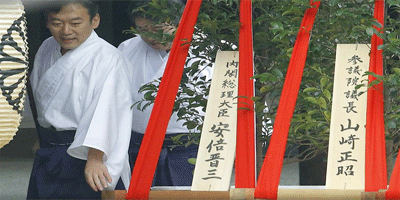
-April 12, China protested against a Japanese Cabinet minister's shirne visit -April 15, Vice-Premier Wang Yang met visiting former Japanese lower house speaker Yohei Kono -April 16, Chongqing bombings survivors sue Japanese govt -April 18, China refuted Abe's words on 'status quo' . Abe said " China is challenging the status quo with force in the East China Sea and South China Sea" -April 19, Beijing asked Tokyo to explain new radar base 150km from Diaoyu Islands -April 20, Japanese minister visited the Yasukuni shrine -April 21, Abe sent offering to Yasukuni Shrine -April 22, 23, No meeting between PLA navy commander and Japanese naval officials -April 22, Japanese lawmakers visited Yasukuni Shrine -April 29, Japanese minister visited the Yasukuni shrine |
||
|
Chinese ships started patroling Diaoyu Islands after Obama backed Japan in territorial disputes,May 2- China, Japan held first ministerial talks since 2012,May 17- Japanese military planes intruded on the airspace of China-Russia naval exercises, China takes preventive measures,May 25- Chinese Vice President Li Yuanchao met with a delegation from the Japan Business Federation,May 28- |
Depicting China as the "big bully" in the East and South China Sea to justify Abe's push to revise Japan's pacifist constitution seems to be a clever calculation as it has huge economic implications due to a potential surging demand for military personnel and equipment. Contrary to what Washington thinks, only a stable and friendly relationship among the US, Japan and China can serve the interests of all the three countries and establish lasting peace and prosperity in Asia. |
||
|
Japanese F-15 stalking Chinese planes. Japanese Chief Cabinet Secretary Yoshihide Suga and Defense Minister Itsunori Onodera on Friday demanded the Chinese side take the videos off the website. Chinese Foreign Ministry spokeswoman Hua Chunying rebuked the request, calling it "shameless" and "unreasonable". |
-June 12, Japan's F-15 tailed Chinese jet, China lodged two official protests -June 20, Japanese government questioned the credibility of the Kono Statement |
||
|
China released archives of Japan's atrocities in WWII,July- Investment from Japan sank as tensions persist,July- Japanese Foreign Ministry released declassified diplomatic archives regarding the Diaoyu Islands, challenges China's sovereignty, July 24- |
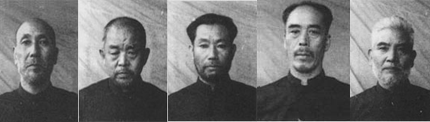
Confessions of Japanese war criminals Japan's claim over China's Diaoyu Islands is yet another attempt to break the international order established after World War II, and it is proof of the Japanese right wing's ambitions to rebuild the country as a military power.
|
||
|
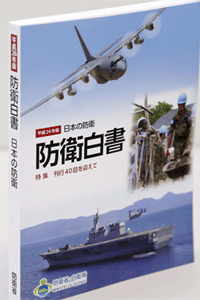
China's Ministry of National Defense said the white paper is "deliberately hyping the threat from China, seeking excuses for its military and security policy maneuvers as well as its armaments expansion". "When it comes to foreign policy, we've seen a lot of gamesmanship from Abe and it's perfectly understandable why countries like China are becoming increasingly suspicious of Abe and his motives" - political commentator and author Philip McNeil |
-Aug 1, Japan named five isles belonging to the Diaoyu Islands, China calls it invalid -Aug 5, Japan approved defense white paper for 2014 -Aug 6, Japanese military planes entered China's ADIZ -Aug 9, Chinese, Japanese FMs held informal contact -Aug 15, Japanese ministers visited Yasukuni Shrine -Late Aug, China published documents on anti-Japanese war |
||
|
Abe visited Bangladesh and Sri Lanka, pushed diplomacy to contain China,Sept- Beijing-Tokyo forum,Sept 28, 29- |
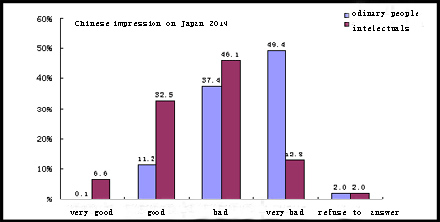
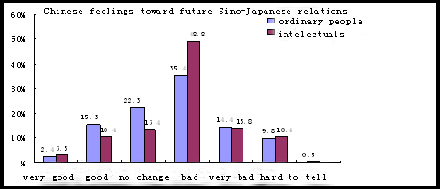 The relationship between China and Japan is at a crossroads, and Japan's attitude and approach to dealing with the history of its militarist aggression can sway where the ties will head. |
||
|
The trip to Yasukuni Shrine will "backfire" as it came while the Japanese Cabinet is trying to kick-start Sino-Japanese relations with a planned meeting of the two countries' leaders at the upcoming APEC Economic Leaders' Meeting. |
-Oct 17, Japanese lawmakers visited shrine -No meeting between Premier Li and Abe at ASEM |
||
|
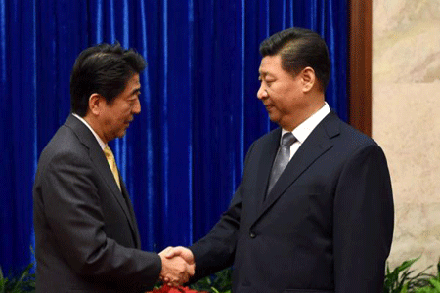
China and Japan reached four-point principled agreement,Nov 7- Japan PM hailed meeting with Chinese President,Nov 11- |
The icy relations between China and Japan now appear to have finally entered the thawing season. No matter what brought the Japanese prime minister to his China policy epiphany, be it his political ambition, economic aspiration or diplomatic calculation, Abe will find a ready partner in China for healing bilateral relations as long as he is sincere and serious. |
||
|
Premier Li said that China-Japan relations must be based on the fourpoint principled consensus. |
-Dec 4, Chinese Premier Li Keqiang met delegates of the 21st Century Committee for China-Japan Friendship -Dec 10, Massacre survivors, relatives urge Japan to reflect in letter to UN |
Copyright 1995 - . All rights reserved. The content (including but not limited to text, photo, multimedia information, etc) published in this site belongs to China Daily Information Co (CDIC). Without written authorization from CDIC, such content shall not be republished or used in any form. Note: Browsers with 1024*768 or higher resolution are suggested for this site.
License for publishing multimedia online 0108263 Registration Number: 130349 


 Sino-Japanese ties at a '40-year low'