Japan needs to 'walk the talk' to improve relationship with China


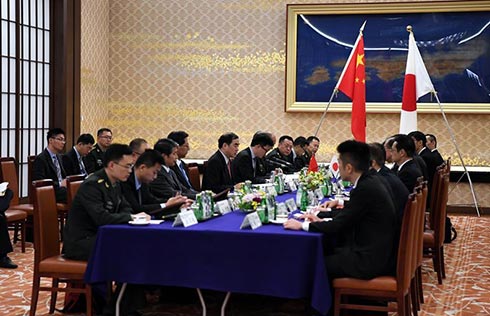
During the sixth meeting of the China-Japan ruling party exchange mechanism held here earlier this week, Japanese leaders once again expressed the wish for a better relationship.
China's basic position of being committed to improving bilateral ties with Japan, its close neighbor, has never changed.
Despite bumps and difficulties in bilateral ties in recent years due to the fault of Japan, China has kept the communication channel open with Japan at all levels.
One landmark event this year was the meeting between Chinese President Xi Jinping and Japanese Prime Minister Shinzo Abe during the Group of 20 Summit in Hamburg, Germany, last month.
Since normalizing ies in 1972, China and Japan have signed four important political documents as well as a four-point principled agreement. These are the political foundation for the bilateral ties and a keystone for bilateral cooperation.
Safeguarding the political foundation is the precondition of developing a healthy relationship between China and Japan.
The current China-Japan ties are still disturbed by various complicated factors. The root cause lies in Japan's unwillingness to truly accept China's development and to treat China as a cooperative partner.
What the Abe administration has said and done in recent years showed Japan's lack of sincerity in improving ties with China.
Moreover, the Abe administration has refused to truly reflect on Japan's invasion of its neighbors before and during World War II, and repeatedly hurt the Chinese people's feelings by visiting the notorious Yasukuni Shrine, meddling in the South China Sea, and continuing with its wrong words and deeds on the Diaoyu Islands and "Comfort Women" issue.
Such "double-facedness" of the Japanese side has made the Chinese people feel confused and regretful.
Japan shall match its words with deeds on historical issues. It shall observe the political documents between China and Japan and honor the promises made by its previous governments including the 1995 statement by then Prime Minister Tomiichi Murayama.
It shall face up to and fully reflect upon history, instead of denying history and repeatedly hurting the feelings of people of the countries that fell victim to Japan's invasions before and during World War II.
Japan shall also match words with deeds in regional security issues. It shall adopt prudent security policies, and focus more on doing things that are conducive to regional peace and stability.
It shall respect China's normal and justified defense buildup and training activities, fully abide by the one-China policy, stop meddling in the South China Sea as an outside country and dump relentless and senseless attempts to wheedle other countries into containing China by hyping up the so-called "China threat."
Japan shall match words with deeds in enhancing mutual trust with China. It shall work with China to properly deal with sensitive issues, respect each other's justified interests and concerns, get rid of its confrontational mentality, and promote practical cooperation in all areas based on equality and mutual benefits.
With the development of global economic integration, the deterioration of ties between China and Japan, the world's second and third largest economies, would take a toll on global economic and trade exchanges.
There is a common call in the business and industrial circles for the two countries to work together to tackle the slack recovery of the world economy and other challenges.
China and Japan are highly complementary in economy while economic and trade cooperation will bring solid benefits to both sides, which can in turn boost bilateral relations.
China's Belt and Road Initiative eyes win-win cooperation between countries along the route. Japanese economic community has pinned high hopes on the initiative for boosting regional prosperity and sharing fruits of development, and has asked the Japanese government to adopt a positive attitude towards it.
"The Belt and Road Initiative exhibits the grand view of the world on the part of Chinese President Xi Jinping, and based on that initiative, there will be various kinds of construction plans. This is something that should win approval from every side," said Yoshinobu Nisaka, governor of Japan's Wakayama prefecture.
This year marks their 45th anniversary of diplomatic ties, and the next year marks the 40th anniversary of the signing of the China-Japan Treaty of Peace and Friendship.
In the new historical period, China and Japan shall assess the situation, bear in mind the overall situation and long-term needs and stick to and take concrete actions to enhance the direction of peace, friendship and cooperation.