


Rail road to growth
By Fu Jing ( China Daily Europe ) Updated: 2014-02-28 08:44:15
|
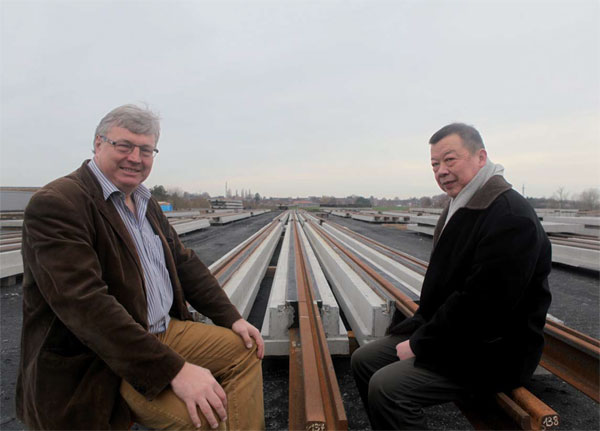
Joseph Rode (left) and Xia Gangyi expect to sell their rail systems to China. Fu Jing / China Daily |
Belgian company scents huge market opportunities in China's railway market
Though China has created an impressive railway network, it can still do a lot to reduce noise levels, the rattling of carriages, the corrugation of the tracks and increase electric isolation, says Joseph Rode, a railway construction expert from Belgium.
Rode, the director of the Belgium-based PREFArails, a company that sells embedded rail systems that fix and support the rail in all directions, says his observations are based on the personal experiences during a fast train ride from Beijing to Hangzhou last year.
"I did not use any devices, but went from carriage to carriage and studied the various parameters and my findings are based on my years of experience in the industry," he says.
Sitting in his modest factory at Soignies, a town less than an hour's drive from Brussels, Rode says that if his company were the main solution provider in China, they would take steps immediately to improve shock absorption, noise and vibration reduction.
"China is a huge railway market where nearly 5,000 kilometers of fresh lines are laid every year. It is important that the country achieves the desired global parameters," he says.
PREFArails has already received expressions of interest for its products from Chinese cities such as Beijing, Shenyang and cities in Zhejiang province, he says.
"We are hopeful that we will clinch a formal agreement soon."
Rode says that PREFArails has an excellent track record in Europe and North Africa, and cites examples of railway lines set up in Belgium, France, Greece, Spain, Tunisia, Morocco, Norway, Germany, Portugal and Italy.
According to Rode, the company's embedded rail system helps isolate noise and vibration, depending on the jacket type, and provides electrical isolation from the surrounding environment. More importantly the company's rail jackets are made from used tires, which results in considerable cost reduction, he says.
The company has recently come out with a new product called "3-S" modules, which do not have any screws, and the "Sand-Snow-Storm" modules, which are encased rails welded together as a whole with holes on both sides of the rail offering protection from sand and snow. These technologies are unique and sure to be a hit with Chinese railway planners, Rode says.
"The biggest advantage of using recycled and used tires for jackets is that they help in shock absorption, noise and vibration reduction, and electro erosion reduction of the foot of the rail. They also increase the life of the tracks by over 40 percent, or in other words from 25 years to 35 years."
In the factory at Soignies, the 80-odd workers were busy manufacturing various modules for railway projects in Europe, with some modules even being subject to extreme weather conditions to gauge wear and tear. Though he does not disclose any profit figures, Rode says that his company has managed to remain in the black.
Despite most of the business coming from Europe, Rode says it is not a promising market as payments are often far behind schedule. "It puts enormous pressure on our cash flow situation," he says, adding that the company is instead banking on railway projects in Africa and China to ensure sustained growth.
Citing numbers, he says that his company used to earn revenue of 30 million euros in 2006, while the same has fallen to 10-15 million euros by last year.
"It is difficult to estimate the annual growth rate, as there are payment issues everywhere. We have to focus on markets outside Europe for growth, especially in destinations like Africa, the Middle East and China."
China's light rail market is still in infancy and most of its 660 cities do not have light rail systems. Rode says that China is planning to expand network in western regions, where sandstorms and snow are common. Statistics indicate that more than 70 percent of global railway projects will be in the sand and snow regions of China.
Rode says his Chinese representative Xia Gangyi, who moved from Zhejiang province to Belgium some 30 years ago, has played a key role in the company's market exploration in China and in the resultant expressions of interest.
Talking about the prospects in China, Rode says that though the railway market is relatively developed there are still several opportunities for foreign companies. "Take the case of Beijing itself. There will be demand for more railway networks due to the pollution and traffic jams, apart from renewed efforts to protect the environment," he says.
"We have already been sounded out for participating in parts of the No.17 urban light rail project in Beijing," Xia says. City officials will soon send a team to Belgium to undertake feasibility studies before awarding the contract, he says.
"We hope to build a demonstration project in which half of the metro line would be on the ground, while the remaining will be underground. Such a model will help showcase our full design capabilities," Xia says. He adds that the company has also received expressions of interest from Chinese companies for sandstorm and snow-proof technologies in railway building.
"Though we are a latecomer, we are moving very fast," Xia says, adding that the company has already set up a jacket production factory in Hangzhou, Zhejiang province. "The unit will start production in two or three months and will be backed up with a marketing company in Beijing. We will also seek patent protection in China for our core technologies."
According to Rode, fast turnaround time is a key attribute the company hopes will open more doors in China, especially when it comes to old city renovation projects in Chinese cities with lots of traffic and large populations.
"Take Morocco for example. We did a railway project with 130 crossings in 2012, and handed over the same two days in advance. We normally finish a crossing over the weekend, but on average, Chinese companies need at least 10 days for the same. Our light rail costs are around one million euros a kilometer (without groundwork), while in China it is around 10 million euros, inclusive of land compensation and other costs."
Explaining the problems in the European market, Rode says that apart from financial constraints, the railway construction market in Europe is mostly confined to companies from respective European Union member states, even though the EU has advocated a single market for several years.
Rode says it is difficult for a Belgian rail company to win bids in major markets such as Germany or France, while there are payment problems in other European markets. "Even in my own country, Belgium, we have not been fully paid for some railway projects."
According to Rode, France and Germany are the most difficult rail markets in Europe due to hidden market barriers. "Believe or not, it's there. You will know once you run into the wall," Rode says. Countries like Tunisia, Turkey and Morocco are relatively open, while African countries, the United Arab Emirates and Saudi Arabia are the most receptive to new products and technologies.
"The reason that we encounter problems in Europe is that many of them still remain very conservative and are hesitant to accept new concepts. Therefore we have to no choice but to explore markets in China and Africa with new products, new design and new concepts," he says.
Though he is aware of the huge business potential in China, Rode remains modest about market prospects. "The need in China is so big and, even if we get a small part of the pie, it would mean a lot for us."
fujing@chinadaily.com.cn


|
|


|
|

|
|
|
|










European Weekly
 We will not give up search, Li vows
International hunt for missing airliner continues after fruitless six-day search

