


Europe map dotted with Huawei R&D
By Fu Jing ( China Daily Europe ) Updated: 2014-07-25 06:12:52
|
Huawei's new smartphone, the Ascend P7, billed as the world's slimmest phone at 6.5 mm thick, during a presentation in Paris in May. Huawei is paying close attention to research and development. Philippe Wojazer / Reuters |

With 7,700 workers and 14 sites in 8 countries, tech giant has powerful presence on continent
While Chinese networking and telecommunication technology giant Huawei has become the world's biggest equipment provider in the field - overtaking Ericsson in sales revenue last year - its research and development spending still trails many of its major US and international challengers, says its founder and CEO, Ren Zhengfei.
But while Huawei keeps its research efforts tightly focused on the small side given its size, it has established a significant R&D presence in Europe, where it is adding staff members and joining in alliances to develop what it sees as the most promising future products.
Since entering the European market in 2000, Huawei has worked hard at integrating itself into the local technological ecosystem and now counts some of Europe's top-20 carriers as its partners.
Huawei sees the current "tip of the needle" for future communications technology as 5G mobile communications, which will not be commercialized until around 2020.
"That's our focus at the moment, especially with our European partners," says Tong Wen, who is Huawei's executive in charge of mobile communication research, "but Huawei certainly aims to take the lead in 5G research".
Tong, who used to work as research head at Canada's Nortel and is a leading expert in global standards for 3G and 4G mobile technology, says Huawei is ready to increase its research and innovation capacity in 5G "by up to three-fold in Europe in the coming five years".
Currently leading Huawei's mobile research unit in Canada, which has more than 200 researchers, Tong says he has been tasked by headquarters to streamline its research capacities in 5G globally, "and Europe is our focus," he adds.
Huawei has about 300 researchers in total employed on 5G communications globally, about a third of them based in Europe. In the next five years, the total number of researchers in Europe will grow from current 800 to 1,700, he adds.
Huawei currently has a total of more than 7,700 staff members based in Europe.
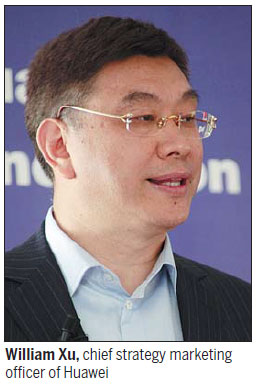
Chief Strategy Marketing Officer William Xu says it expects to add another 5,500 staff to its 7,700 European workforce over the next five years.
The company runs 14 research and development sites in eight European countries and operates 18 joint innovation centers in the continent.
Tong says Huawei's European research center in Munich, Germany, is at the forefront of its 5G research and is focused on developing the key technology components of 5G wireless interface.
Huawei released its vision for 5G development and deployment in a white paper in January, in which it defined key objectives including growing capacity and connectivity, support for an increasingly diverse set of services, and efficient spectrum use.
The document also stressed that 5G primarily depends on successful global LTE (or 4G) deployment, to which Huawei has already made a major contribution by helping to install the first commercial European 4G networks in Sweden and Norway.
The company's wireless networks currently support more than 500 mobile operators and 2 billion mobile subscribers on 3G and LTE networks worldwide.
"Huawei supports global collaboration among ecosystem partners, international trade associations, universities, governments and private sector companies to drive 4G and 5G technologies," says Tong.
The key breakthrough for 5G mobile communication technology will come with increasing traffic, which may be 1,000 times that of today, allowing billions of devices to be connected to networks, company officials say.
The design of the devices themselves will also be crucial; they will have to be lightweight and low-energy consuming, which is also a challenge for manufacturers.
So far Huawei has set up 28 joint research centers globally with partners.
"These are engaged in localized technology and Europeans will benefit," says Tong.
Huawei started investing in 5G in 2009, and in November it announced plans to invest an additional $600 million into 5G technology by 2018.
"But the eventual investment is expected to be far more than this," adds Tong.
He says Huawei is not only a pioneer of technology but a bridge builder that can turn investment into progress for Europe due to its open and collaborative approach, which involves various industry partners, consortiums, universities and leading innovation platforms around the world.
He recognizes that Europe has a long tradition in forming public-private partnerships in innovation research and says Huawei is honored to have a chance to invest, as part of the European Union's overall Horizon 2020 framework, considered the biggest EU research and innovation program ever with nearly 80 billion euros ($107.7 billion) of funding available over the next six years.

|
|


|
|

|
|


|
|







European Weekly
 We will not give up search, Li vows
International hunt for missing airliner continues after fruitless six-day search

