Latest News
Quake-hit Japan nuclear plant faces fresh threat
(Agencies)
Updated: 2011-03-13 13:16
 |
Large Medium Small |
|
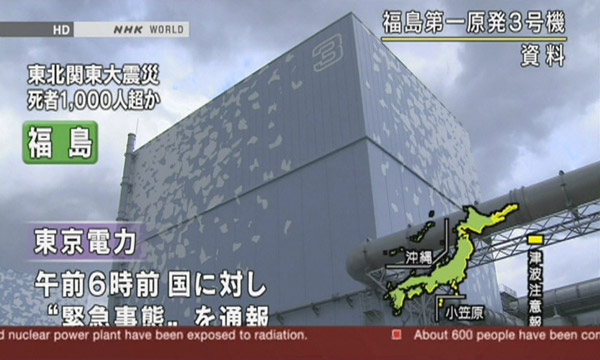 The exterior of reactor No. 3 at Fukushima Daiichi nuclear plant is seen in this still image taken from undated file video footage. Japan battled to contain a radiation leak at an earthquake-crippled nuclear plant on March 13, 2011, but faced a fresh threat with the failure of the cooling system in a second reactor. [Photo/Agencies]? |
SENDAI – Japan faced a fresh radiation threat at an earthquake-crippled nuclear plant on Sunday after the cooling system failed at a second reactor in what could be the world's worst nuclear disaster in 25 years.
The previous day, thousands were evacuated following an explosion and leak from the facility's No. 1 reactor in Fukushima, 240 km (150 miles) north of Tokyo.


Nuclear plant operator Tokyo Electric Power (TEPCO) said radiation levels around the Fukushima Daiichi plant had risen above the safety limit but it did not mean an "immediate threat" to human health.
It said earlier it was preparing to vent steam to relieve pressure in the No.3 reactor at the plant and the government had warned of a rise in radiation during the procedure.
Thousands spent another freezing night huddled over heaters in emergency shelters along the northeastern coast, a scene of devastation after the 8.9 magnitude quake sent a 10-meter (33-foot) wave surging through towns and cities in the Miyagi region, including its main coastal city of Sendai.
"It's hard to even imagine the scale of it," a resident said. "I came to Miyagi during the last earthquake as well to help, but once there is water involved, it becomes a whole different story. It's hard to think about."
Kyodo news agency, which said the number of dead or unaccounted was expected to exceed 1,800, reported that there had been no contact with around 10,000 people in one town, more than half its population.
The government had insisted radiation levels were low following Saturday's explosion, saying the blast had not affected the reactor core container. The International Atomic Energy Agency (IAEA) said Japan had told it that levels "have been observed to lessen in recent hours".
But Japan's nuclear safety agency said the number of people exposed to radiation could reach 160. Workers in protective clothing were scanning people arriving at evacuation centers for radioactive exposure.
"They are working on relieving pressure and pumping in water into the No. 3 reactor," Chief Cabinet Secretary Yukio Edano told a news briefing.
"This will result in some radiation leakage, although at a level that won't affect peoples' health. It will help stabilize the situation." He also said radiation from the No. 1 reactor was "low enough not to affect people's health".
Officials ordered the evacuation of a 20-km (12-mile) radius zone around the plant and 10 km (6 miles) around another nuclear facility close by.
Around 140,000 people had left the area, the IAEA said, while authorities prepared to distribute iodine to protect people from radioactive exposure.
"There is radiation leaking out, and since the possibility (of being exposed) is high, it's quite scary," said Masanori Ono, 17, standing in line on Saturday to be scanned for radiation at an evacuation center in Fukushima prefecture.
TEPCO has been pumping seawater into the No.1 reactor to cool it down.
"The use of seawater means they have run out of options. If they had any other water they would have used it. It likely means the power for their pumps is gone. They must be pumping the seawater in," said David Lochbaum, director of the Union of Concerned Scientists Nuclear Safety Project.
| 分享按鈕 |