Nuclear Meltdown
Japan fights to avert nuclear meltdown
By Taiga Uranaka and Ki Joon Kwon (China Daily)
Updated: 2011-03-14 07:25
 |
Large Medium Small |
|
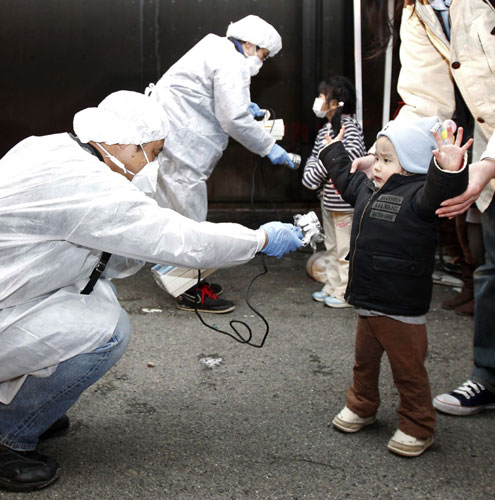 Medical officials check for signs of radiation on children from the evacuation area near the Fukushima Daiichi nuclear plant in Koriyama, Japan, on Sunday. Kim Kyung-hoon/Reuters |
FUKUSHIMA, Japan - Japan fought on Sunday to avert a meltdown at two earthquake-crippled nuclear reactors, describing the massive quake and tsunami, which may have killed more than 10,000 people, as the nation's biggest crisis since World War II.


The Japanese Meteorological Agency upgraded the magnitude of Friday's massive earthquake from 8.8 to 9.0 on Sunday, the strongest ever recorded in Japan.
"The earthquake, tsunami and the nuclear incident have been the biggest crisis Japan has encountered in the 65 years since the end of World War II," a grim-faced Prime Minister Naoto Kan told a news conference.
"We're under scrutiny on whether we, the Japanese people, can overcome this crisis."
He said the nation's future will be decided by the choices made by each Japanese person and urged all to join in their determination to rebuild the nation.
As he spoke, officials worked desperately to stop fuel rods in the damaged reactors from overheating, which could in turn melt the container that houses the core, or even explode, releasing radioactive material into the wind.
A complete meltdown - the collapse of a power plant's ability to keep temperatures under control - could release uranium and dangerous contaminants into the environment and pose major, widespread health risks.
Chief Cabinet Secretary Yukio Edano said on Sunday that a hydrogen explosion could occur at No 3 reactor of the Fukushima Daiichi nuclear complex, the latest reactor to face a possible meltdown.
That follows a blast the day before in the power plant's No 1 reactor, and operators attempted to prevent a meltdown there by injecting seawater into it.
"At the risk of raising further public concern, we cannot rule out the possibility of an explosion," Edano said.
He said there might have been a partial meltdown of the fuel rods at the No 1 reactor. Engineers were pumping in seawater, trying to prevent the same happening at the No 3 reactor.
"The use of seawater means they have run out of options," said David Lochbaum, director of the Union of Concerned Scientists Nuclear Safety Project.
The operator of the nuclear reactors said on Sunday the top of fuel rods at the reactors had been three meters above water, an indication of a possible meltdown.
Tokyo Electric Power warned that the No 3 reactor was overheating and that so much of the cooling water had briefly evaporated that mixed oxide fuel rods were exposed to the air, Kyodo news agency said.
"Radiation has been released in the air, but there are no reports that a large amount was released," Jiji news agency reported.
Up to 160 people might have been exposed to radiation, said Ryo Miyake, a spokesman from Japan's nuclear agency. The severity of their exposure, or if it had reached dangerous levels, was not clear.
|
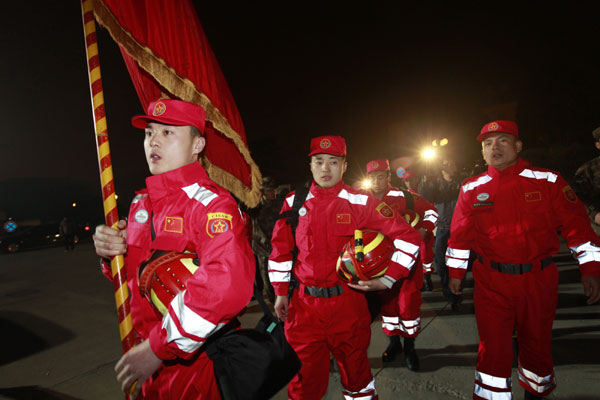 A Chinese rescue team, comprised of 15 members, prepares to leave for Japan at Beijing Capital International Airport on Sunday morning. It is the first time the Japanese government has accepted assistance from China for disaster relief. Ren Zhenglai/Xinhua |
Broadcaster NHK, quoting a police official, said more than 10,000 people may have been killed.
Almost 2 million households were without power in the freezing north, the government said. There were about 1.4 million without running water.
Kyodo said about 300,000 people were evacuated nationwide, many seeking refuge in shelters, wrapped in blankets, some clutching each other, sobbing.
Tokyo Electric Power says it will ration electricity with rolling blackouts in parts of Tokyo and other Japanese cities.
Deng Wei, Chinese embassy spokesman in Tokyo, said on Sunday that there are, so far, no reports of Chinese casualties but Kyodo reported that 40 Chinese trainees sent by a service company in Shandong province have lost contact after the earthquake. Embassy staff members are working hard to track all Chinese citizens in Japan, Deng said.
Authorities in Japan have set up a 20-km exclusion zone around the Fukushima Daiichi plant and a 10-km zone around another plant nearby. About 170,000 people have been moved out, while authorities prepared to distribute iodine to protect people from radioactive exposure.
The nuclear accident, the worst since the Chernobyl disaster in 1986, sparked stinging criticism that authorities were ill-prepared for such a massive quake and the threat that could pose to the country's nuclear power industry.
Kan said on Sunday the crisis was not the same as Chernobyl.
"Radiation has been released in the air, but there are no reports that a large amount was released," Jiji news agency quoted him as saying. "We are working to prevent damage from spreading."
Japanese officials said they had also ordered up the largest mobilization of their Self-Defense Forces since World War II to assist in the relief effort.
The Chinese International Search and Rescue Team arrived in Japan on Sunday - the first time the government has accepted assistance from China for disaster relief.
The 15 team members took with them four tons of materials and equipment for search and rescue, power supply and telecommunication. They began their work in Iwate prefecture. More than 30,000 Chinese nationals are estimated to live in Iwate and the other two most seriously damaged prefectures, Miyagi and Fukujima.
|
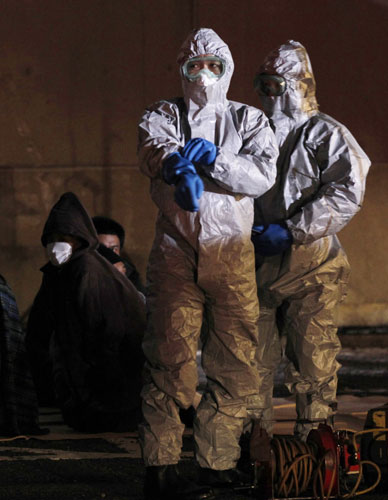 Authorities in protective gear stand next to people from the evacuation area near the Fukushima Ⅱ nuclear plant in Koriyama on Sunday. The Japanese government was preparing to distribute lodine to protect people from radioactive exposure. Kim Kyung-hoon/Reuters |
Renewed public concern
Meanwhile, nuclear safety worries are rising. Authorities in both Russia and China, Japan's two biggest neighbors, have been closely monitoring radiation levels along their shores.
China intensified its monitoring in Beijing and the 11 coastal provinces after Saturday's explosion. The data showed that by Sunday evening, China had not been affected, according to the Ministry of Environmental Protection.
Experts at State Nuclear Power Technology Corp Ltd agreed unanimously Sunday morning that, if information from Japan were accurate, the crisis would have "far less catastrophic effect" even at its worst than the explosion and fire at Chernobyl though it could be more disastrous than the partial core meltdown at Three Mile Island in 1979.
The incident will have "minimal effect" on China, the experts wrote in an internal assessment that was submitted to the National Nuclear Safety Administration, said an insider who requested anonymity because no official announcement had been made.
Moving ahead?
In recent years, the United States and other countries have announced plans to increase investment in nuclear power with the aim of reducing dependence on fossil fuels. But German Chancellor Angela Merkel on Sunday announced a safety inspection of the country's 17 nuclear power plants and called for a special European Union-level summit after an emergency meeting with cabinet members.
The government decided last year to extend the lifespan of the plants, which had been running for an average 12 years beyond their original shutdown dates.
Italy is the only G8 industrialized nation that does not produce nuclear power, but its prime minister, Silvio Berlusconi, wants to generate a quarter of the country's electricity from nuclear in the future. That plan will proceed, Fabrizio Cicchitto, a leader of Berlusconi's PDL party, said over the weekend.
In the UK, the London-based Guardian newspaper reported, many in government and the private energy sector worry that nuclear disaster will affect plans to build 10 nuclear power stations to replace aging reactors.
China, the world's second largest energy consumer, also plans to boost nuclear power out of pressure to reduce its reliance on coal and to curb the growth of carbon emissions. Draft development plans for the next five years call for nuclear plants with a total installed capacity of 40 gigawatts by 2015, up from its current 10.8 gigawatts at 13 operating reactors.
"China will not change its determination and plan to develop nuclear power," Zhang Lijun, the vice-minister of environmental protection, said Saturday in Beijing.
Chen Zhanghua, an expert from China National Committee on Nuclear Safety, said Sunday on his micro blog: "The most direct consequence of the Japan incident . . . would be enhanced security standards for the nuclear power industry, to shore up defenses against even the most devastating natural disasters."
Pros and cons
Proponents of nuclear power say its public safety risks are no stronger than those for fossil fuels. Three Mile Island and Chernobyl were the only major accidents in 14,000 reactor-years of commercial operation in 32 countries over five decades, the World Nuclear Association said.
Nuclear engineers believed that with enough redundancy built into plant safety systems, risks such as natural disasters can be warded off. Proponents also say that nuclear power produces virtually no conventional air pollution, qualifying it as "clean energy".
Opponents worry about the complexity of design and engineering of nuclear plants. Any failure or operation error could lead to catastrophic consequences, they say. Radioactive substances, if dispersed, pose a direct radiation hazard, can contaminate soil and vegetation, and be ingested by humans and animals.
The management of spent fuel - its transportation and storage - also poses safety risks because it is still highly radioactive with devastating environmental potential.
Duan Yan, Li Jing, Qin Jize, Li Lianxing, Hu Yinan and agencies contributed to this story.
| 分享按鈕 |