Nuclear Meltdown
Fuel rods at nuclear reactor exposed
By Taiga Uranaka and Ki Joon Kwon (Agencies)
Updated: 2011-03-15 07:05
 |
Large Medium Small |
|
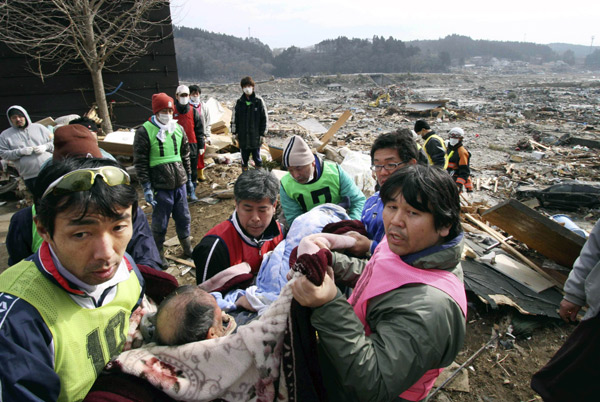 An eldly survivor is rescued by local residents on Monday in the devastated northern Japanese town of Minamisanriku, Miyagi prefecture. Yomiuri Shimbun/Agencies |
FUKUSHIMA, Japan - Fuel rods at a troubled nuclear reactor were once again fully exposed on Monday, hours after authorities were able to stabilize a similar emergency to prevent a meltdown.
| ||||


Water levels had dropped earlier at No 2 reactor at the Fukushima Daiichi nuclear complex, completely exposing the fuel rods and raising the threat of a meltdown. Engineers began pouring in sea water to re-cover the rods, but they were again fully exposed last night.
These events happened just days after a devastating earthquake and tsunami probably killed at least 10,000 people.
Roads and rail, power and ports have been crippled across much of Japan's northeast and estimates of the cost of the multiple disasters have leapt to as much as $170 billion.
Japanese stocks closed down more than 7.5 percent, wiping $287 billion off market capitalization in the biggest fall since the height of the global financial crisis in 2008.
Rescue workers combed the tsunami-battered region north of Tokyo for survivors and struggled to care for millions of people without power and water in what Prime Minister Naoto Kan has dubbed his country's worst crisis since World War II.
Officials say at least 10,000 people were probably killed in the 9.0-magnitude earthquake and tsunami that followed it. Kyodo news agency reported that 2,000 bodies had been found on Monday in two coastal towns alone. Crematoriums were overwhelmed and rescue workers ran out of body bags.
"It's a scene from hell, absolutely nightmarish," said Patrick Fuller of the International Red Cross Federation from the town of Otsuchi, in Iwate prefecture, which was obliterated.
The big fear at the Fukushima nuclear complex, 240 km north of Tokyo, is of a major radiation leak.
The explosion happened at the No 3 reactor, two days after a blast at the No 1 reactor.
A meltdown raises the risk of damage to the reactor vessel and a possible radioactive leak.
Levels of cooling sea water around the No 2 reactor core had been reported as falling earlier in the day. Jiji news agency said the pump had run out of fuel.
The core container of the No 3 reactor was intact after Monday's explosion, the government said. The plant operator, Tokyo Electric Power Co, said 11 people had been injured in the blast.
Kyodo said 80,000 people had been evacuated from the zone, joining more than 450,000 other evacuees from quake- and tsunami-hit areas in the northeast.
Authorities have been trying to pour sea water into the nuclear plant's three troubled reactors after cooling system failures.
Nuclear experts said it was probably the first time in the industry's 57-year history that sea water has been used in this way, a sign of how close Japan may be to a major accident.
"Injection of sea water into a core is an extreme measure," Mark Hibbs, of the Carnegie Endowment for International Peace, said. "This is not according to the book."
A Japanese official said that 22 people were confirmed to have suffered radiation contamination and up to 190 may have been exposed. Overall, more than 1,500 people had been scanned for radiation exposure in the area.
Almost 2 million households were without power in the north, the government said. There were about 1.4 million without running water. Tens of thousands of people are missing.
Whole villages and towns have been wiped off the map by Friday's wall of water, triggering an international humanitarian effort of epic proportions.
As of Monday, the Chinese embassy in Tokyo had not received any casualty reports concerning Chinese nationals in quake- or tsunami-hit areas, said press counselor Deng Wei.
He said that the embassy has sent three working groups to areas hit by the quake and tsunami and they are still collecting information concerning Chinese nationals there. Up to 8,446 Chinese nationals were confirmed to be safe, he said.
AP, Xinhua contributed to this story.
Reuters
| 分享按鈕 |