Nuclear Meltdown
Mistakes, misfortune, meltdown: Japan's quake
(Agencies)
Updated: 2011-03-18 11:36
 |
Large Medium Small |
|
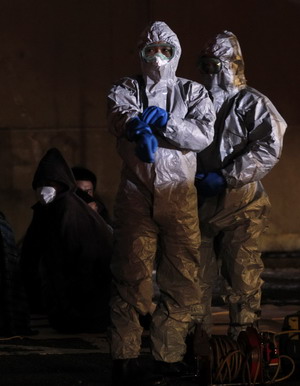 Officials in protective gear stand next to people from the evacuation area near the Fukushima Daini nuclear plant, in Koriyama, on Sunday March 13, 2011. [Photo/Agencies] |
On Monday a second hydrogen blast rocked the plant. TEPCO again said the explosion had not damaged the primary containment vessel. But by this stage even the stoic Japanese had begun to question the information they were receiving.
"They don't tell the truth. It's in their DNA," said Taro Kono, a member of the Liberal Democratic party and a long-time opponent of nuclear power.
Nuclear power analysts, officials and executives said they had seen nothing in the response to suggest that mistakes on the ground had compounded the crisis that now threatens a wide swath of Japan including Tokyo's nearly 13 million residents.
But the speed with which the crisis spun out of control has exposed a fundamental flaw in the risk planning that still governs much of the nuclear industry in Japan and elsewhere.
In diplomatic cables acquired by WikiLeaks and seen by Reuters, US diplomats said a top Japanese official at the International Atomic Energy Agency had neglected safety in Japan.
Tomihoro Taniguchi, a Japanese official who headed the IAEA's department of Nuclear Safety and Security, hindered progress for years, according to a December 2009 cable to Washington from the US embassy in Vienna.
"Taniguchi has been a weak manager and advocate, particularly with respect to confronting Japan's own safety practices, and he is a particular disappointment to the United States for his unloved-step-child treatment of the Office of Nuclear Security," said another cable, sent on July 7, 2009.
Marin Kostov, an earthquake engineering expert in Bulgaria and a member of the IAEA expert team sent to Japan after the 2007 quake that hit the Kashiwazaki-Kariwa plant, said one of the main problems is not how plants are built but where they are built.
"Selecting where these nuclear power plants have to (be) built is a crucially important task," he said. Nuclear engineers had too "much belief that they are going to cope with these external events with making the buildings very strong, very safe."
"At the same time you have a situation like what has happened (in Japan) where although the building is safe -- nothing has happened after the tremor, after the shaking everything is there -- but then you do not have infrastructure, you do not have water, you do not have power, you have nothing."
|
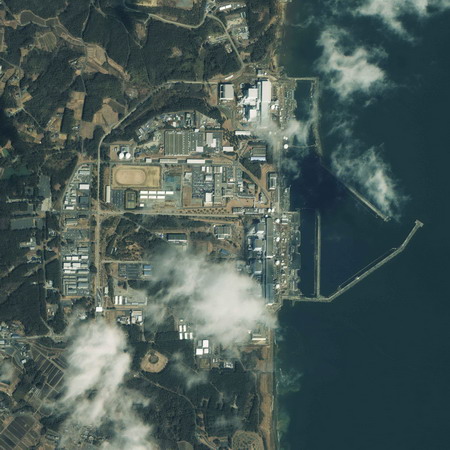 This one-meter resolution satellite image of Fukushima Daiichii Nuclear Power Plant in Japan, was taken one day after an 8.9-magnitude earthquake struck the Oshika Peninsula in Japan on March 11, 2011 and released to Reuters on March 12, 2011. [Photo/Agencies] |
BLACK SWAN
Nassim Nicholas Taleb's 2007 book The Black Swan described how the commonly held views of risk exclude the truly unexpected events that shape history and markets. The book has fueled new thinking on how to manage the risk from apparently low-probability, world-shaking events such as the attacks of September 11, 2001.
Nuclear experts have thought a lot about that over the past few years. In the wake of the Sept 11. attacks, US regulators required plant operators to develop plans to deal with potential airline attacks.
In February last year, the IAEA posted a report on its website about the 2007 Japan quake, saying it was a "wake-up call that reverberated around the globe."
"There has been a misconception since the early days of nuclear power that human error or mechanical failure, in other words risk factors within the plant itself, are the most significant variables regarding possible radiological release to the environment," the story read. "In fact, the greatest threat to a plant's operation may lie outside its walls.
"Nuclear power plants all over the world are exposed to natural hazards, such as hurricanes, floods, fires, tsunamis, volcanoes and earthquakes. With safety always a key concern, engineers, safety specialists and architects also have to take extreme natural forces into consideration."
Avinash Nafday, a California-based researcher who consulted for the US Nuclear Regulatory Commission and has written on the Black Swan effect for nuclear plants, agrees. "In doing nuclear plant designs, you have to look at the consequences of events, no matter how low the probability," Nafday said.
But Ed Lyman, a physicist and nuclear plant design expert with the Union of Concerned Scientists, said watching plant workers put their lives at risk in a bid to prevent meltdown is a good reminder that even the most thorough plans will never be enough.
"I think we need to reevaluate the realism of those plans in light of what we're seeing here, because they involve the reliance on heroic actions on the part of workers and possibly life-or-death decisions to protect (against) larger scale releases," he said.
|
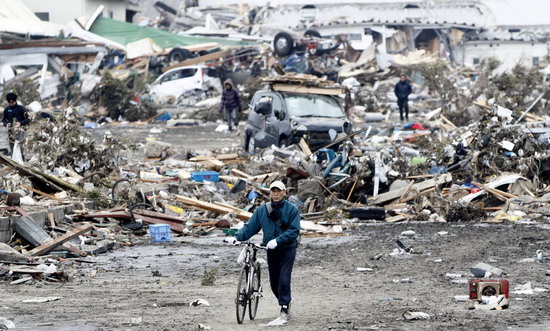 A resident with a bicycle walks in an area hit by an earthquake and tsunami in Sendai, northeastern Japan, on Tuesday March 15, 2011. [Photo/Agencies] |
| 分享按鈕 |