Nuclear Meltdown
Japan lays power cable in race to stop radiation
(Agencies)
Updated: 2011-03-19 13:03
 |
Large Medium Small |
|
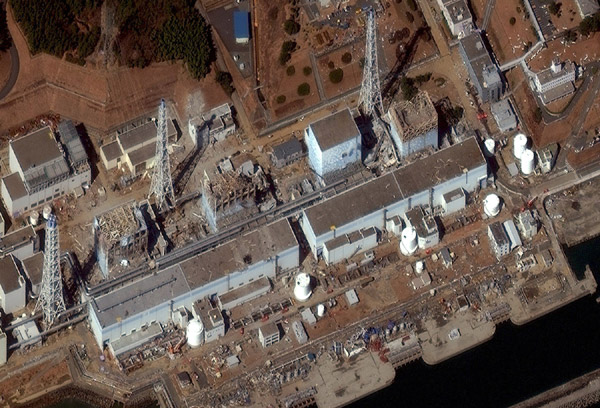 (From R to L) Reactors No. 1 to 4 are seen at the Fukushima Daiichi Power Plant in Fukushima in this satellite image, taken and released by DigitalGlobe March 18, 2011. [Photo/Agencies] |
TOKYO – Exhausted engineers attached a power cable to the outside of Japan's tsunami-crippled nuclear plant on Saturday in a desperate attempt to get water pumps going that would cool down overheated fuel rods and prevent the deadly spread of radiation.
Hopes were dashed of miracle survivors when it turned out that a story was wrong that a young man had being pulled alive from the rubble eight days after the quake and tsunami ripped through northeast Japan, triggering the nuclear crisis.
|
||||


Beleaguered Prime Minister Naoto Kan sounded out the opposition, which only hours before the quake struck had been trying to oust him from office, about establishing a government of national unity to deal with a crisis that has shattered Japan and sent a shock through global financial markets, with major economies joining forces to calm the Japanese yen.
It has also stirred unhappy memories of Japan's past nuclear nightmare -- the US atomic bombs dropped on Hiroshima and Nagasaki in 1945. Japan is the only country to have been hit by an atomic bomb.
Further cabling was under way before an attempt to restart water pumps needed to cool overheated nuclear fuel rods at the six-reactor Fukushima plant in northeastern Japan, 240 km (150 miles) north of Tokyo.
Officials expect to have power from outside drawn to No. 2 reactor first. Then they will test the pump and systems to see if they can be started.
Working inside a 20 km (12 miles) evacuation zone at Fukushima, nearly 300 engineers got a second diesel generator attached to No. 6 working just after 4 am, the nuclear safety agency said. They then used that power to restart cooling pumps on No. 5. Reactor No. 6 is drawing power from a second diesel generator.
"TEPCO has connected the external transmission line with the receiving point of the plant and confirmed that electricity can be supplied," the plant's operator, Tokyo Electric Power Co, said in a statement.
Another 1,480 meters (5,000 feet) of cable are being laid before engineers try to crank up the coolers at reactor No.2, followed by numbers 1, 3 and 4 this weekend, company officials said.
"If they are successful in getting the cooling infrastructure up and running, that will be a significant step forward in establishing stability," said Eric Moore, a nuclear power expert at US-based FocalPoint Consulting Group.
If that fails, one option under consideration is to bury the sprawling 40-year-old plant in sand and concrete to prevent a catastrophic radiation release.
That method was used to seal huge leakages from the 1986 Chernobyl disaster, the world's worst nuclear reactor disaster.
Underlining authorities' desperation, fire trucks sprayed water overnight in a crude tactic to cool reactor No.3, considered the most critical because of its use of mixed oxides, or mox, containing both uranium and highly toxic plutonium.
"I humbly apologize to the public for causing such trouble. Although it was due to natural disaster, I am extremely regretful," the Mainichi Shimbun newspaper quoted TEPCO CEO Masataka Shimizu as saying in a statement.
Japan has raised the severity rating of the nuclear crisis to level 5 from 4 on the seven-level INES international scale, putting it on a par with the Three Mile Island accident in 1979, although some experts say it is more serious.
Chernobyl, in Ukraine, was a 7 on that scale.
| 分享按鈕 |