Nuclear Meltdown
Breach in reactor suspected at Japan nuke plant
(Agencies)
Updated: 2011-03-25 21:45
 |
Large Medium Small |
|
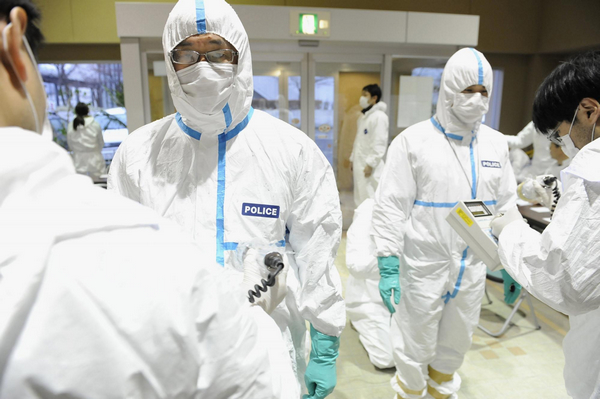 Police who have finished checking Minamisoma City for radiation are screened for radiation contamination in Kawamata, Fukushima Prefecture in northeastern Japan, in this photo by Kyodo on March 25, 2011. Japan said on Friday workers who suffered burns while trying to cool a crippled reactor were exposed to radiation levels 10,000 times higher than expected, adding evidence that the crucial containment vessel for nuclear fuel had been ruptured.[Photo/Agencies] |
TOKYO?- A suspected breach in the core of a reactor at the stricken Fukushima nuclear plant could mean more serious radioactive contamination, Japanese officials revealed Friday, as the prime minister called the country's ongoing fight to stabalize the plant "very grave and serious."
A somber Prime Minister Naoto Kan sounded a pessimistic note at a briefing hours after nuclear safety officials announced what could be a major setback in the urgent mission to stop the plant from leaking radiation, two weeks after a devastating earthquake and tsunami disabled it.
"The situation today at the Fukushima Dai-ichi power plant is still very grave and serious. We must remain vigilant," Kan said. "We are not in a position where we can be optimistic. We must treat every development with the utmost care."
The uncertain situation halted work at the nuclear complex, where dozens had been trying feverishly to stop the overheated plant from leaking dangerous radiation. The plant has leaked some low levels of radiation, but a breach could mean a much larger release of contaminants.
Suspicions of a possible breach were raised when two workers waded into water 10,000 times more radioactive than is typical and suffered skin burns, the Nuclear and Industrial Safety Agency said.
|
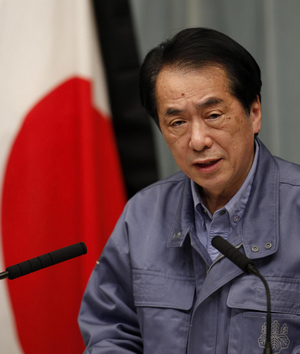 Japan's Prime Minister Naoto Kan speaks in front of the Japanese flag with a black mourning cloth during a news conference at his official residence in Tokyo March 25, 2011. Kan said on Friday that the situation at a quake-damaged nuclear plant in northeast Japan remained very precarious.[Photo/Agencies]? |
Kan apologized to farmers and business owners for the toll the radiation has had on their livelihoods: Several countries have halted some food imports from areas near the plant after milk and produce were found to contain elevated levels of radiation.
The prime minister also thanked utility workers, firefighters and military personnel for "risking their lives" to cool the overheated facility.
The alarm Friday comes two weeks to the day since the magnitude-9 quake triggered a tsunami that enveloped cities along the northeastern coast and knocked out the Fukushima reactor's cooling systems.
Police said the official death toll jumped past 10,000 on Friday. With the cleanup and recovery operations continuing and more than 17,400 listed as missing, the final number of dead was expected to surpass 18,000.
The nuclear crisis has compounded the challenges faced by a nation already saddled with a humanitarian disaster. Much of the frigid northeast remains a scene of despair and devastation, with Japan struggling to feed and house hundreds of thousands of homeless survivors, clear away debris and bury the dead.
A breach could mean a leak has been seeping for days, likely since the hydrogen explosion at Unit 3 on March 14. It's not clear if any of the contaminated water has run into the ground. Radiation readings for the air were not yet available for Friday, but detections in recent days have shown no significant spike.
But elevated levels of radiation have already turned up in raw milk, seawater and 11 kinds of vegetables, including broccoli, cauliflower and turnips. Tap water in several areas of Japan — including Tokyo — also showed radiation levels considered unsafe for infants, who are particularly vulnerable to cancer-causing radioactive iodine, officials said.
The scare caused a run on bottled water in the capital, and prompted officials to distribute bottled water to families with babies.
Previous radioactive emissions have come from intentional efforts to vent small amounts of steam through valves to prevent the core from bursting. However, releases from a breach could allow uncontrolled quantities of radioactive contaminants to escape into the surrounding ground or air.
Government spokesman Yukio Edano said "safety measures may not be adequate" and warned that may contribute to rising anxiety among people about how the disaster is being managed.
"We have to make sure that safety is secured for the people working in that area. We truly believe that is incumbent upon us," the chief Cabinet secretary told reporters.
Edano said people living 12 to 20 miles (20 to 30 kilometers) from the plant should still be safe from the radiation as long as they stay indoors. But since supplies are not being delivered to the area fast enough, he said it may be better for residents in the area to voluntarily evacuate to places with better facilities.
"If the current situation is protracted and worsens, then we will not deny the possibility of (mandatory) evacuation," he said.
Nuclear and Industrial Safety Agency spokesman Hidehiko Nishiyama said later that plant operator Tokyo Electric Power Co. was issued a "very strong warning" for safety violations and that a thorough review would be conducted once the situation stabilizes.
Meanwhile, damage to factories was taking its toll on the world's third-largest economy and creating a ripple effect felt worldwide.
Nissan Motor Co. said it may move part of its engine production line to the United States because of damage to a plant.
The quake and tsunami are emerging as the world's most expensive natural disasters on record, wreaking up to $310 billion in damages, the government said.
"There is no doubt that we have immense economic and financial damage," Finance Minister Yoshihiko Noda said. "It will be our task how to recover from the damage."
At Sendai's port, brand new Toyota cars lay crushed in piles. At the airport, flooded by the tsunami on March 11, US Marines used bulldozers and shovels to shift wrecked cars that lay scattered like discarded toys.
Still, there were examples resilience, patience and fortitude across the region.
In Soma, a hard-hit town along the Fukushima prefecture coast, rubble covered the block where Hiroshi Suzuki's home once stood. He watched as soldiers dug into mounds of timber had been neighbors' homes in search of bodies. Just three bodies have been pulled out.
"I never expected to have to live through anything like this," he said, mournfully. Suzuki is one of Soma's lucky, but the tsunami washed away the shop where he sold fish and seaweed.
"My business is gone. I don't think I will ever be able to recover," said Suzuki, 59.
Still, he managed to find a bright side. "The one good thing is the way everyone is pulling together and helping each other. No one is stealing or looting," he said."It makes me feel proud to be Japanese."
| 分享按鈕 |