Nuclear Meltdown
Highly toxic plutonium seeps from nuke plant
(China Daily)
Updated: 2011-03-30 07:15
 |
Large Medium Small |
* Trace amounts of atmospheric radiation from Japan have been detected in more parts of China.
TOKYO - Highly toxic plutonium is seeping from the damaged nuclear power plant in Japan's tsunami disaster zone into the soil outside, officials said on Tuesday, as the government grew frustrated by missteps in the effort to stabilize the overheated facility.
|
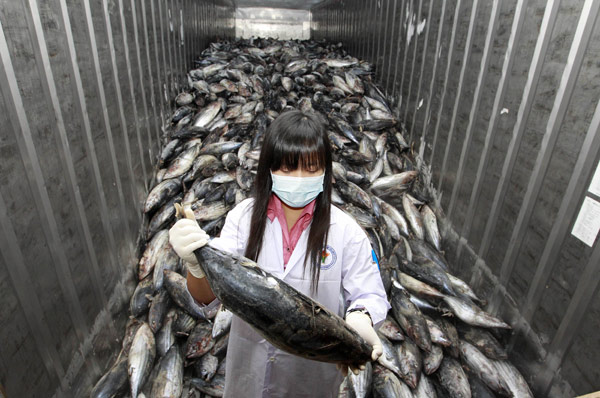 An official from Thailand's Food and Drug Administration takes a sample from a shipment of frozen fish imported from Japan to test for possible radiation contamination in Bangkok on Monday. Thai authorities have asked importers and distributors to avoid or at least reduce imports of Japanese food products. [Photo/Agencies] |
Japan's Prime Minister Naoto Kan told parliament that the country was on "maximum alert" to bring its worst crisis in decades under control, as traces of atmospheric radiation have been detected in China.


"The situation is very grave," Chief Cabinet Secretary Yukio Edano told reporters. "We are doing our utmost to contain the damage."
A tsunami spawned by a magnitude-9.0 earthquake on March 11 destroyed the power systems needed to cool the nuclear fuel rods at the complex. Since then, three of the plant's six reactors are believed to have partially melted down.
Radiation seeping from the plant has made its way into produce, raw milk and even tap water as far away as Tokyo, prompting some nations to halt imports from the region.
Chinese authorities said on Tuesday trace amounts of atmospheric radiation from Japan have been detected in more parts of China.
In a notice on its website, the Ministry of Environmental Protection says that apart from Heilongjiang in the northeast, further traces were found in Beijing, Tianjin, Hebei, Henan, Shanxi, Ningxia, Shandong, Jiangsu, Shanghai, Zhejiang, Anhui, Guangdong and Guangxi. The ministry says the tiny amounts of iodine-131 pose no threat to public health.
The nuclear crisis has complicated the Japanese government's ability to address the humanitarian situation facing hundreds of thousands left homeless by the twin disasters. The official number of dead surpassed 11,000 on Tuesday, police said, and the final figure is expected to top 18,000.
The urgent mission to stabilize the Fukushima plant has been fraught with setbacks.
Workers succeeded last week in reconnecting some parts of the plant to the power grid. But as they pumped water into units to cool the reactors down, they discovered pools of contaminated water in numerous spots, including the basements of several buildings and in tunnels outside them.
The contaminated water has been emitting radiation more than four times the amount the government considers safe for workers and must be pumped out before electricity can be restored to the cooling system.
That has left officials struggling with two crucial but sometimes-contradictory efforts: pumping in water to keep the fuel rods cool and pumping out - and then safely storing -- contaminated water.
Nuclear safety official Hidehiko Nishiyama called it "delicate work". He acknowledged that cooling the reactors took precedence over concerns about leakage.
"The removal of the contaminated water is the most urgent task now, and hopefully we can adjust the amount of cooling water going in," he said, adding that workers were building makeshift dikes with sandbags to keep contaminated water from seeping into the soil outside.
The discovery of plutonium, released from fuel rods only when temperatures are extremely high, confirms the severity of the damage, Nishiyama said.
When plutonium decays, it emits what is known as an alpha particle, a relatively big particle that carries a lot of energy. When an alpha particle hits body tissue, it can damage the DNA of a cell and lead to a cancer-causing mutation.
Plutonium also breaks down very slowly, so it remains dangerously radioactive for hundreds of thousands of years.
But Yu Zhuoping, an expert on reactor engineering with China's National Nuclear Emergency Coordination Committee, said there is no need to worry about the toxic leak. "It's a minimal amount. It will pose no major health hazards if it is diluted," he said.
Xia Yihua, Yu's committee colleague, said the plutonium will not affect China and expressed confidence in the Japanese government's handling of the crisis.
Reuters, Li Xiaokun contributed to this story.
Associated Press
| 分享按鈕 |