Casualties and Damages
Q & A: Japan, Chernobyl disasters
(Agencies)
Updated: 2011-04-13 10:03
 |
Large Medium Small |
|
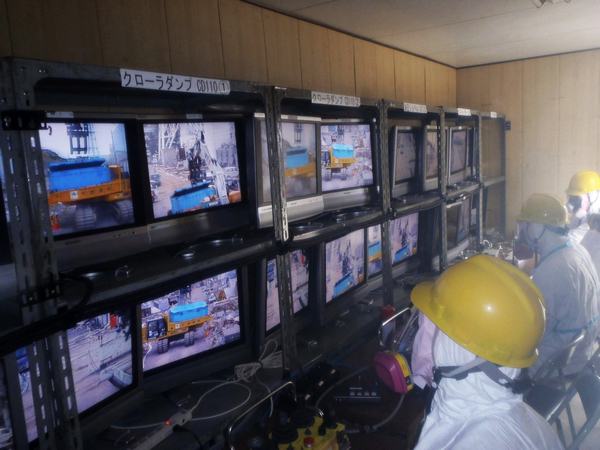 Workers in protective suits operate remote-controlled machinery to clear debris in the compound of Tokyo Electric Power (TEPCO) Co.'s crippled Fukushima Daiichi Nuclear Power Plant in Fukushima, northern Japan in this April 10, 2011.[Photo/Agencies] |
Japan raised the assessment of its nuclear crisis to the most severe rating of Level 7 Tuesday,the same level as the Chernobyl disaster, the world's worst to date. Some answers to questions about the assessment and health and safety concerns:
Q. Has the situation at the Japanese nuclear power plant worsened?
A. No. The heaviest radiation leaks at the Fukushima Dai-ichi nuclear complex occurred in the first days after the March 11 earthquake-triggered tsunami crippled the plant's cooling systems. Workers are trying to lower temperatures in the overheated nuclear reactors, but still don't have full control. Problems persist, like the leak into the ocean plugged last week, but authorities say the radiation leaks are declining.
Q. If the situation's not getting worse, why did Japan raise its assessment of the crisis?
A. The decision was based on new assessments of radiation leaks since the crisis began, rather than on deteriorating conditions. The new data showed emissions exceeding the threshold for a "major accident," level 7 on a 1-to-7 scale set by the International Atomic Energy Agency. Only one accident has previously rated 7, the 1986 meltdown at the Chernobyl nuclear power plant.
Q. So is Japan's crisis as bad as Chernobyl's?
A. Not yet. Chernobyl was a fast-moving crisis. A routine shutdown went awry, causing a reactor to overheat, explode and burn. For 10 days, the reactor spewed high levels of radiation into the air and only cooled after helicopters dropped sand, clay, lead and other materials on it. By contrast, Fukushima crisis has been a slow cascade of problems over a month. Explosions occurred at three of Fukushima's reactors and one may be leaking. But the two plants' reactor designs are different. Unlike Chernobyl's reactors, Fukushima's have pressure vessels of steel six inches (15 centimeters) thick that may have helped contain the damage.
Q. Then why the same severity level rating?
A. The IAEA defines a level-7 accident as one in which a large amount of radiation is released into the atmosphere, likely harming human health and damaging the environment over the long-term. That threshold is set at several tens of thousands of terabecquerels - a unit of radiation - of iodine-131, a radioactive element commonly released in nuclear accidents. Leaks at both plants have exceeded that limit, but the Japanese government says Fukushima's are still one-tenth of those released by Chernobyl. The possibility Fukushima's emissions could surpass Chernobyl's is considered small, but still a risk until Fukushima's cooling systems are restored.
Q. What are the health risks?
A. Radiation normally occurs in the environment, and at low levels cause no health problems for people. In higher doses, radiation may cause types of cancer. Limiting exposure is key. Because radioactive elements are heavy, they tend to concentrate closest to the source, in this case the nuclear plant. The Japanese government has evacuated people living near the plant and advised people a bit farther out to stay indoors.
Q. Are only people close to the plant at risk?
A. Winds have been blowing to the northwest of the plant, rather than out to sea, carrying radioactive elements farther inland. The government has banned the sale of vegetables and milk from certain areas after they showed contamination. The government on Monday also ordered people in five communities outside the evacuation zone to leave to avoid long-term radiation exposure.
Q. What about people outside Japan?
A. Weather patterns are already carrying traces of radiation from Fukushima to South Korea and China. Airborne radioactive particles have also reached the United States. In all cases, the governments say the amounts detected aren't dangerous.
Q. Didn't people die at Chernobyl?
A. Thirty-one men died mostly from being exposed to very high levels of radiation trying to contain the accident. About 5 million people were exposed to radiation. Higher rates of thyroid cancer have been found among people 18 or younger at the time of the accident. An IAEA study said about 4,000 people would ultimately die from cancer, though a U.N. study estimated cancer deaths at more than twice that number and other groups put the fatalities many times higher.
Q. Is the same thing happening at Fukushima?
A. At Fukushima, 21 workers have been exposed to radiation doses the equivalent of 100 millisieverts. Two were treated for burns after walking in heavily contaminated water in a plant building. But no deaths from radiation exposure have occurred so far. Cancers often take years or decades to develop.
Q. What radioactive elements have been found so far?
A. Most measurements have focused on two, iodine and cesium. Radiation from iodine-131 dissipates quickly, falling by half every eight days and nearly disappearing after 80 days. If inhaled or swallowed, it can concentrate in the thyroid and cause cancer. Cesium-137 lingers far longer, 30 years to decay by half and 300 to disappear. Cesium too can build up in the body and is linked to cancers, though studies after Chernobyl did not find an increase in cancers linked to cesium.
| 分享按鈕 |