Latest News
Facts versus rumors and myths
(China Daily)
Updated: 2011-04-17 07:46
 |
Large Medium Small |
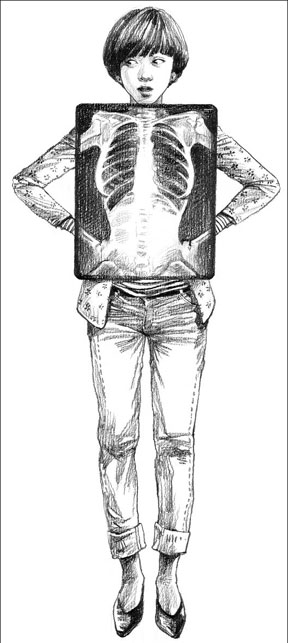
As radiation bulletins come in waves and Japan struggles to contain the damage at the Fukushima nuclear power plant, China's citizens have tried to stem their fears with an odd assortment of "cures and preventions".?China Daily seeks the truth from those who really know.
Let's get prepared, say some, stocking up on face masks and anti-radiation suits.
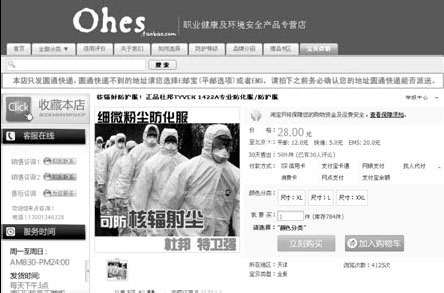
We're talking about a full-body suit meant to protect against chemical or asbestos contamination, and it sells right next to "anti-radiation maternity frocks" on Taobao.com. In the last 30 days, the website has sold 504 suits, available at less than 30 yuan.
"I bought the suit just in case," said a buyer called mirimao4. "I hope I won't need to use it." The sentiments are repeated by many buyers, most of who had stocked up "just in case".
There are even more bizarre suggestions. "One should wear clothes of lighter shades to prevent overexposure to nuclear radiation," a netizen called Shuangzhaishang290 advised on an information-sharing site run by the search engine Baidu.
Are face masks or biohazard suits effective against radioactive particles in the air?
The amount of radioactive particles in the air is minuscule, so people do not need to wear face masks when they go outdoors, says Chen Xiaoqiu, a researcher with the Nuclear and Radiation Safety Center of the Ministry of Environmental Protection.
He says washing your face or taking a shower is enough to remove traces of radioactive particles that settle on the body's surface from the air.
How much radioactivity or radioactive particles would be harmful?
People encounter radiation in everyday life, the experts say. There's natural background radiation made up of cosmic rays from outer space; radiation from the disintegration of radium, uranium and other radioactive minerals in the Earth's crust; and radiation emitted by the disintegration of potassium, carbon and other radioactive isotopes in living cells.
There are also artificial sources such as medical X-rays, radioactive minerals in construction materials and fertilizers, as well as radiation-emitting components in electronic products like televisions and cellular phones.
"The radioactivity of some of these materials is even higher than that of the radioactive particles from Japan," said Su Xu of the Chinese Center for Disease Control and Prevention. "The current levels of radioactive material in the air and water in China are very low - about 1/100,000th of natural background radiation. For now, they cannot be passed on to humans."
Eat lots of salt and black sesame, chew on gingko leaves and drink lots of green tea to prevent radiation?
Web forums are flooded with articles saying certain food can help protect the body from nuclear radiation. These include green tea, herbal tea, black sesame, ginkgo leaf and pollen products.
"In the aftermath of the bombing of Hiroshima, some locals recovered from radiation sickness, curing themselves by drinking a herbal tea called water dragon," an article attributed to a traditional Chinese medicine publication says.
But there's probably nothing more illustrative of the degree of people's anxiety than the panic buying of salt across the country in mid-March.
It resulted in the purchase of 672,000 tons of salt within a three-day period - a daily average 15 times the norm, according to the China National Industry Salt Corp.
Why the run on salt?
People fear that future supplies of salt produced from seawater would be contaminated. They also believe that the iodine in table salt would protect the body from radioactive iodine.
Is natural iodine in sea salt any use in countering radioactive iodine?
The Chinese Ministry of Health says table salt does not contain enough iodine to help radiation poisoning. An adult would need to ingest 3 kilograms of salt in one sitting to help counter the effects of radiation.
Will sea salt production be affected by the dumping of radioactive waste into the sea at Fukushima?
As a source of salt, China's seawater will not be affected by the radioactive leaks because of ocean currents, officials said. "According to our data on tidal movements, the tides near Fukushima generally go to the east, to the Pacific Ocean," says Li Yun, a researcher with the National Marine Environmental Forecasting Center of the State Oceanic Administration. China lies to the west of Japan.
Will seafood sourced from waters around China be affected? Is it safe to eat?

Most of the radioactive particles that end up in the Pacific Ocean will get diluted eventually.
"Radioactive material in the ocean will spread relatively slowly since the Pacific contains a colossal amount of water," says Su Xu, director of the Radiation Protection and Nuclear Safety Medical Institute of the Chinese Center for Disease Control and Prevention.
How about vegetables that show traces of radioactivity?
Su also says people should not worry about eating vegetables, even those found to have traces of radioactive particles. He says all the tainted vegetables in China show a radioactivity of less than 3 Becquerels per kilogram, which is 2 percent of the government-set danger level for radioactivity in food.
"Recent experiments show that radioactive particles in tainted spinach can no longer be detected after it is soaked in water for 10 minutes," Su says, explaining that radioactivity has been detected only on vegetable surfaces and not inside them.
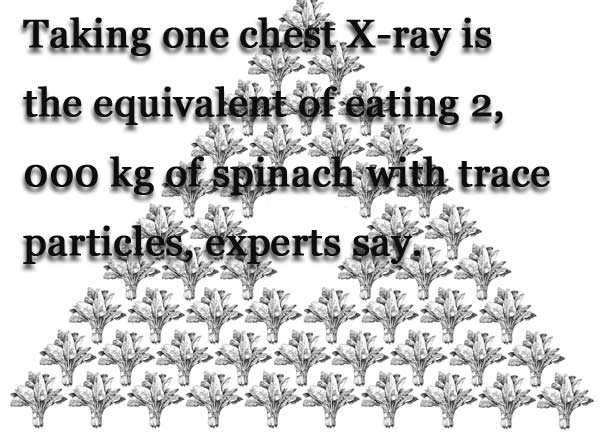
"Eating 2,000 kilograms of the tainted vegetable equals absorbing radiation from one chest X-ray," he says. It's safer to eat spinach.
While there is no cause for panic for now, we still lack adequate information on the long-term effects of low-dose nuclear radiation, such as those we're getting from Fukushima.
The two most worrying radioactive isotopes from the power plant are iodine and cesium. The former halves in radioactivity every eight days, but radioactive cesium - which has a half-life of 30 years - will remain in the water, air and soil for decades.
"Cesium may affect generations," said Chen of the Nuclear and Radiation Safety Center.
But for now, the experts are telling the public to go on as before: to continue leading normal lives, but not to forget to wash their vegetables before eating.??
|
One government expert says there is no need now to rush out and buy masks and gear. Taking a shower removes any traces of radioactivity. [Photo/China Daily] |
| 分享按鈕 |