
Two college applicants, one from Shanghai and the other from Zhejiang, got the full score for the Chinese language prose they wrote for the national college entrance examinations.
Their works were quickly published in local newspapers and posted on the Internet. After all, their good writing serves as fine examples for college applicants in the coming years.
However, the two prose works have sparked a debate among netizens. Some question whether it is proper to give the full score, without a serious critique.
I agree with these people who worry that too much eulogy over the two works will turn them into set samples for many teens to copy and thus restrict creativity among younger students, even though there is no reason to place high expectations on the teens.
But I am more interested in the debate on how the two young writers describe the countryside.
One writer actually portrays the life of children of migrant workers "at the city's end", where there are no urban hustle and bustle, no neon lights but only rundown houses. They have to brave "biased stares" from "urban folks" and "pray in the middle of the night that their schools would stay open, even though the management is unable to pay the electrical bill..."
But in this prose piece, he/she writes that the migrant children have left behind "green mountains and clear water where they grew up and the flowering crops where they planted a lot of expectations", and came to settle in the city with their parents for a life and a future.
However, the other youth pens out mostly the pain that "the farmer" has to go through year in and year out. "He uses his sweat to nourish the land, but tears would run down his wrinkled face as he watches the field flooded, smothering his breath ... Or he sees no hope of harvest when the crops become as thin and dry as his own body..."
In a word, the two youths give two contrasting pictures of the countryside. One still outlines an idyllic life, but the other seems harsh, using such words as pain, humility and even cruelty to force urban people to give their heart to their rural kin.
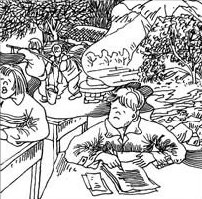
However, netizens are right in pointing out that today's urban youths have too little chances to learn about rural life.
Burdened with too much school work, those teens who grow up in urban centers are confined to the small ivory towers of academics, and thus know too little what the society really is until they start hunting for jobs.
I believe today's education system should still introduce some kind of programs for urban youths to live and work in the countryside for a short while at least once or twice in the six years of middle school, just as the people of my age did during the "cultural revolution" (1966-76) years.
Things have become more complicated today. One netizen who grew up in a village in Zhejiang was only nostalgic about the few years in the late 1980s, when his father's village became "well-off" at that time. However, industrialization has ripped his father and others of their land and many of the elderly now worry what their children and grandchildren will have for their livelihoods.
In fact, urbanization and industrialization are wreaking havoc in the countryside, creating problems from environmental pollution, grain security to the care of the elderly.
I believe the two youths do write well, although I think it proper to cut one or two points off the full scores for the two prose works.
Although we simply ask too much for them to turn their prose into essays expounding the best ways for rural development, it will only do them good if they have more chances to experience the rural life.
E-mail: lixing@chinadaily.com.cn
(China Daily 06/26/2008 page8)