|
 |
|
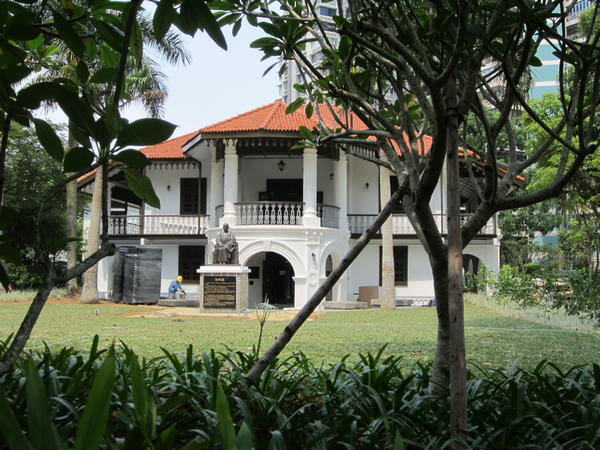
The Sun Yat-sen Nanyang Memorial Hall was re-opened on Saturday after extensive renovations. [Provided to China Daily] |
SINGAPORE - Like many other cities with large Chinese communities, Singapore is commemorating the centenary of the 1911 Revolution. After all, the island served as the Southeast Asian headquarters of Sun Yat-sen's revolutionary movement, Tongmenghui.
The activities in the island nation are more low-key than those in Hong Kong, Taiwan and the Chinese mainland itself. Still, they aim to increase public understanding of the historic significance of 1911, and the role played by Southeast Asia in the revolution. Activities include an academic conference, a stamp exhibition, a school-organized exhibition and public talks. They culminated in Saturday's re-opening of the Sun Yat-sen Nanyang Memorial Hall, which had been closed for renovation for more than a year.
On the commercial end, cashing in on the 100th anniversary of the Xinhai Revolution, cinemas are screening Jackie Chan's 1911, a movie based on the events. The film was released in Singapore on Sept 29.
Commemorative activities kicked off last year with a conference on Sun and Southeast Asia, organized by the Institute of Southeast Asian Studies, Chinese Heritage Center and National University of Singapore. It focused on the 1911 Revolution and Nanyang, which was how Southeast Asia was known to the Chinese then.
Sun traveled around Southeast Asia when he was drumming up support for the nationalist movement in China. Themes at the conference thus included Sun in the Straits Settlements and Southeast Asian nationalism. The Nanyang communities gave financial and moral support to the 1911 Revolution and played a role in the establishment of modern China. Overseas Chinese support for Sun's cause was so significant that he claimed they were "the Mother of the Revolution".
One interesting event in Singapore was an exhibition of rare stamps depicting Sun and his contributions. Between July and September, "Dr Sun Yat Sen: The Man Who Changed China" exhibition was staged at the Singapore Philatelic Museum. It featured more than 300 historic items on loan from Beijing philatelist Meng Zhaolong, who regards Sun as a personal hero. The collection, which came from all over the world, took Meng some 25 years to build up. The items included first-day covers and postcards dating to 1912.
A highlight was a stamp issued in December 1912 to commemorate the 1911 Revolution: It was the first designed and issued by the Chinese government then, as well as the first to bear a portrait of Sun.
An ongoing event, staged jointly by the prestigious Hwa Chong Institution and the Memorial Hall, is an exhibition featuring the struggles and contributions of Sun's local supporters. Interweaving historical facts with reflections by students, this exhibition explores the crucial role Southeast Asia played in the Revolution.
The jewel in the crown of the series of activities was the re-opening of the Memorial Hall, a bungalow built in the 1880s and called Wanqingyuan. The Singapore Chinese Chamber of Commerce and Industry and the National Heritage Board, which manages the museum, spent around $4.3 million to renovate the two-story villa and its five galleries.
For the first time, more than 180 artifacts will be showcased to highlight Singapore's contribution during the revolution. They include a photograph of Sun at the bungalow in 1906.
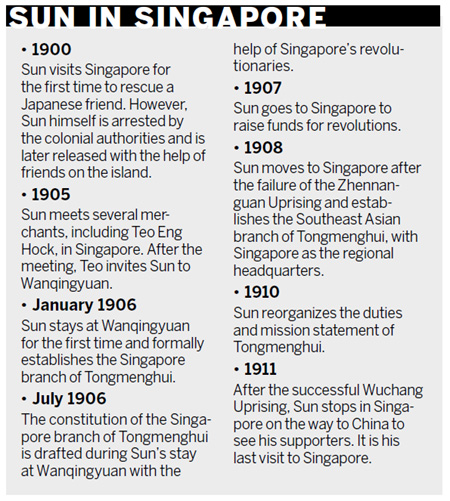
Twenty of these artifacts are on loan from the descendants of local merchants such as Teochew businessman Teo Eng Hock. In 1906, Teo offered the villa to Sun to serve as his Singapore headquarters. Sun stayed there on three occasions.
The villa had at least 10 owners between 1912 and 1938, when it was acquired by a group of six merchant-philanthropists. They donated the villa to the Singapore Chinese Chamber to be preserved as a historical site. In 1964-65, it was refurbished to commemorate Sun and his movement and became known as Dr Sun Yat-sen Villa.
In 1966, a museum was opened to commemorate the centenary of Sun's birth. The building was declared a national monument in October 1994 for its unique historical and architectural significance.
A book, Sun Yat-sen, Nanyang and the 1911 Revolution, was to be launched at the re-opening of the museum. On the calendar too is a three-week cultural festival through Oct 30.
The nearby newly completed Zhongshan Park also was to open on Saturday. A pathway in the 0.46-hectare park leading to the museum includes a record of Sun's eight trips to Singapore from 1900 to 1911.
A huge stone mounted in the park bears the Chinese characters tian xia wei gong, meaning "for the people", on one side. Words describing Sun as "a man who changed the destiny of China", written by Lee Kuan Yew, Singapore's founding prime minister, are inscribed on the other side.
|
 |


Copyright 1995 - . All rights reserved. The content (including but not limited to text, photo, multimedia information, etc) published in this site belongs to China Daily Information Co (CDIC). Without written authorization from CDIC, such content shall not be republished or used in any form. Note: Browsers with 1024*768 or higher resolution are suggested for this site.
License for publishing multimedia online 0108263 Registration Number: 130349