Educational institutes climb ladder quickly although they have a long way to go, Karl Wilson reports from Sydney.
Look at any world university ranking and the same names pop up high: Harvard, Princeton and Stanford in the United States, Oxford and Cambridge in the United Kingdom.
They are the elite of the elite, but you have to look well down the list to find a university from Asia. That might change over time.
|
 |
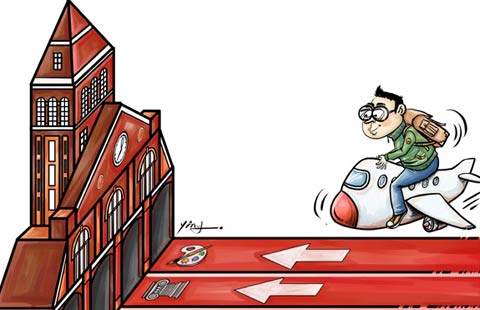
China, Japan, South Korea and Singapore are investing more in higher education. Experts hope universities from this region will give top Western schools a run for their money.
UK-based Times Higher Education World University Rankings lists five universities in Japan, four in Hong Kong, three each on the Chinese mainland and in South Korea, two in Singapore and one in Taiwan.
"Our top-200 list represents only about 1 percent of the world's universities, so to be in the 200 is in itself an excellent achievement," said Phil Baty, editor of Times Higher Education magazine, which has published the rankings for eight years.
"Asian nations are well ahead when it comes to literacy, numeracy and scientific competence among school-age children," Baty said. "This, combined with growing private and public investment in universities in Asia, alongside growing economic strength, may see the balance of power in higher education shift in the future."
Critics say the current ranking system betrays a bias toward the West.
"How can you compare Harvard with a university from a developing country?" said Dzulkifli Abdul Razak, vice-chancellor of Al Bukhary International University in Penang, Malaysia. "How do you judge a good university? "By the number of academic papers written in English? Do they promote better education or do they simply promote an elitist, Western system?"
Baty admitted that English-language journal citations tend to dominate, but said journals from other regions are included. "This year we examined more than 50 million citations to around 6 million articles published over five years, with journals drawn from the Thomson Reuters database."
Higher education has turned into a business in many parts of the world, Dzulkifli said. "They pay big money for academics. How can universities in the developing world compete in salary terms with the likes of Princeton? Universities are not football clubs based on a couple of stars."
With higher education now a multibillion-dollar business, especially in the United States and many countries in Europe, it's easy to see why universities want to appear on those lists. The higher you are ranked, the easier it is to market your university and its programs and to attract foreign students willing to pay high fees.
In Australia, for example, education is now the country's third largest source of foreign money, with just over 500,000 fee-paying students as of August, according to government data.
Ignore the Joneses
Every year dozens of companies publish their lists of the world's top universities, compiling masses of data from the universities as they go. The most influential are the Times Higher Education World Top 400, the QS World University Rankings, and the US News & World Report World's Best Universities.
One critic of the ranking system recently described them as "a high-stakes beauty contest".
Universities, especially those in developing countries, were told recently to avoid trying to keep up with the Joneses. The comment came at a forum organized by UNESCO, the Institutional Management of Higher Education and the World Bank.
"Instead of trying to conform to the prevailing monoculture approach to higher education by funneling scarce public funds to create flagship universities, governments should ignore rankings altogether," forum participants were told.
Sandro Calvani of the Asian Institute of Technology in Bangkok agrees.
"Asian universities manage knowledge on Asia better than the West and they do it in a way the West cannot see or does not wish to see," Calvani said. He is an education expert and director of the institute's ASEAN Regional Center of Excellence on Millennium Development Goals.
In his view, many Western elite universities lack Asian expertise on sustainable development, global public good and human security concerns. "The Times and QS university rankings . . . do not take into consideration the relevant direct outreach work done in Asia by Asian universities to facilitate policy innovation and problem solving."
Apples and oranges?
A Malaysian academic who did not want to be identified said that comparing Asian universities with Harvard is neither relevant nor helpful. "Universities have their own, unique role to play within a society. Comparing them to universities from a different environment and political system is not fair."
 |
The elite US research universities, Baty said, often enjoy very large treasuries and generous alumni donations. The latest data show Harvard's endowment in 2009 was about $26 billion, about the size of Panama's GDP.
"They also enjoy high levels of administrative and academic freedom, which is important to nurturing and protecting world-class universities," Baty said. "This keeps them highly competitive, able to attract the best academic staff with top salaries and to provide cutting-edge facilities."
Very few universities in developing countries "can ever afford to compete with the finances available to these super-elite universities, to avail of the world's who's who of intellectual talent, and to pick and choose from what is considered as cutting-edge research", Calvani wrote in a report.
"For . . . globally focused universities possessing similar resources and orientation, uniform rankings are probably useful," he said. "Indeed, arguing the relative merits of the scholarship at Cambridge, Massachusetts, versus Cambridge, England, is a fair debate, and even a fun pursuit."
Looking ahead
Tan Eng Chye, deputy president for academic affairs and provost of the National University of Singapore, said the ranking system provides "useful composite indicators" of a university's performance, although "methodological constraints inherent in some rankings may favor some institutions over others."
Tan said, for example, that the Times ranking "gives significant weight to a university's reputation in teaching (15 percent) and research (18 percent), and this may favor older and more established universities - predominantly in Europe and the US - that are more internationally renowned."
However, he thinks Asian universities are at the most exciting phase of their development, and he ticked off his reasons.
"First, Asian countries are investing very heavily in higher education. Second, Asian universities are becoming very research-intensive. And third, Asia is rising rapidly in economic and global importance."
Tan sees the future for Asian universities as very bright.


Copyright 1995 - . All rights reserved. The content (including but not limited to text, photo, multimedia information, etc) published in this site belongs to China Daily Information Co (CDIC). Without written authorization from CDIC, such content shall not be republished or used in any form. Note: Browsers with 1024*768 or higher resolution are suggested for this site.
License for publishing multimedia online 0108263 Registration Number: 130349