Delegates from all sectors will help set future course, Jiang Xueqing and Tang Yue report in Beijing.
Although the exact date of the 18th National Congress of the Communist Party of China has yet to be announced, the names of the 2,270 delegates who will vote in the quinquennial leadership election were announced earlier this month.
|
 |
Before the election, the CPC Central Committee, which convenes the congress and decides the number of delegates who will attend, determined that the number of candidates in the elections should be at least 15 percent more than the number of delegates, and the ratio of delegates from the grassroots, especially workers, should be increased.
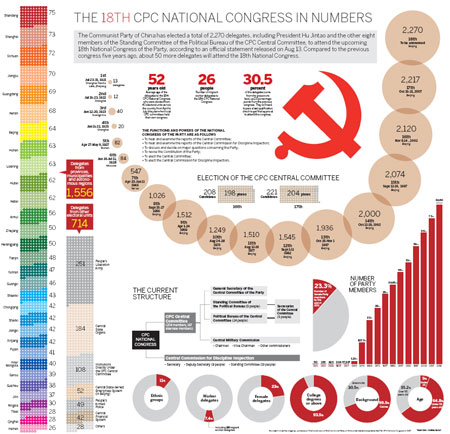
The delegates were elected in 40 electoral units across the country. The average age of the delegates is 52, while 64.8 percent of the delegates are under 55. More than 93 percent of the delegates have college degrees or above.
Wang Jingqing, deputy head of the Organization Department of the CPC Central Committee, said that for this congress there are more delegates from the grassroots and young Party members.
|
 |
Of the 2,270 delegates, 30.5 percent come from the grassroots, up 2.1 percentage points from the previous congress in 2007. There are also 26 migrant workers and four graduate village officers. Olympic champion Jiao Liuyang, 21, who won the women's 200m butterfly event in London, is the youngest delegate.
To carry out the election, the Organization Department of the CPC Central Committee offered dedicated training for the election work, and distributed flow charts of the election and supervision procedures.
A typical election at the grassroots level followed the procedure of nominations, feedback on candidates from Party members, voting and the announcing of those candidates who had been elected as delegates.
There were a greater number of candidates to choose from at this year's elections with 115 candidates for every 100 delegates. Apart from intra-Party announcements of those who were nominated to be delegates to the congress, 11 provincial and municipal Party committees also released the names of nominees to the media to encourage more Party members to participate and offer feedback on the candidates.
Cai Xia, a professor of Party- building studies with the Party School of the Central Committee of the CPC, said intra-Party democracy has been carried out in an unprecedented scale during these elections.
"But the ability of grassroots delegates to discuss the major issues remains to be seen," she said.
"As representatives of grassroots Party members, the fact that they have the right to join discussions on essential issues is only the starting point. They still need to prove they are capable of doing so."
Her opinion was echoed by Wang Changjiang, director of the Party-building department of the Party School of the Central Committee of the CPC, in a recent interview with Southern Weekly.
"The delegates must have a strong sense of responsibility and good abilities. They can't just show gratitude to the Party. They should know the opinion of the grassroots Party members and convey it at the congress," he said.
Candidates in the elections had to be elite Party members with strong virtues, a good working style, excellent achievements and the ability to fulfill the duties of a Party delegate, as those attending the congress are expected to discuss and decide on vital issues concerning the Party and the country on behalf of more than 82 million Party members and the entire Chinese population.
According to the Party's Constitution, the delegates will hear and examine the reports of the Central Committee and the reports of the Central Commission for Discipline Inspection. They will also elect the CPC Central Committee, the ruling body of the Party, and the Central Commission for Discipline Inspection.
The Central Committee will then elect the Political Bureau, the Standing Committee of the Political Bureau and the General Secretary of the Central Committee of the Party in the first plenary session immediately after the congress.
The Central Committee of the Party is elected for a five-year term, with the number of members and alternate members of the committee determined by the congress. Members and alternate members of the committee must have been Party members of good standing for five years or more.
Wang confirmed at a recent news conference that a competitive election will be adopted for the CPC Central Committee, but the number of candidates has yet to be decided.
The past decade has seen growing competition for membership of the Central Committee. At the 16th National Congress in 2002, 198 were elected from a pool of 208. Five years ago, 221 candidates vied for 204 berths.
"This is a positive trend," Cai said. "Only when there is a wide pool of candidates, can the voters choose the best."
Cai said that it was not until the 13th Party's National Congress in 1987 that a competitive election was included in the Party's Constitution.
"We expect the choice to be bigger this time, which is a significant sign of intra-Party democracy," she said.
Besides the members of CPC Central Committee, the delegates will also elect the alternate members of the committee. When the members are announced to the public, the names of the alternative members will be listed in order, according to the number of votes they received, but the names of the Central Committee members will be announced based on the number of strokes there are in the characters of their surnames.
Why are they announced differently? The order of the alternate members is important because when there is a vacancy to fill in the Central Committee, the person who received the most votes will automatically qualify.
Not disclosing the order of Central Committee members according to the number of votes they received shows their equality.
"We hope a competitive election will also be introduced for the Political Bureau and its Standing Committee in the future. But it must be achieved step by step," said Zhen Xiaoying, former vice-president of the Central Institute of Socialism.
The Constitution of the Party does not specify the number of the members of the CPC Central Committee, the Political Bureau and its Standing Committee. From 1992 to 2002, there were seven members in the Standing Committee. It rose to nine at the 16th National Congress in 2002 and remained unchanged at the congress in 2007.
"The number of the Standing Committee members there will be this time is not yet known," said Cai. "But one basic principle to follow is that the number of posts should depend on what functions it will have."
Contact the writers at jiangxueqing@chinadaily.com.cn and tangyue@chinadaily.com.cn
Mo Jingxi and Wu Wencong contributed to this report.


Copyright 1995 - . All rights reserved. The content (including but not limited to text, photo, multimedia information, etc) published in this site belongs to China Daily Information Co (CDIC). Without written authorization from CDIC, such content shall not be republished or used in any form. Note: Browsers with 1024*768 or higher resolution are suggested for this site.
License for publishing multimedia online 0108263 Registration Number: 130349