Patriotism and maturity come to the fore, He Na, Yang Wanli and Zhang Yuchen report.
Wang Peng works for a consultancy in Beijing. On Friday, his boss gave him and some of his colleagues the afternoon off so they could join a protest rally at the gates of the Japanese embassy in the city's downtown area.
|
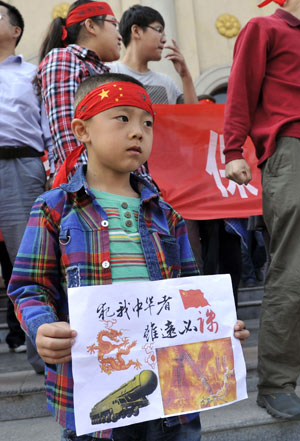 A boy takes part in a protest in Taiyuan, the capital of Shanxi province, on Sept 15. He was one of thousands of protesters across China who voiced their displeasure over Japan's claims on the Diaoyu Islands. Wei Liang / China News Service |
"He (the boss) is a patriot. We just can't endure it any longer. It's like a robber breaking into your house and trying to steal your belongings," said the 30-year-old, referring to Japanese claims to have "bought" the Diaoyu Islands.
Most of those protesting on the streets of China's biggest cities are in Wang's age group, 20s and 30s.
However, the dispute over the islands is the cause of conflicting emotions among many young Chinese people.
They know all about Japan because they grew up during China's three decades of opening-up and reform, watching Japanese cartoons, listening to Japanese pop music and following Japanese movie and television stars.
They are impressed by the country's pop culture and high-tech products, its high level of education and well-ordered society. Many of those interviewed by China Daily have either traveled to the country or have Japanese friends and colleagues.
Some are radical, others less so, but these young Chinese share a common sentiment over the issue, tempered by their individual points of view.
Liu Xiushan, 33, is a lawyer in Beijing. He clearly remembers when he was aged 7 and his father bought a black-and-white television set. A dozen neighbors flocked into the family home every evening to watch a Japanese love story. Liu's mother can still recite the name of almost every actor and actress in the soap opera.
Liu grew up watching Ikkyu-san, an animation about a young Japanese monk. Even after all these years, he still often imitates the monk's characteristic body language when deep in thought, drawing circles near his temples with his index finger.
But when he was getting older, he learned more about history and got to know more about the Japanese invasion and occupation between 1937 and 1945.
"Those brutal scenes are so deeply rooted in my mind that I can't really bring myself to like Japan," he said.
Despite that, he wanted to take his wife to Hokkaido after watching the movie You are the One, which was shot in the scenic Japanese city. However, he recently abandoned that idea.
Jin Xin, 31, the manager of Dalian Wakalu Japanese advertising agency in Northeast China's Liaoning province, has immersed himself in Japanese culture.
"About 80 to 90 percent of the animations I saw as a child were made in Japan. I majored in Japanese at the university, and now my customers are mainly Japanese companies, restaurants and shops," he said.
The issue of the Diaoyu Islands has become the hottest topic among his friends and colleagues.
"I've been paying great attention to the progress of the dispute and during the first few days I even updated my news app every five minutes," said Jin.
"So far there hasn't been a large protest in Dalian, although if there is one, I will be the first to join. Through our protests, we can tell the Japanese government that we are brave enough to guard our homeland," he said.
Divergence of opinion
 |
|
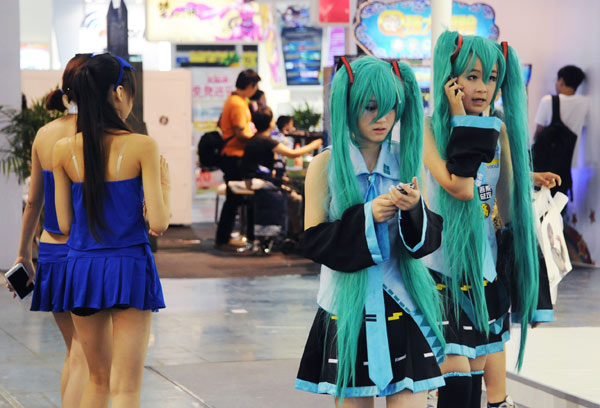
Many young Chinese are impressed by Japanese pop culture, such as animations and movies.Yang Yi / for China Daily |
Where opinions diverge is over the necessity of holding such protests: "It (the protest) is not a march without a result. We are showing our attitude here. I can be a soldier if my nation calls on me, or at least I would be able to cook for the soldiers," said Cui Yutong, 23, who joined the crowds outside the Japanese embassy in Beijing on Sept 6.
After seeing posts on the Internet on Sept 5 calling for people to gather, they arrived at the designated time and place the next day.
Her boyfriend stood at the front of the march, holding a banner that read, "Give the Diaoyu Islands back to China."
Both Yang Yue, a 32-year-old Beijing real estate agent, and her brother requested a half-day's leave from work and joined the protests on Thursday afternoon.
"We took a bus there, but it went straight past the stop at the front of the embassy. So we got off at the next stop and walked back. When we arrived, the embassy was already encircled by a large number of police, spaced out at 10-meter intervals," she said.
"Just as we were wondering how to get to the front gate, a large crowd walked toward us waving the Chinese flag and shouting slogans. We joined the march immediately and were given flags by the others. Talking to the man walking beside me, I learned that all the people had arrived on their own initiative, like us.
"The dispute over the Diaoyu Islands is the biggest topic in my family. We want to express our anger and put pressure on Japan," she said.
 |
|
Many young Chinese are impressed by Japanese pop culture, such as animations and movies. Provide to China Daily |
Boycotting products
Liu, the lawyer, decided not to join the protests.
"Honestly speaking, I won't go out on the streets, because shouting slogans won't scare away the enemy. I prefer to work hard and make the country much stronger," he said.
"I am boycotting Japanese goods as a show of support. If the dispute leads to a war, I will donate money or even apply to join the armed forces."
Tang Fang, 28, a sales manager at a Beijing branch of Nike China, also decided against joining the protests.
"I worked for a Japanese electronics enterprise for two years and made many Japanese friends. They are very polite and work very hard. Although I left the company some time ago, I still keep in touch with some of my old colleagues," she said.
Jin, the advertising agency manager, said a friend's Japanese restaurant has seen a sharp decline in customers, and one of the Japanese men who eats there tells people that he's from South Korea, for fear of reprisals should the dispute escalate.
Jin's agency has not yet witnessed any marked change in orders from Japanese clients. "But in the long run, if emotions continue to rise, who knows?" he said.
Although he had long wanted to buy a Japanese car, Jin has now dropped the plan, and he's also bought a new watch so he can leave his Japanese one at home.
"Boycotting Japanese goods is the simplest way for people to express their anger toward Japan and to support our country," he said.
However, he admitted that he has previously bought a lot of Japanese products, such as notebook PCs, cameras, watches and household appliances, because the quality is so high.
Yang Yue has also stopped buying Japanese goods, including cosmetics. "There are so many products on the market, why do we have to choose theirs?"
China is already the world's second-largest economy and has a large share of the global production chain, said Liu.
"In a way, made-in-Japan goods only encourage domestic enterprises to keep updating the technology to catch up with them," he said.
In addition to the technology, Tang admires the working methods of Japanese companies, especially in terms of service. She believed their adoption would help Chinese companies to better serve their customers.
She said that in the final analysis the target of the protests should be the Japanese government, not the Japanese people.
"They are innocent, just as we are," she said. "They are no different to people from other countries and just want to be friends with the Chinese."
Jiang Xueqing also contributed to the report.
Contact the reporter at hena@chinadaily.com.cn


Copyright 1995 - . All rights reserved. The content (including but not limited to text, photo, multimedia information, etc) published in this site belongs to China Daily Information Co (CDIC). Without written authorization from CDIC, such content shall not be republished or used in any form. Note: Browsers with 1024*768 or higher resolution are suggested for this site.
License for publishing multimedia online 0108263 Registration Number: 130349