 |
|
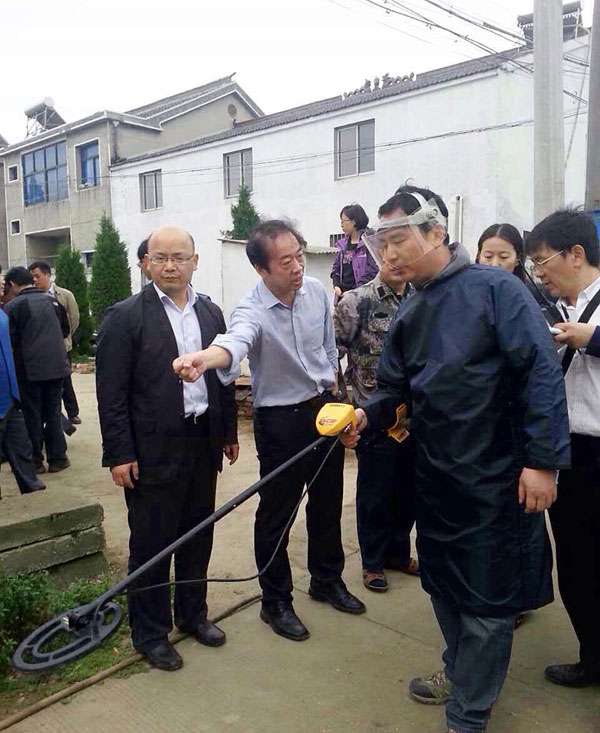
Members of staff from Nanjing Environmental Protection Bureau during the search for the missing ir-192, which was lost on May 7, in Nanjing, Jiangsu province. Provided to China Daily |
Monitoring procedures for all medical and industrial sources of radioactivity will be strengthened by authorities in Jiangsu province.
The use of radioactive testing equipment will also be suspended in Nanjing, the provincial capital, in August after inspection equipment containing iridium-192 was lost for three days.
A bracelet-shaped loop containing the radioactive material, known as Ir-192, was mislaid by workmen during routine inspections at a construction site in Nanjing's Luhe district on May 7. Authorities said the workmen failed to observe safety procedures while packing equipment.
The loss prompted a major police search and led to a construction site cleaner being hospitalized.
The silvery-white metal is used widely in industrial radiography to check for flaws in metal welds and castings, and in medicine, especially during interior radiotherapy procedures.
The workmen, from Tianjin Hongdi Engineering Inspection Development Co, a division of oil refiner Sinopec, didn't notice the bracelet was missing until the evening of May 8, when they tried to use the equipment and found it was malfunctioning.
The bracelet was found on Saturday afternoon by Yu Jianjun, director of the Getang Community Office in Luhe, who was assisting police and environmental experts in the search. When he discovered the bracelet, which contained a soybean-sized piece of ir-192, Yu sealed it in a plastic box before rushing to show it to the experts. The bracelet was then sealed in a lead-lined container and taken away for disposal.
"I've never run so fast. I can't say I wasn't afraid, but the material had to be recovered ... someone had to do it," Yu said.
The bracelet had been discarded near the community office by a construction site cleaner called Wang, who found it as he was sweeping the floor of the construction company's welding workshop at 8 am on May 7.
Wang said he slipped the bracelet into his pocket because he thought it would make a good key chain, but during his lunch break three hours later, he decided he didn't want it and threw the object into his front yard.
However, after learning that the police were searching for a piece of radioactive material lost at the site, he became afraid, so he wrapped the bracelet in a plastic bag and threw it into bushes near his home at 5 am on May 10.
Wang was later diagnosed with acute, short-term radiation sickness and is now being treated at the Second Affiliated Hospital of Soochow University in Suzhou.
| A short history of radioactivity-related incidents |
|
In 1954, China had its first accident involving radioactive material. From 1954 to 1987, human error, including poor management and lack of professional expertise, caused 84.64 percent of such accidents, according to Fan Shengen, an expert on radiation prevention with the health ministry. Other factors, including technical faults, accounted for less than 20 percent. In 1986, China had 70 incidents, but from 1988 to 1998, there were 332 involving 966 people, and 584 sources of radioactivity were lost - 256 of them were not recovered - according to the Case Compilation of China's Radiological Accidents 1988-1998, compiled in 2001 by the ministries of health and public security. In the 1990s, China had 40 times as many incidents as the United States. In 2004, a survey launched by the environmental and health authorities and the Public Security Bureau found that more than 10,000 agencies across China possessed more than 140,000 sources of radioactivity. The survey also discovered that more than 2,000 sources had gone missing, and the number of sources was growing at an annual rate of 5 to 10 percent. From 1954 to 2007, 10 people died because of radiation emitted by radioactive sources and in industries in which nuclear techniques were used; 49 people suffered radiation sickness and 16 suffered burns to the skin, according to Liu Senlin, a researcher at the China Institute of Atomic Energy. From 1954 to 2007, two people suffered radiation sickness after nuclear tests and 52 suffered burns to the skin. No one died or got radiation sickness in the nuclear military industry or nuclear plants. - Cang Wei |


Copyright 1995 - . All rights reserved. The content (including but not limited to text, photo, multimedia information, etc) published in this site belongs to China Daily Information Co (CDIC). Without written authorization from CDIC, such content shall not be republished or used in any form. Note: Browsers with 1024*768 or higher resolution are suggested for this site.
License for publishing multimedia online 0108263 Registration Number: 130349