 |
|
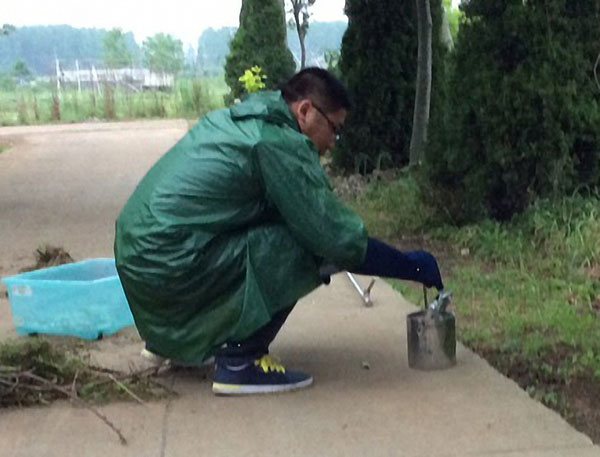
An expert places the mislaid ir-192 in a lead-lined container. The radioactive material had been missing for three days. Provided to China Daily |
Lack of expertise
Tang Shuangling, director of the radiation prevention and environmental protection department at Nanjing University of Science and Technology, said a lack of professional expertise among workers, poor management by related agencies, and the large number of radioactive sources have contributed to the high accident rate.
The health authorities used to monitor sources of radioactivity in China, but widespread industrial use of radioactive materials meant they were no longer able to undertake those duties, resulting in the environmental authorities assuming responsibility from 2003.
"Radioactive materials are widely used in hospitals, industry, agricultural colleges and research institutions," said Tang. "Although China has formulated strict monitoring regulations, the enforcement mechanism still requires improvement."
Lu Jigen, head of Jiangsu's Nuclear and Radiation Safety Supervision Management Bureau, said each source is strictly monitored during use. The province has 8,627 sources of radioactivity, the largest number in the country, at 5,257 agencies.
"Each source is given a unique code when it's produced," Lu said. "If an agency wants to transfer a source, the move must be approved by the monitoring department, and the vehicles and containers that carry the sources must meet strict requirements."
"When the sources are no longer needed, they are taken to the provincial urban radioactive waste site to be destroyed," he added.
According to Pan, the country's third national radioactive waste disposal site, Feifengshan, or Flying Phoenix, in Sichuan province, will become operational later this year or early in 2015.
China's first national disposal site, which was put into use in 1999, is located in Gansu province, while the second, which began operations in 2000, is in Guangdong province.
"Although every province has established its own disposal site, greater efforts are required to meet the huge demand," Pan said, adding that China will establish a disposal site for high-level radioactive waste before 2050. Sites are under consideration in several provinces, including Shandong and Guangdong.
Tang said it's essential that public understanding of the uses and potential risks of radioactive materials are heightened.
"Nuclear technology will be applied to people's daily lives ever more frequently as the economy develops. The technology has already been widely adopted in the fields of food irradiation, medical examinations and industrial testing. The public needs to improve its knowledge of radioactivity and nuclear materials."
Contact the writers at cangwei@chinadaily.com.cn and songwenwei@chinadaily.com.cn


Copyright 1995 - . All rights reserved. The content (including but not limited to text, photo, multimedia information, etc) published in this site belongs to China Daily Information Co (CDIC). Without written authorization from CDIC, such content shall not be republished or used in any form. Note: Browsers with 1024*768 or higher resolution are suggested for this site.
License for publishing multimedia online 0108263 Registration Number: 130349