Fireworks' 'recreational pollution' makes environmentalists fume







Fireworks come under fire regularly. And China and the US are two of the major users.
An article this month in the British medical journal The Lancet points out the "great consequences for health, especially in periods with extremely high particulate matter less than PM2.5 in diameter — such as Chinese New Year".
"During the Chinese New Year air pollution is more serious and widespread than usual. This is not a coincidence," writes Chao Ye of Nanjing Normal University.
For all their dazzling geometry and stirring booms and crackles, fireworks deliver a smorgasbord of grim chemicals into the skies above.
Perchlorate, the chief propellant, contaminates the ground and water below. It inhibits the thyroid's absorption of iodine and has been shown to cause neurodevelopmental deficits and goiter in infants and children and thyroid problems in adults and animals. One study found perchlorate concentrations 26 times above normal following New Year's Eve celebrations in Lanzhou city, Gansu province.

That brilliant green blossoming above is created with barium nitrate, which is not only radioactive and poisonous, but can cause respiratory irritation.
Blues are made with copper compounds like polychlorinated dioxins that can bioaccumulate — that is, build-up in living things — and cause cancer.
The brilliant whites sparkling above are most likely brought courtesy of aluminum compounds, which also bioaccumulate in any living thing below as well as cause skin rash.
Reds can come from lithium, which is toxic and creates irritating fumes when burned, or strontium, which can disrupt calcium functions in the body.
Add to the palette painting the night sky antimony, rubidium, arsenic, magnesium, potassium nitrate and lead, each producing its twist or effect, and it's little wonder environmentalists are concerned.
There are also the gaseous by products to be considered. Studies have found spikes in free radical nitric oxide, the highly toxic nitrogen dioxide and acid rainmaker sulfur dioxide following firework shows. Another study found that the ultraviolet light emitted by the flashing light triggers a burst in ozone levels.
One study in the US found that within one hour of a fireworks display, levels of copper in the air increased six fold, potassium 11 fold, barium 12 times, magnesium 22 times and strontium a staggering 120 fold.
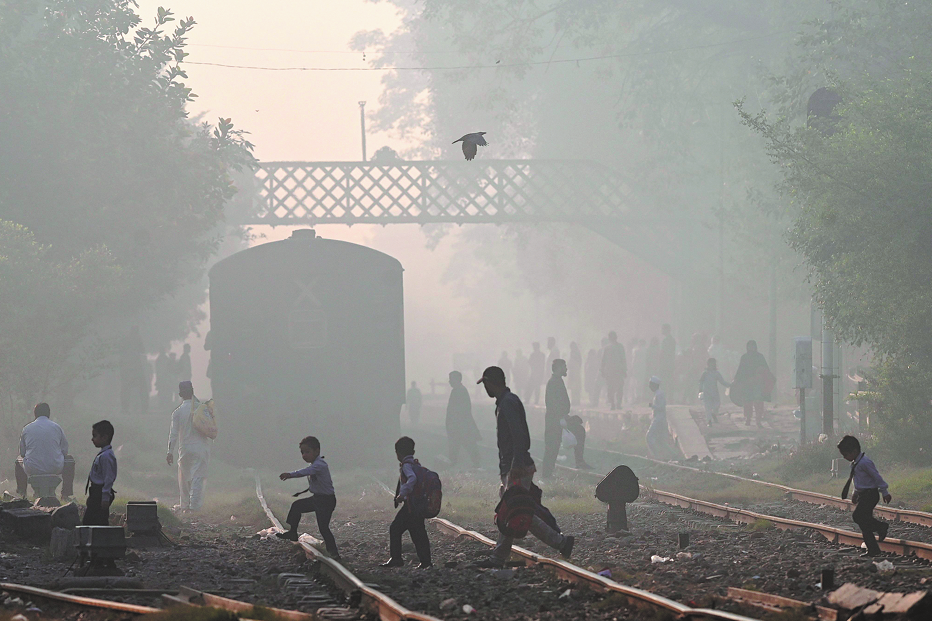
The International Business Times reports that this past Lunar New Year's Eve, the municipal government of Beijing sent out a text message blast urging everyone to "set off fewer fireworks or none at all". It didn't seem to work. At 11 pm air quality index levels were at 207, already in the "very unhealthy" range. By 2 am, after the traditional fusillade of fireworks and firecrackers had raged for three hours throughout the city, air quality readings were up to 394, well above the "hazardous" threshold.
The city of Hangzhou tried to get stricter, allowing fireworks for only the first three days of the holiday instead of the usual 18. One microblogger responded: "So you want us to stop lighting fireworks but you won't shut down steel factories that are pumping pollution daily?"
True, the so-called "recreational pollution" of holiday firework displays is transient by nature. But it's also apparent to researchers that the pollutants are delivered in highly concentrated form and add significantly to the yearly total emissions in some areas, according to a study published in Atmospheric Environment journal.
Scientists writing in The Lancet blame deeply entrenched cultural customs. Setting off fireworks on New Year's Eve in China is traced back to the ferocious monster of myth Nian, who lived in the mountains and emerged before the new year to eat people, especially children. Bright lights and loud noises are the only way to scare Nian off, fireworks being an ideal weapon.
The US tradition of fireworks on Independence Day goes back to a letter from John Adams to his wife Abigail dated July 3, 1776, where he wrote that the signing of the Declaration of Independence should henceforth be a "great anniversary festival" and "solemnized with pomp and parade, with shews (shows), games, sports, guns, bells, bonfires and illuminations (fireworks) from one end of this continent to the other from this time forward forever more."
Environmentalists say there are alternatives to fireworks, laser light shows being the most frequently cited. Electronic firework display lamps and indoor firework projectors are also mentioned. Walt Disney has developed a way of launching fireworks using compressed air rather than perchlorate, taking at least one of the toxins out of the recipe.
But as researchers say in The Lancet: "Tensions between cultural practices and environmental protections will not be easy to solve, because such traditional practices are deeply embedded in Chinese society, but it is time to reassess and improve the relations between culture and environmental issues."
Fourth of July on the Washington Mall, New York Harbor and countless other cities and towns throughout the US without fireworks? Hard to imagine.
Contact the writer at chrisdavis@chinadailyusa.com