Home market is back on terra firma







Fresh curbs on buying in four cities settle fears of runaway prices and a property bubble
Housing curbs by Beijing and three major cities are part of a larger effort to rein in China's real estate industry where home prices tended to skyrocket of late, threatening to create a property bubble, experts say.
On March 17, Beijing raised the down payment requirement for buyers of a second home from 50 to 60 percent of the full price.
Now, buyers of a second home are defined as those who have a record of either a residential property ownership or a mortgage. In the past, if buyers whose mortgage had been paid off applied for a new mortgage for a second home, they were regarded as first home buyers.
Like Beijing municipality, Guangzhou in South China's Guangdong province; Shijiagzhuang, capital of Hebei province; and Zhengzhou, capital of Central China's Henan province, announced similar measures to contain speculative buying in the residential segment of the property industry and thereby ensure housing remains a necessity for personal use, not an investment vehicle.
Zhang Dawei, chief analyst at Centaline Property, says the recent measures will have a significant impact on Beijing's housing market, particularly preowned homes and luxury properties.
"People who sell one apartment to buy another one will be defined as buyers of a second home and have to make a higher down payment. This will hurt sales of preowned homes as well as their price growth. If the new measures continue for a year, I'd expect the capital's average price of preowned homes to drop around 15 percent," says Zhang.
Guo Yi, marketing director of real estate consultancy Yahao, agrees.
"These measures will largely reduce leverage and cool the market quickly," Guo says.
But, in the long run, home prices are still likely to rise after this round of correction, she says.
Even before the four major cities cracked the whip, there were signs that market players may have heeded the government's discourse and begun to fall in line.
The signs are like dots that, when connected, morph into a tell-tale figure (or story, if you will).
Dot 1: One day recently, Zhang Yuanfan, 33, a graphic designer in Shanghai, was curious why the outlet of a real estate agency chain in her residential community was redecorating the office, and had ripped off all the price tags that used to be displayed on the glass wall.
"Every day, as I passed by the glass wall, I'd glimpse the house prices, which have been rising in the past two years. Now all the numbers are gone, and I suddenly felt like I had lost contact with an old acquaintance," says Zhang.
Dot 2: Luo Dongwen, 34, a property agent, says many of his peers in the real estate market in Shanghai are doing the same - removing prices of apartments, and adding more information to guide buyers. Full disclosure is in fashion these days.
Dot 3: Buyers get loads of information, especially price changes, about apartments up for sale or rental.
"When prices go up quickly, buyers care the most about the changes. Price growth is also a barometer of buyer interest. Sometimes, people get eager to buy just by seeing how fast the price changes. They fear if they hesitate for another day, they might have to pay tens of thousands of yuan more.
"Now price growth is really mild. Buyers care more about the apartments. More buyers come to agents to buy an apartment for their own use, unlike in the past when many would buy for investment," says Luo.
Such dots abound...
They represent the change in buyer attitudes, a result of the recent tightening of property industry regulations.
Market players says the real estate industry, particularly its housing segment, has been advised several times in the past three months to grow in a healthy and sustainable manner.
"In key cities, homes are no longer a means to park investments for value appreciation. They are now bought by those who really need a place to live. We need to change our strategies accordingly," says Ma Chengpeng, 32, a sales manger at Hengyu Real Estate Agency.
In the Government Work Report delivered by Premier Li Keqiang during the fifth plenary session of the 12th National People's Congress, the government reiterated a modest and differentiated property policy stance.
"The Government Work Report called for sustainable and healthy property market development, and some senior officials talked about avoiding property market fluctuations, implying that neither too much property strength nor weakness is desired," says a UBS China research note.
The Government Work Report says large-city local governments should increase the land supply and regulate housing sales to curb rapid price increases, while lower-tier or smaller cities should provide support for building upgrades and migrant settlement-related demand.
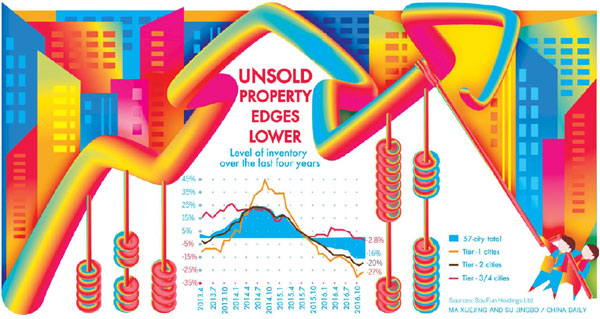
Housing market policies for lower-tier cities will focus on reducing inventories in the next 12 months. This may include a wide range of measures including easier access to financing for homebuyers, according to Zhang Dawei, chief analyst with Centaline Property.
Wang Zhaoxing, deputy director of the China Banking Regulatory Commission, said during a media briefing recently that differentiated credit financing policies will be applied to the housing market.
"For third- and fourth-tier cities with excessive pressure to reducing inventories, and for buyers with solid demand (people who migrated from rural areas to urban areas), favorable credit financing policies will be given as a support," said Wang.
For homebuyers, this could mean more favorable policies for seeking mortgage loans in lower-tier cities, to get more discounts on benchmark borrowing rates, or lower payment requirements for buying a first home.
In Shanghai and Beijing, and some other key cities, financing has been tightened for homebuyers as most lenders have pushed up interest rates for mortgage loans by up to 10 percent.
According to Xing Ziqiang, chief economist with Morgan Stanley in the China market, Chinese homebuyers used more credit to buy homes in the last two years.
Very often, a buyer pays 50 percent of the home price toward a downpayment and borrows another 50 percent from lenders.
For developers, a tighter policy environment in top-tier cities and the pressure of reducing inventories in lower-tier cities could mean more pressure on cash flow.
A research note from Essences Securities says that shrinking sales in top-tier cities could mean slower cash income for developers, as that has been the main source of cash in the past few years.
It takes time for lower-tier cities to transfer inventory into cash income. For big companies that have diversified their development portfolios, the pressure is under control. Smaller ones need to come up with more measures to accelerate sales to maintain a safe cash flow, the note says.
According to the Government Work Report, the administration aims to complete 6 million homes under shantytown renovations, improve public services and facilities for people who live in affordable housing projects, and build affordable rented housing projects.
"This is also an opportunity for companies that are involved in urban renovation projects. For developers and companies that have the capacity to join public-private partnerships or PPP programs, renovation projects are good channels to diversify investment portfolios," a research note from Zhongtai Securities says.
Contact the writers at wuyiyao@chinadaily.com.cn
(China Daily European Weekly 03/24/2017 page26)





Today's Top News
- Trade-in subsidy aims to drive more consumption
- Cooperation can boost cross-Strait integration
- State-owned firms register stable performance
- Global experts hail Xi's people-centered message
- Trips promote equality and coexistence
- Tech crucial factor shaping China-US ties