


A passing of the torch
As the curtain falls on the careers of a host of Team China stalwarts, a new generation is set to pick up the baton







December saw the Chinese national athletics team gather in Nanning, Guangxi Zhuang autonomous region, for a 16-day winter training camp, building toward next year's Nagoya Asian Games, the 2027 Beijing World Athletics Championships and, ultimately, the 2028 Los Angeles Olympics.
This year's training roster reflects a generational shift: the majority of the athletes are young new faces, while veteran stars are increasingly rare — a mirror of the broader landscape of Chinese athletics in 2025.
Legendary figures like Su Bingtian and Gong Lijiao have retired, while rising talents such as Chen Yujie and Deng Xinrui are beginning to make their mark.
The story of Chinese athletics in the past decade is one of peaks and transitions. In 2015, Beijing hosted the World Athletics Championships for the first time, where the national team earned nine medals and introduced a generation of athletes who would carry the nation's hopes in international competitions with aplomb.
Over the past two years, that cohort has gradually stepped off the competitive stage, many transitioning into coaching or teaching, nurturing the next generation.
By 2027, as the world championships return to Beijing's National Stadium, better known as the Bird's Nest, China's post-2000 athletes are ready to inherit the legacy.
Fond farewells
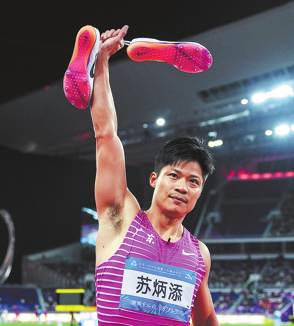
The year's farewells were poignant. At the National Games held in the Guangdong-Hong Kong-Macao Greater Bay Area in November, 36-year-old "Flying Man" Su, representing his native Guangdong province, ran his final race — the men's 4x100m relay final. Afterward, he held up his running shoes and waved to the cheering crowd.
"It's a great honor to say goodbye to everyone in my hometown," Su said. "Over the past 21 years, I am grateful that athletics has nurtured me from a naive child to competing on the international stage."
Su's career peak came at the 2021 Tokyo Olympics, where he ran an Asian record of 9.83 seconds in the semifinals. Now head of the School of Physical Education at Jinan University, he is guiding young athletes in starting techniques and helping cultivate the next generation.
"I hope that, in the future, I can continue to help young sprinters achieve their dreams on the track I love, and cultivate generation after generation of Chinese sprint talent," he said.
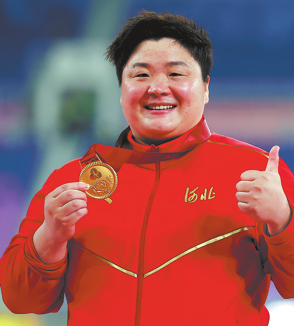
Women's events saw farewells as well. Shot put legend Gong ended her career with a fifth consecutive National Games title. After the competition, she embraced fellow competitors, saying: "From now on, it's up to you."
"Farewell hugs are both a commemoration and a hope. I'm looking forward to seeing more excellent Chinese women's shot put athletes appearing on the international stage," Gong said.
Over more than 20 years, Gong competed in five National Games, five Olympic Games and 10 world championships, winning one Olympic gold and two world titles to go with her national honors.
Despite her reluctance, the farewell moment arrived — the toll of her injuries became too severe, and she needed three injections just to compete in November's nationals.
With the Games behind her, she now plans to undergo surgery and take a long break.
Even after leaving the competitive stage, though, she intends to remain involved in sports.
"My goal has always been to make the relatively niche sport of women's shot put popular, and see more Chinese female shot put athletes reach the world's highest podium," Gong said.
In pole vault, Asia's leading female athlete Li Ling, 36, cleared 4.15 meters to finish fourth at the National Games — the final jump of her career. She missed the 2024 Paris Olympics due to injury and spent the subsequent year battling physical setbacks.
"Being able to stand on this stage is a perfect ending for me," Li said.
Having overcome many obstacles to return to the field, Li firmly believes the sport defined her. "Fortunately, I found my lifelong passion when I was young and it has persisted to today. I chose pole vault, and this sport has made me who I am."
Sprinter Wei Yongli, 34, also chose the Games to bring down the curtain on her career, earning silver in the women's 100m final. After crossing the finish line, she bowed deeply to the crowd, bidding farewell to the track, on which she had chased down countless dreams.
She will join Nanning Normal University as a physical education teacher and serve as a consultant for the Guangxi athletics team, hoping to cultivate new talent.
Rising stars
With the curtain falling on an era defined by Su, Gong, Li and Wei, Chinese athletics stands at a crossroads. As these seasoned champions pass the torch, a roster of young talent is poised to step onto the track.
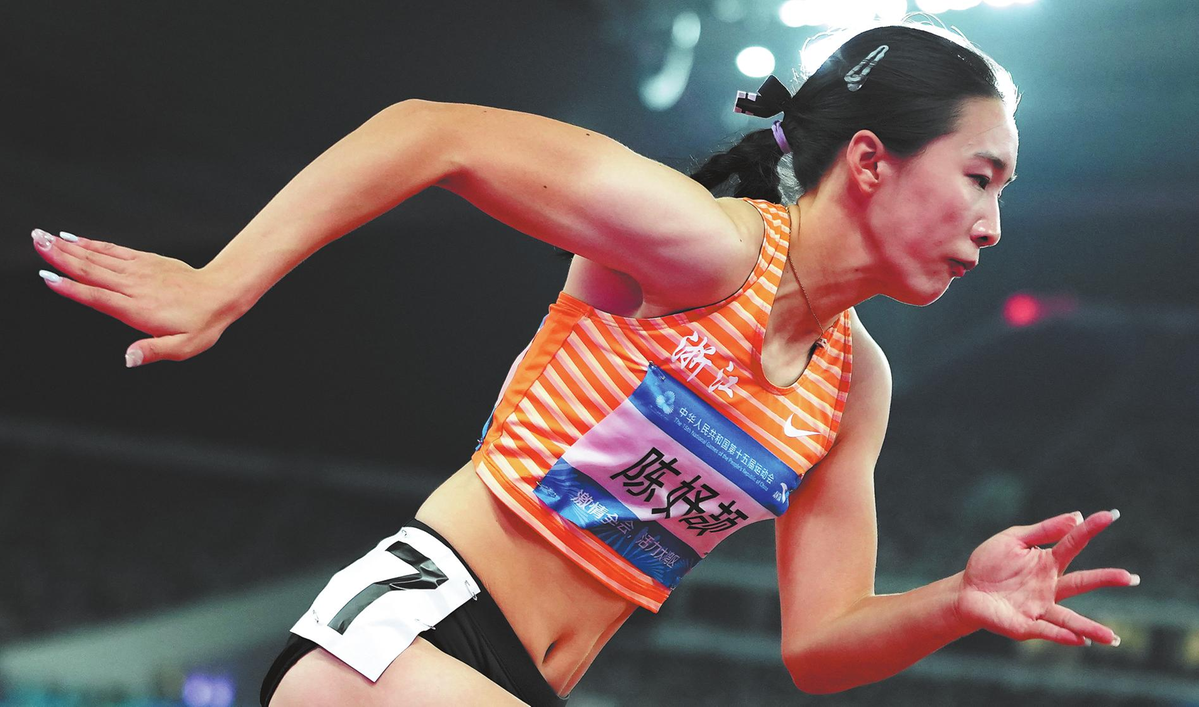
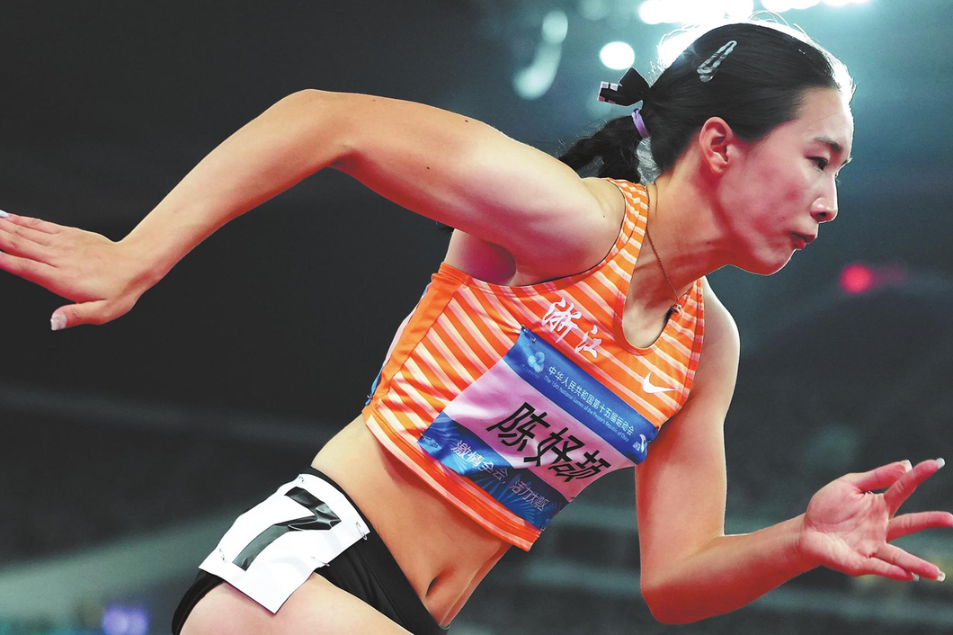
In the women's 100m final at the National Games, 17-year-old Chen Yujie defeated Wei, winning gold in 11.10 seconds and breaking the Asian youth record, becoming the youngest women's 100m champion in National Games history. She also claimed her second gold in the women's 200m final.
The young athlete, who frequently changes her nail art and loves fashion, last year became one of the brightest new stars in Chinese athletics. Born in 2008 in Ningbo, Zhejiang province, Chen initially trained in tennis before switching to athletics in fifth grade, quickly revealing her extraordinary talent.
At last year's Asian Championships in South Korea, she ran a personal best of 22.97 seconds to win the 200m title and ran the first leg of China's gold-winning 4x100m relay team.
Known as "Little Sister", she leapt from youth competitions to the world stage in an almost meteoric rise.
At the 2027 World Athletics Championships, Wei says she will bring her family to watch Chen compete, hoping the young star can beat her times and even break the 11-second barrier.
Men's sprinting also saw breakthroughs.
Twenty-two-year-old Deng Xinrui ran 10.06 seconds in the 100m at the National Athletics Championships in Quzhou, Zhejiang province, drawing widespread attention.
At the National Games, 25-year-old Li Zeyang ran 10.08 seconds in the preliminaries and 10.11 seconds to win gold in the final.
For the first time in National Games history, all eight finalists were born after 2000, and did not include Su or Xie Zhenye — signaling the arrival of a new generation.
Men's long jump also welcomed new faces.
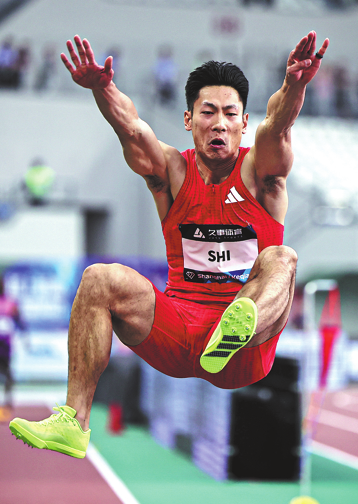
World champion Wang Jianan missed the entire year due to injury, but, at the Tokyo world championships, Shi Yuhao won bronze with 8.33 meters, continuing a decade of podium finishes in the event.
At the World University Games in Germany, Peking University student Shu Heng won men's long jump gold with a leap of 8.09 meters.
In May, the 21-year-old won the Asian Athletics Championships in South Korea with 8.22 meters and claimed gold at the National Games with 8.17 meters.
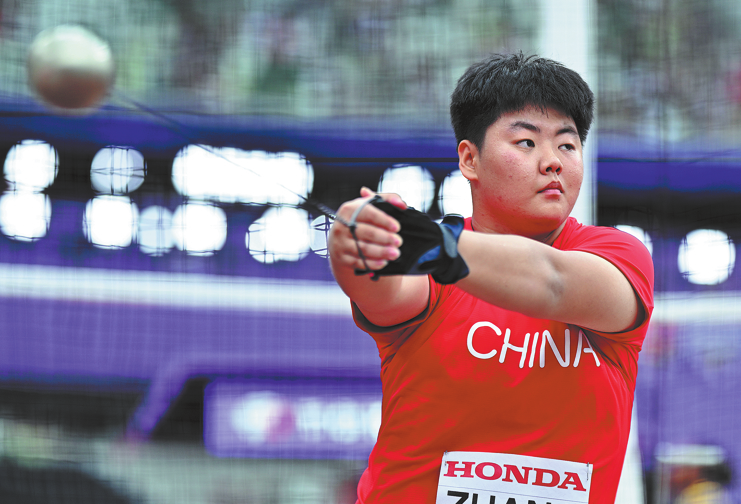
In the hammer throw, 19-year-old Zhang Jiale became the first Chinese athlete to win the Women's Rising Star Award at the World Athletics annual awards ceremony in Monaco, having broken the world youth record twice last year.
At the National Championships, she won with a throw of 77.24 meters, the third-best result in Asian history, narrowly missing the Asian record of 77.68 meters.
At the Tokyo World Championships, she added a bronze medal to her collection.
The future looks even brighter, too.
At just 15, Li Zeyang witnessed the 2015 World Championships at the Bird's Nest in Beijing, watching sprint icons Usain Bolt, Justin Gatlin and Su in action.
Two years from now, he may stride down the same track, racing in their footsteps.
liyingxue@chinadaily.com.cn

Most Popular
- A passing of the torch
- Chongqing contest sets new records for Chinese arm wrestling
- China's national football team announces 26-man roster under new coach Shao
- Continued gains mask growing pains
- On top of their game
- China's sports science institute trumpets national fitness rise