College grads choose grassroots jobs to 'accomplish something big'







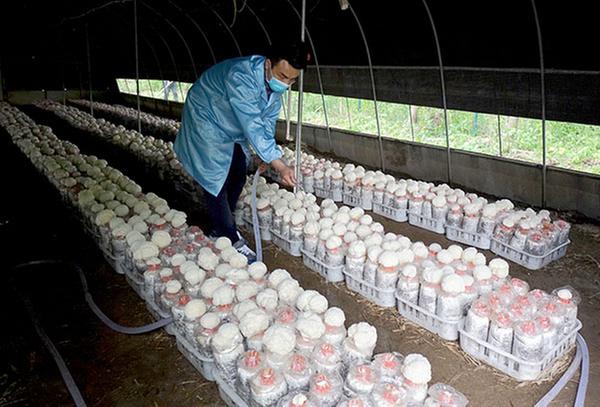 |
| Fan Yang, a 24-year-old life sciences graduate, wets the ground in a farm shed to maintain the humidity. He started a company to grow edible fungus in a community in Jingjiang, Jiangsu province.[Photo/Xinhua] |
Many hours of hiking over rugged hills to visit families living in poverty has been Liu Hai's routine since graduating from college and becoming a junior officer in a small county in Southwest China's Guangxi Zhuang autonomous region.
In 2014, Liu, 29, left Beijing Institute of Technology after receiving his master's degree and began working on poverty-relief as deputy secretary of the Youth League Committee in mountainous Nandan county.
He has visited 151 villages there, including 47 in poverty.
"I made up my mind in high school to work in China's most remote and difficult places and to devote myself to their development," Liu said.
He said there were more than 1,000 college graduates like him in Guangxi. They received their educations at big-city universities and then voluntarily chose to work in underdeveloped areas, where they were most needed.
It has not been an easy job for them to gain villagers' trust and fully understand their needs. Liu even needed a translator at the beginning.
"The solution was clear. Experience the difficulties of real life and offer true help," Liu said: "Many of them did a better job than me. I want to follow their example."
The young officer admits that what he does is not much related to his university major.
"What we learned in school was mainly scientific thought and thinking patterns. We graduates need to be practical and understand where we can give full play to our ability," Liu said. "What we are doing here is maybe just small things, but it matters to the locals. By gaining experience in handling small things, we can accomplish something big in the future."
He has never regretted turning down other appealing offers of employment upon his graduation, including some from international companies and State-owned enterprises.
"My parents could not understand my decision at that time," he said. "Since then, I've told my family about my life and work here, and they have become quite supportive."
Like Liu, 28-year-old Abulimit did not choose to work in Beijing after graduation in 2016, but returned to his hometown, Urumqi, capital of the Xinjiang Uygur autonomous region, where he felt needed and fulfilled.
Abulimit said that what he learned at school was gratitude. He was exempted from tuition for his bachelor's and master's degree studies. Now he is returning the favor.
He has worked as a Uygur translator in local government for more than half a year. In February, he was dispatched for translation to a village in Kashgar city, where he also taught the farmers Chinese.
The son of a welder in Urumqi, Abulimit enjoyed talking to villagers and making friends by offering help.
"I like working in remote areas and doing what I can do for villagers. I feel happy for them when I see their lives improving," Abulimit said.
Liu and Abulimit are among the thousands of university graduates in China who have chosen to work in remote regions, where poverty is more common. This year, the central government issued a guideline to encourage more college graduates to work at the community level.
Graduates were encouraged to find employment in rural areas-with rural cooperatives and helping to develop tourism and e-commerce.
The guideline encouraged college graduates to work in the central and western parts of the country, in the northeast and in other less-developed and remote areas.
The government estimates that about 7.95 million college students will graduate this year, accounting for over half the newly added urban labor force.





- Xi urges deepening reform, opening-up during Guangdong inspection tour
- Xi attends carrier's commissioning
- Xi inspects Meizhou in South China's Guangdong
- Senior Xi'an official facing probe by China's anti-corruption watchdogs
- Philippines risks creating trouble for itself: China's defense ministry
- Newborn with congenital heart disease receives life-saving surgery in Yunnan