The promise Pearl River Delta region holds







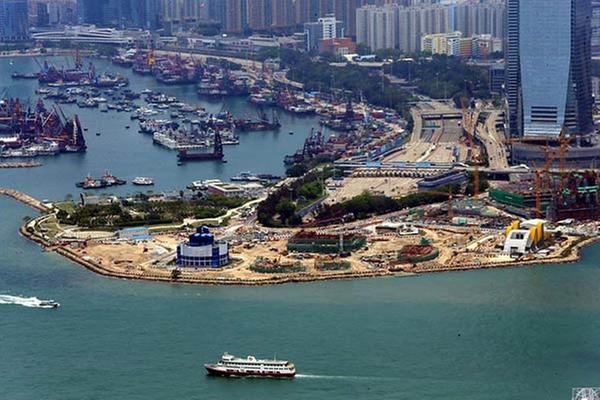 |
| A view of the West Kowloon Cultural District, Hong Kong, which is under construction, from Victoria Peak on April 30, 2017. [Photo/Xinhua] |
July 1, 2017, will mark the 20th anniversary of Hong Kong's reunification with the motherland. It comes at a moment when Chinese leaders are increasingly promoting Hong Kong's unique role in advancing the country's economic development.
Two months ago, Premier Li Keqiang described China's intention to deepen economic cooperation across the Guangdong-Hong Kong-Macao Bay Area-which Hong Kong analysts call the Pearl River Delta region-in order to reinforce its role as a major driver of sustainable development. The region comprises Guangdong's nine key cities-including Guangzhou, Foshan and Shenzhen-plus Hong Kong and Macao. Last year, the PRD region's population stood at 68 million, and its GDP was $1.3 trillion.
The PRD region is the southern pillar of the three Chinese coastal growth clusters. In the middle is the Yangtze River Delta region, which includes Shanghai and has a population of 130 million and GDP of $2 trillion. To the north is the Beijing-Tianjin-Bohai corridor, covering 10 key cities; it has a population of 100 million and GDP of $1.3 trillion. Taken together, these three clusters account for 21 percent of China's population and just under 40 percent of its GDP.
The PRD region has the lowest population of the three, but the highest income per capita, and it forms an important link between China and global supply chains. It gains a distinct advantage from the free-trade, low-tax, and highly globalized cities of Hong Kong and Macao-which are special administrative regions of China under its "one country, two systems" principle. Another major asset is Shenzhen, a highly innovative "special economic zone" boasting a dynamic capital market and a tradition of experimentation with private-sector-driven job creation and integration into global supply chains.
The PRD region's competitiveness is no accident. Former Chinese leader Deng Xiaoping used the region as a kind of public-policy laboratory, allowing different legal and institutional arrangements to exist concurrently, while China figured out how to approach globalization. The system clearly works, but it does suffer from a fundamental contradiction, related to economist Ronald Coase's concept of transaction costs.
Thanks to China's geographic, demographic and economic scale, "reform and opening-up", in Deng's phrase, and technological progress naturally drive down transaction costs, improving markets' capacity to allocate resources. This process often fuels specialization, with regional or municipal economies focusing on their own competitive advantages, in order to maximize their gains from the decline in transaction costs.
Such specialization can be seen clearly in the PRD region. Hong Kong is a hub of international finance and services, while Macao establishes itself as a global gambling and entertainment center. On the other hand, Shenzhen is focusing on technological innovation; Guangzhou is a global trading hub; and Foshan and Dongguan are major manufacturing bases. While each city appears to be imbalanced in its economic structure, the city cluster as a whole is well balanced and highly competitive.
But, and herein lies the contradiction, massive numbers of transactions can raise financial, social and security risks, which in turn can fuel systemic volatility and contagion across regions and sectors. To mitigate these risks, governments and regulators must intervene, potentially even imposing restrictions on markets that artificially raise transaction costs. China's leaders would do well to remember this as they attempt to take advantage of the strengths of various systems to build a more open, modern, and faster-growing economy.
Chinese policymakers certainly recognize the value of city clusters to advance economic development and ease the pressures of rapid urbanization. The urban share of the Chinese population surpassed 50 percent in 2011, and another 300 million people could be living in urban areas within the next 20 years. In this context, city clusters could be essential to innovation and job creation, particularly in the service sector, while limiting resource wastage, avoiding further environmental degradation, and easing urban congestion from overcrowding.
As for Hong Kong, China's leaders view it as a source of valuable economic-development "software"-including an independent judiciary, a robust anti-corruption regime, a stable currency, and world-class capital markets. Hong Kong's high quality and internationally oriented education system, and efficient and sophisticated urban-management plans are also important assets. Hong Kong's "software" complements the mainland's broader drive to build the "hardware" of development, exemplified in the Belt and Road Initiative, which entails massive investment in infrastructure linking China to Eurasia and Africa. Already, stock-connect projects involving Hong Kong, Shanghai, Shenzhen and London are being established to support Chinese city clusters' ability to meet the Belt and Road-driven demand for offshore financing.
But more must be done to help Hong Kong-and, more broadly, the PRD region-to meet its potential. Hong Kong's world-class services sector is working below capacity now, owing to physical constraints. With better cross-border transport infrastructure and more flexible plans for delivering medical, financial and social services, senior citizens could retire outside of Hong Kong's city limits, creating space for younger workers.
While many observers focus on China's credit glut, the authorities are quietly fostering the development of dynamic city clusters. But, in order to protect and sustain this progress, Chinese policymakers must work to minimize the risks associated with rapid urbanization and growing specialization. Otherwise, trends that are doing China so much good may end up undermining prosperity and social stability.
Andrew Sheng is distinguished fellow of the Asia Global Institute at the University of Hong Kong and a member of the UNEP Advisory Council on Sustainable Finance, and Xiao Geng, president of the Hong Kong Institution for International Finance, is a professor at the University of Hong Kong.