What use are the humanities in the age of AI?







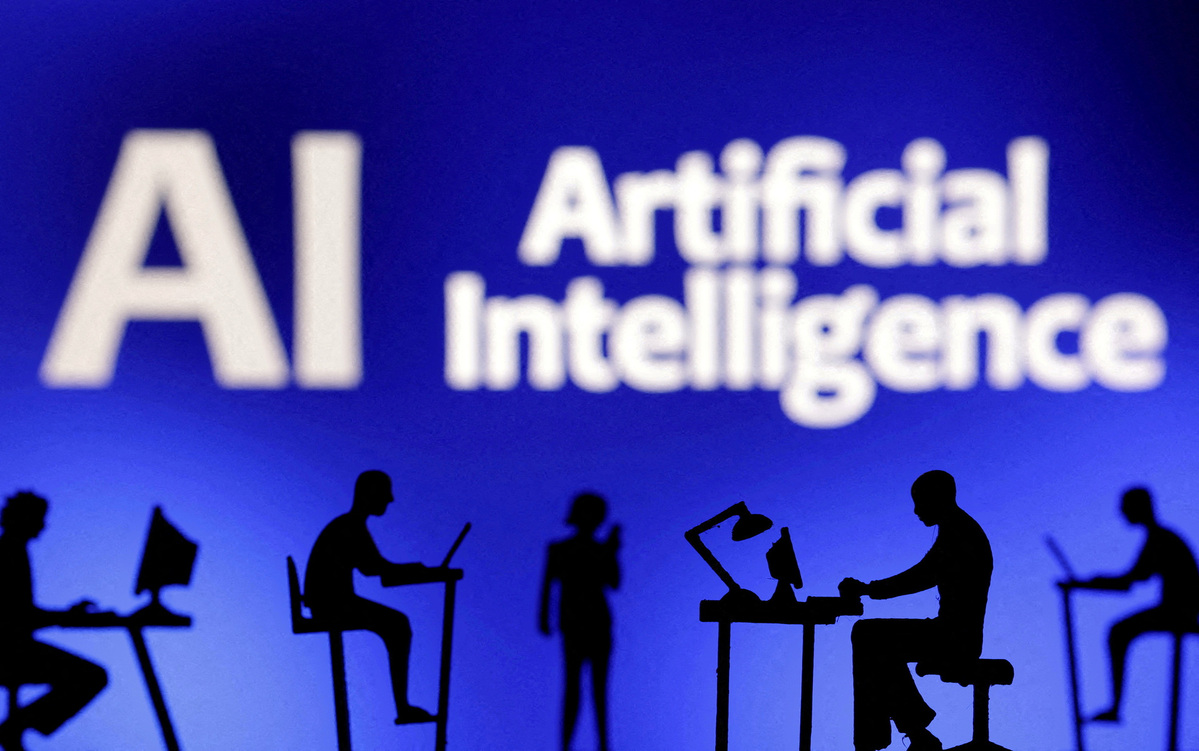
Figurines with computers and smartphones are seen in front of the words "Artificial Intelligence AI" in this illustration. [Photo/Agencies]
What use are the humanities? That blunt question has ricocheted across social media in recent years, especially since ChatGPT and DeepSeek vaulted large language models into the popular imagination. Students are flocking to engineering — above all to the new, AI-adjacent disciplines — while mathematics enjoys renewed prestige for its links to finance. Medicine keeps its steady draw because lives are at stake. And the humanities? Literature drifts to the margins, history quietly recedes, philosophy keeps its ascetic posture, law's popularity slips, and even journalism — once a lively, public-facing craft — has been riven by controversy. If not for civil-service exams or the lure of a stable post, many humanities majors might never have attracted so many applicants in the first place.
This is not merely an anecdote. Institutional choices mirror the mood. In autumn 2024, Harvard's undergraduate college dropped at least 30 courses across more than 20 departments — most of them in the arts and humanities. And in 2025, Fudan University sharply reduced its humanities intake to around 20 percent; the university president cited shrinking applicant pools and perceived societal demand. From public attitudes to job listings to curricular planning, the humanities are sliding.
But disciplinary fashions wax and wane. Over the past two centuries, scientific modernity has steadily siphoned off the humanities' explanatory authority. Big language models now step on the accelerator: they can produce fluent prose, mimic styles and simulate argument with astonishing fluency. If the humanities are reduced to wordplay and stylistic flourishes, how can they possibly compete with machines that generate copy at near-zero marginal cost?
The answer begins by recognizing that different fields have different meta-tasks. Engineering is goal-directed: it shapes the physical world to achieve specified ends, and its virtue lies in efficiently realizing objectives. The natural sciences seek to translate the messy world into numbers, to map phenomena to mathematical laws so that complexity becomes tractable and predictable. The humanities have a distinct meta-task of their own: they produce meaning.
Meaning-production is not a luxury; for Homo sapiens it is structural. We do not live by calculations alone. Science can tell us how to travel to Mars; engineering can build the rocket. But only the humanities can help us decide where we should go, what kinds of futures are worth pursuing, and how to live while we are on the journey. Through concepts, critique, narrative and moral imagination, the humanities make sense of ends, not merely means.
Why, then, is the appetite for meaning so diminished? One reason is the triumph of quantification. Modern science has converted almost every measurable quality into numbers — color becomes wavelength, sound becomes frequency, smell becomes molecular concentration. When value is reduced to cash, and success to pay packets, the question "Why?" is too often eclipsed by "How much?" The relentless logic of the market and the compression of attention into ever-shorter digital moments have produced a culture of the immediate, the ephemeral and the transactional.
Contemporary life is dominated by pointillist time: a series of discrete, clickable instants. Short dramas, livestream commerce, viral clips — none of these invite retrospective reflection or patient continuity. In such a climate, long narratives — ethical, historical, philosophical — lose purchase. Young people, anxious about jobs and livelihoods, are understandably pragmatic. If a degree does not make the rent, what good is it? The result is a collective shrinkage of horizons: less appetite for big stories, fewer investments in the capacities that sustain them.
The social cost is not just aesthetic. When we stop supplying the memory, frameworks and vocabularies for interpreting experience, existential malaise follows. Depression, anxiety and a host of "time-disordered" maladies are part of our present landscape. People still yearn for things that outlast a payday: dignity, purpose, solidarity, transcendence. The humanities supply those things — or at least the tools to discover them.
What about AI? Won't large language models simply manufacture meaning at scale? They can mimic sentiment, assemble convincing narratives and synthesize arguments. But their core architecture remains a probabilistic token predictor. It forecasts the next most likely word given prior context. That is extraordinary, but it is not the same as having a lived body, a history of embodied perception, or a moral imagination forged in communities over centuries. Machines do not experience redness, grief, shame or awe. They do not possess what philosophers call intentionality — the directedness of minds toward meanings. They simulate the surface features of meaning; they do not anchor them in the moral and sensory continua that make meanings endure.
This is not to romanticize the humanities as immune to change. Far from it. The humanities must be rigorous, public-minded and exacting: surgically attentive critique, panoramic perspective, crystalline logic, a keen ear for language and a capacity to produce new concepts that matter. In the age of algorithmic abundance, humanists must reassert the craft of meaning-making: translating complexity into intelligible narratives, defending the public sphere against the flattening of values, and constructing ethical frameworks that guide technological deployment.
We possess a rare, fragile gift: a species-wide capacity to ask why, to make sacrifices for ideals beyond selfish calculation, to preserve collective memory. Let us not squander it on the altar of novelty, nor outsource it to machinery that cannot shoulder our moral inheritance. Reinvest in the humanities not as an indulgence but as an urgent social technology: the only discipline equipped to remind us why certain futures are worth choosing.
So when the next student asks, "What use are the humanities?" we should answer plainly: they are the instruments by which we refuse to be reduced to mere processors of data and consumers of convenience. They give us reasons to remain human.
The author is a lecturer at the School of Journalism and Communication, Wuhan University, as well as a host and debater.
The views don't necessarily represent those of China Daily.
If you have a specific expertise, or would like to share your thought about our stories, then send us your writings at opinion@chinadaily.com.cn, and comment@chinadaily.com.cn.