Robust PLA needed to better defend nation







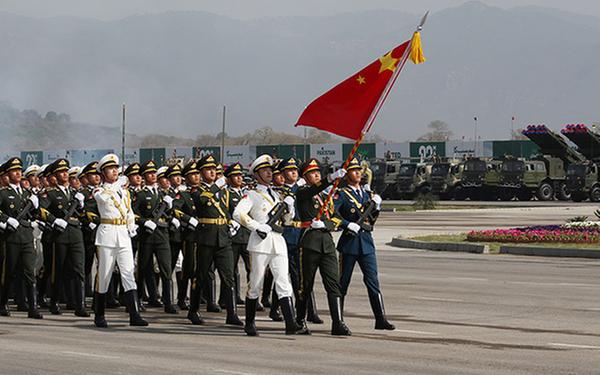 |
| The People's Liberation Army Honor Guards take part in a rehearsal for the annual Pakistan Day parade in Islamabad, on March 19, 2017. [Photo by Wang Qi/For China Daily] |
 |
| Yang Yannan [Photo/China Daily] |
In the 90 years since its establishment on Aug 1, 1927, the People's Liberation Army has evolved significantly and rapidly, particularly when it comes to the defense technologies and the weapons it uses.
Heavy weapons were a luxury to the PLA, whose capability of producing ammunition and repairing sophisticated equipment was limited before the founding of the People's Republic of China in 1949. Most of the weapons the PLA used were, in fact, seized from the enemies.
But between 1950 and 1978 China managed to rid itself of the reliance on imported weapons. Major imports from the Soviet Union, including MiG-15 aircraft and T-54 tanks, allowed China to develop what were then cutting-edge weapons on its own. China's J-5 fighter jets and Type-59 battle tanks, for example, drew inspiration from the MiG-15 warplanes and T-54 tanks. By 1959, China also managed to make artillery equipment domestically. These gradual developments were in line with the economic recovery and the industrial buildup of New China.
The development of the atomic bomb and missiles was another landmark for China, especially because the Soviet Union had withdrawn its technological aid to China in 1962. In the following two decades, Beijing shifted its focus from emulating advanced weapons to developing them independently.
The first atomic bomb test at the Lop Nur nuclear test site in Northwest China's Xinjiang Uygur autonomous region in 1964 made China the fifth nuclear power. The "Two Bombs, One Satellite" project, which included atomic and hydrogen bombs and artificial satellite, cost China about 10 billion yuan, 2 percent of its annual expenditure and 12 percent of its defense expenditure then.
Over the past three decades, China has expedited the development of its defense sector. On June 28, the PLA Navy launched its latest and first domestically built destroyer in Shanghai. Two months ago, it launched the first domestically built aircraft carrier, a Type 001A vessel.
Moreover, neither outer space nor cyberspace are strangers to Chinese technological innovation. By the 60th anniversary of the founding of New China, the country had become capable of independently designing many state-of-the-art conventional weapons and miniature unconventional ones, and Chinese defense personnel were better trained and more combat ready.
China has also achieved success in developing equipment and strategic missiles for its navy, army and air force. Dongfeng-31 intercontinental nuclear-capable missile and the submarine-launched ballistic missile, Julang 2, have a maximum range of 8,000 kilometers, can carry more powerful warheads and have enhanced mobility on land as well as at sea.
The nuclear-powered Type-094 ballistic missile submarines, which have the highest displacement among all Chinese submarines, along with Type-093 and Type-091 nuclear-powered attack submarines, can help the PLA Navy to better execute open sea missions. And the commissioning of the ZTZ-99 tanks, the PLA's most advanced main battle tank, and the latest J-20 stealth fighter will greatly boost China's efforts to build a versatile, modern military.
The deepening structural reform, which restructured the seven theater commands into the Eastern Theater Command, Western Theater Command, Northern Theater Command, Southern Theater Command and the Central Theater Command, is in line with the need to focus on joint operations and technologies, as was the establishment of 84 new units led by major-general-level officers in April.
But the 90 years of armament development is just one aspect of the PLA's modernization. It is not meant to flex China's military muscles; instead, it reflects the determination and combat capability of an evolving military to protect the country and its people. China follows a defensive defense policy, so the modernization of its military and defense equipment is meant to only inject more vitality into the defense forces so that they can better safeguard the country, and regional and global peace.
The author is an associate researcher at the National Defense University of the People's Liberation Army.