Summer camps: A dilemma for Chinese parents







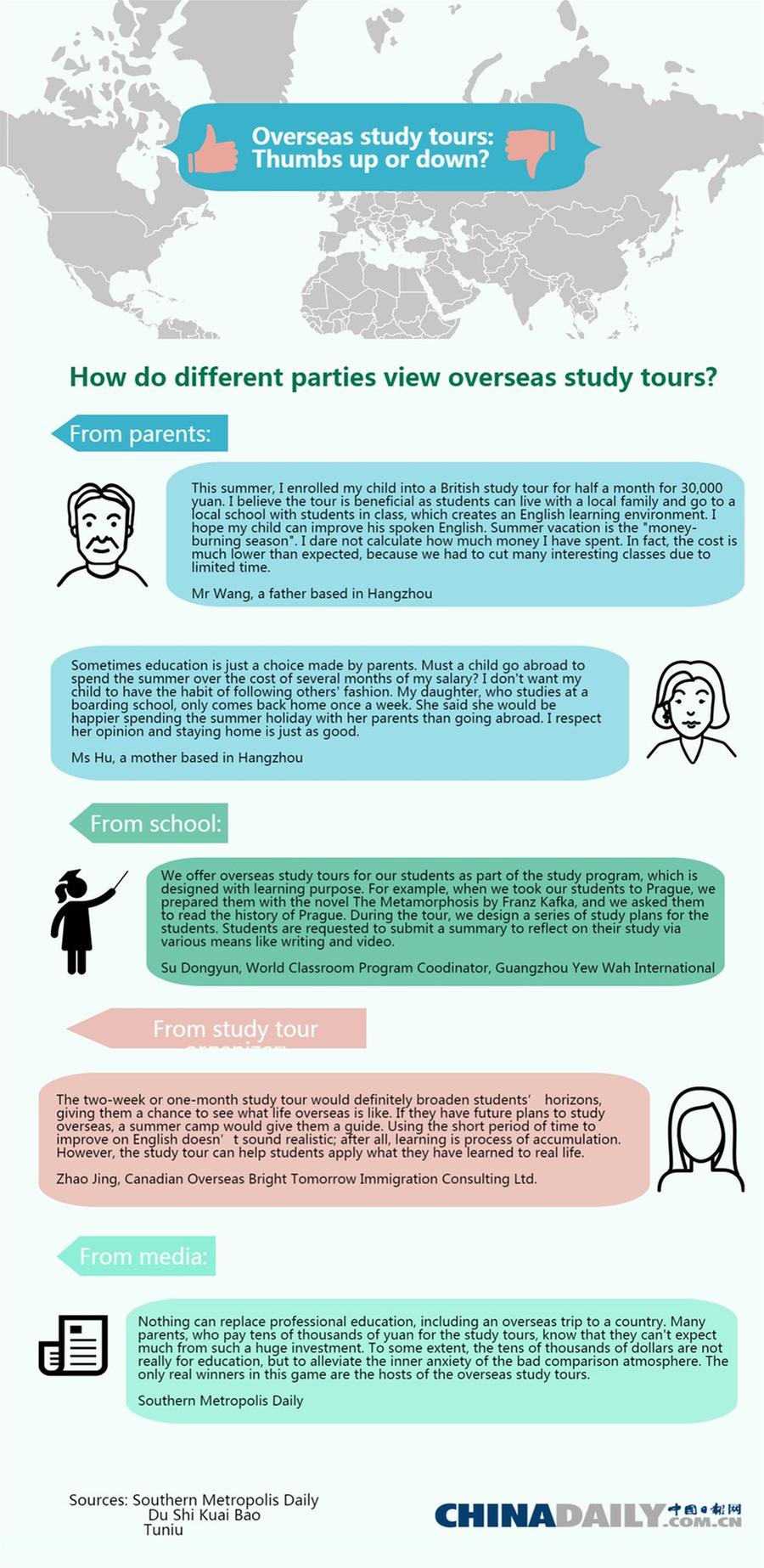
As we know, Chinese parents are willing to "sacrifice" or pay high costs for their children to attend summer programs where they experience a Western lifestyle and culture, expecting them to be successful one day.
An online article, A White Collar Working Mother Cannot Afford a Child's Summer, went viral among Chinese parents over the weekend. In the story, a mother earns 30,000 yuan ($4,460) a month but she paid nearly twice her salary to pay for her daughter's two-day summer camp.
Students in China are hardly slackers, spending an average of 40 weeks a year at school, compared with 36 weeks for the US school year. And while parents have long sent their children to academic programs to keep them busy during the summer, now the growing trend is for them to attend top-notch US and UK schools.
The decision to send children abroad can be complex. While many parents are spurred by a desire for their children to speak fluent English and live in a Western culture, they also want them to become more exposed to extra-curricular activities that are unavailable at many schools in China and that colleges see as evidence that students have well-rounded backgrounds.
That kind of exposure doesn't come cheap. Now many Chinese educational institutions are catering to the expanding ambitions of Chinese parents, and their offspring, by offering must-have summer experiences costing $3,000 to $10,000 for several weeks in the United States. These are often a first step to an American college education, or a high school diploma, which have become badges of prestige in the country.
Parents have other motivations for sending their children abroad as well. Most of the families that have become very successful have made their fortunes by pushing boundaries. The question for families is will their kids be able to do the same thing. They don’t want their children to lag behind peers.
Therefore, they send their kids to the most expensive summer camp – as if the more superior environment they can provide while their children are growing up, the more qualified middle-class parents they are. They may harbor a sense of superiority over those who cannot afford these things, but if this sense of superiority exercises an invisible, formative influence on their children's character, it is by no means a thing to be proud of.
But more concerns about the effectiveness of overseas summer camp, rather than the program’s cost, have been the focus of a sharp national discussion.
Chinese parents who send their children to overseas summer programs are still traditional in that they don’t want the activities to stray too far away from academic learning. They expect the programs will be well-scheduled.
However, some camp organizers are purely driven by profit and might not offer the high level of services that they claim to provide. What’s worse is that some summer programs made little effort to offer more than sightseeing and a stay with a host family.
The popularity of these camps, as well as the high profits, has made them a popular money-making scheme. Despite some negative news reports, a lack of supervision means it is easy for companies to find customers. Many institutions offer dubious quality in terms of meals, accommodation and tour guides, and there are even traps to push students to make purchases.
So before making the choice of good or bad summer camps, parents should communicate with children, go through the camp details carefully with them and make a final decision.
People’s Daily also contributed to the story.